
Lieferung heute & morgen

Qualitätsgarantie

Willkommens-Angebote freischalten: KOSTENLOSE Lieferung | Bis zu 80 % RABATT | Kostenlose 30-Tage-JoyPlus-Testphase
App herunterladen
A children’s bed should suit your child’s age, the size of the room and your family’s everyday routine. In practice, poor purchases are often caused not by the appearance, but by unsuitable dimensions, missing mattress information or features that are rarely used in the child’s room. A bed with a desk, for example, requires considerably more floor space than a classic single bed. A themed bed, on the other hand, can quickly become too small if the sleeping area measures just 70 x 140 cm.
The term children’s bed 90x200 cm generally refers to the required mattress size, not the overall dimensions. A model with this sleeping area may be considerably longer and wider once side panels, a ladder or storage space are included. You should therefore check both measurements before buying:
For smaller rooms, a children’s bed 90x190 cm may be more suitable. Mattresses measuring 90 x 200 cm and 90 x 190 cm must not be confused, as this could create gaps between the mattress and the frame.
Depending on its design, a children’s bed with a fall-out guard may have a continuous barrier, raised side panels or only a limited protected area. The height, length of the guard and width of the entrance are all important. A ladder also changes how the bed is used: children should initially practise climbing up and down under supervision.
For a high or mid-sleeper bed, you should also check whether the model is suitable for your child’s age. The manufacturer’s specifications, assembly instructions and weight limits must be followed.
A children’s bed with drawers or children’s bed with storage can help keep things tidy if the drawers are deep enough and open fully. In smaller rooms, however, drawers need additional space in front of the bed. Storage beneath the sleeping area is more flexible, but may be harder to access.
Useful information includes:
A baby bed 60x120 cm is suitable for the early sleeping stage, provided this size matches the relevant age and weight recommendations. An adjustable-height bedside cot can be aligned with the height of the parents’ bed. When used as a bedside cot, it must be securely fixed to the parents’ bed using the specified fastenings. The width and frame thickness of the parents’ bed should be checked against the technical specifications in advance.
For older children, single beds measuring 90 x 190 cm or 90 x 200 cm are suitable options. A larger bed can be used for longer, but requires more space. A Montessori children’s bed with a low entrance supports independent access, but does not replace age-appropriate supervision and careful assembly.
For a wooden children’s bed, the product description should distinguish between solid wood, plywood, MDF and coated wood-based materials. These materials have different surfaces and construction properties. Rounded edges, sturdy connection points and a well-fitted slatted base support are objectively verifiable details.
A white children’s bed suits many room designs. However, with combinations of white and wood-effect finishes, pay close attention to the colour description. Some models are not completely white, but combine a white surface with a light or grey-beige wood effect.
A children’s bed with desk combines a sleeping area, workspace and storage. Before choosing one, check the desk’s load capacity separately. Drawers, benches and shelves may also have their own weight limits. Many beds do not include a mattress; specific mattress thicknesses are often recommended. This requirement should be followed so that the side panels and protective areas retain their intended function.

Why this product suits this profile: This mid-sleeper single bed focuses on the sleeping area, safety rail and storage beneath the bed. It is specified for children aged 3 and over and requires a 90 x 200 cm mattress.
The product details state the mattress size, the 35 cm entrance gap and the 44 cm-high area beneath the bed. This makes it easier to assess the space required and how the bed can be used before buying.
Solid pine, a continuous fall-out guard, a low ladder and a stated maximum load of 120 kg.

Why this product suits this profile: This multifunctional bed combines a sleeping area, workspace and storage. It is designed for families who want to combine several functions in a single piece of furniture.
The features include specific load capacities: 120 kg for the bed, 30 kg for the desk and 100 kg for the top of the drawers. The recommended mattress thickness is 13 cm.
Two large drawers, storage beneath the bed, raised side panels, plus rounded edges and corner protectors according to the product description.

Why this product suits this profile: Two deep drawers, shelving compartments at the head and foot of the bed, plus a seating and storage bench make this a practical choice for families with extensive storage needs.
According to the specifications, the drawers can be fitted on the left or right. At the same time, the load capacity of the storage bench is explicitly stated as unspecified, so this should be checked before heavy use.
Flexible drawer positioning, 13 cm-deep shelves, a recessed mattress frame and a stated maximum user load of 120 kg.
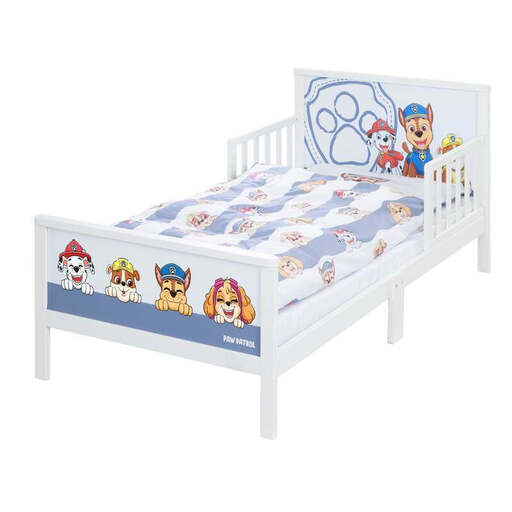
Why this product suits this profile: This low bed features a Paw Patrol design, is made for a 70 x 140 cm sleeping area and comes with a slatted base, bed linen and two side guards.
The specifications clearly state the compatible mattress size, a maximum load of 35 kg and the EN 716-1/-2:2008 + A1:2013 standard. This makes it easier to assess the bed beyond purely themed or design-led claims.
Low entrance height, two side guards, 100% cotton bed linen and an open, Montessori-inspired design according to the manufacturer’s specifications.
We have put together a complete, regularly updated list of products that fully meet these strict selection criteria and the safety regulations applicable in the EU.
Every children’s bed requires careful assembly. Before first use, check all screws, connection points and side panels. The mattress must fit in the designated frame without any significant gaps. For a bed with a ladder, drawers or pull-out elements, regular function checks are recommended.
You should also:
This depends on your child’s age, the available floor space and how long you want to use the bed. A bed measuring 70 x 140 cm is more compact and is often chosen for toddlers. Sizes of 90 x 190 cm or 90 x 200 cm provide more sleeping space for older children. The key point is always that the mattress fits the frame exactly.
There is no fixed period of use. The relevant age and weight specifications for the model, your child’s physical development and the condition of the bed are all important factors. With a baby bed or Montessori children’s bed, you should check whether the construction remains suitable for independent use and for your child’s size.
The price depends on factors including the material, size, contents of the delivery and number of functions. A bed with a desk and drawers may have a higher purchase price, but could replace several individual pieces of furniture. You should also include the mattress, delivery, assembly costs and, where applicable, suitable bed linen in your overall budget.