
Lieferung heute & morgen

Qualitätsgarantie

Willkommens-Angebote freischalten: KOSTENLOSE Lieferung | Bis zu 80 % RABATT | Kostenlose 30-Tage-JoyPlus-Testphase
App herunterladen
A children’s bedroom night light should provide orientation without unnecessarily brightening the room. For parents, more than a cute design matters: light colour, operation, power supply and the intended placement are all crucial. Subtle guidance lighting can also be useful in hallways, on stairs or in the bathroom.
Cool white light with a high colour temperature can appear bright, but it is not automatically suitable for finding your way around a child’s or baby’s room at night. A warm white night light of around 2700 to 3200 Kelvin is often perceived as more subtle. A more neutral light colour may be more practical for work or play areas.
Actual brightness is also important. Specifications such as lumens indicate how much light a lamp emits. A dimming function is often more useful than a blanket claim such as ‘particularly bright’.
A night light with a motion or dusk sensor can be convenient, although the two types of sensor work differently:
A specific measurement makes the specification easier to assess: according to the product information, the Aigostar model switches on automatically below 20 Lux. This is a technical product specification, but it does not guarantee identical behaviour in every home environment.
A rechargeable night light can be placed flexibly, but it needs to be charged regularly. Runtime depends on brightness, light colour and usage. With a lamp offering a stated battery life of 15 hours, the actual runtime may vary at higher brightness levels.
A plug-in night light, on the other hand, does not need its battery replacing or a charging cable. However, its placement is limited to a free socket. In children’s bedrooms, hallways and stairwells, cables should be avoided wherever possible and sockets should remain easily accessible.
For finding your way around at night, a low, easily adjustable brightness is usually more practical than permanently strong lighting. A dimmable night light allows you to adapt the light to different situations, such as changing a nappy at night, reading a story or walking to the toilet.
Look out for:
RGB functions are mainly interesting for decorative lighting. However, an RGB night light should also offer a separate warm white setting if it is to be used regularly as a guidance light.
An LED night light with low power consumption may be suitable for continuous use. Even so, the specific model should be compared in terms of power consumption, charging time and ease of use.
Touch controls are convenient, but young children may activate them unintentionally. Timer functions reduce the length of time the light stays on, while a dusk sensor takes care of switching it on and off automatically. With rechargeable lamps, the charging port, battery capacity and whether the lamp can be used while charging are also relevant.
Material specifications such as ABS, PC, metal or ceramic can help with your choice, but they do not replace careful use. Before buying, check:
Some models are expressly not intended for children under three years of age. Damaged rechargeable lamps or swollen batteries should not be used. For bathrooms and damp areas, the stated IP rating is crucial. According to its specification, a model with IP20 is intended only for dry indoor areas.

Why this product suits this profile: Two plug-in night lights with an automatic dusk sensor are ideal for households looking to light several areas, such as a child’s bedroom and hallway.
The three brightness levels prevent the light output from being permanently fixed and unsuitable for different situations. The sensor switches the light on and off in the dark.
2700 Kelvin, three brightness levels, 0.5 W power consumption and a two-piece set according to the product description.

Why this product suits this profile: This portable table lamp is aimed at users looking for a flexible light for the bedside table, bedroom or children’s bedroom, with precise brightness control.
The lamp is not tied to a socket and offers touch dimming from 0 to 100 per cent. This reduces the limitations of a fixed placement or inflexible brightness.
1800-mAh battery, USB-C connection, three colour temperature settings and up to six hours of stated runtime.
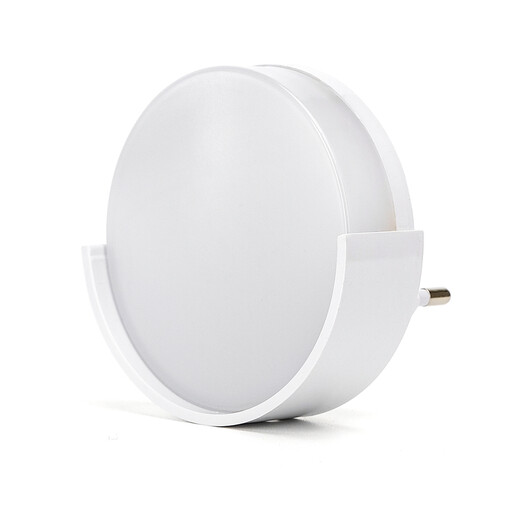
Why this product suits this profile: This compact plug-in solution is suitable for hallways, stairs, children’s bedrooms or bedrooms when automatic operation without a battery is required.
According to the product information, it requires neither batteries nor charging. The dusk sensor switches on below 20 Lux and switches off when there is sufficient ambient light.
1 W LED, 40 lumens, 120-degree beam angle, 220–240 V and a stated IP20 rating for dry indoor areas.
We have put together a complete, regularly updated list of products that fully meet these strict selection criteria and the safety regulations applicable in the EU.
That depends on its purpose and the size of the room. For simple orientation, a low brightness level is usually enough. More light is needed for changing a nappy or reading. A dimming function or several brightness levels make it easier to adjust the light. The key point is that the light should not shine directly at eye level.
The LED itself is designed for a long service life, but the actual lifespan depends on the model, electronics and operating conditions. With rechargeable lamps, the battery’s capacity is also relevant. A plug-in night light does not require the battery to be replaced, but it should not be covered and should only be used indoors in accordance with the manufacturer’s instructions.
Running costs can be calculated from the power consumption, operating time and electricity price. A device using 0.5 W consumes 0.012 kWh per day when operated for 24 hours. A 1 W model consumes 0.024 kWh per day. Actual consumption may be lower depending on the sensor, dimming level and operating time.