
Lieferung heute & morgen

Qualitätsgarantie

Willkommens-Angebote freischalten: KOSTENLOSE Lieferung | Bis zu 80 % RABATT | Kostenlose 30-Tage-JoyPlus-Testphase
App herunterladen
A children's bed or cot must suit your child's age, the size of the room and how you intend to use it. Many unsuitable purchases are not caused by the price, but by unclear product information: a bed may be advertised as “growing with your child”, even though only a few configurations are available. Or the mattress may not be included and later needs to be bought separately in an unusual size.
Parents should check three common pitfalls before buying:
The sleeping surface determines which mattress can be used. The 60 x 120 cm format is common for babies. A cot with mattress can make buying easier, but you should still check the exact mattress dimensions and what is included.
For older children, 90 x 190 cm and 90 x 200 cm are common sizes. A 90x200 cm children's bed can be used for longer, but naturally requires more space. In smaller rooms, a 90x190 cm children's bed may be the more practical choice. What matters is not just the length, but also the manufacturer's stated age range and maximum load.
You should also check:
A children's bed with fall-out guard should have a clearly described access point. A continuous side rail can provide protection, but it should not make it unnecessarily difficult for your child to get in and out independently. For mid-sleeper beds with a ladder, you should also check whether the manufacturer states that the bed is only suitable from around the age of three.
A solid wood children's bed can impress with sturdy posts and a robust construction. However, the material alone is no substitute for checking the fastenings, side panels and slatted base. Once assembled, all connections should be checked regularly. Children should not jump on the bed or use the ladder as play equipment.
A bedside cot for the parents' bed must be securely attached to the adult bed. An adjustable-height bedside cot should offer several clearly defined positions and be compatible with your own bed. Measure the height of the adult mattress, including the frame.
Castors make the cot easier to move, but also mean that it must be used correctly: the brakes must be applied when it is stationary. A mobile cot must not simply be left unsecured next to the adult bed. For products with fabric sides, also check whether access is via a zip and how the textiles can be cleaned.
The following selection categorises specific models according to their intended use and verifiable features.
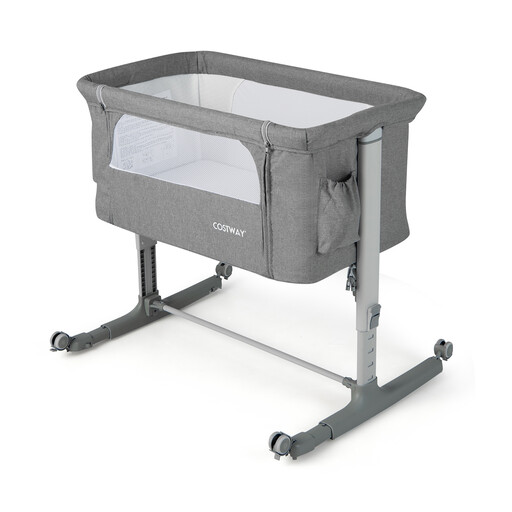
Why this product suits this profile: This compact model combines a bedside cot, cradle and carrycot. Five height positions, castors with brakes and a carry bag make it appealing to families who need flexibility.
The product details explicitly state the mattress dimensions, a load capacity of 9 kg and the recommended age range of 0 to 5 months.
Five height settings, two fastening straps, mesh sides and foldable construction for transport.
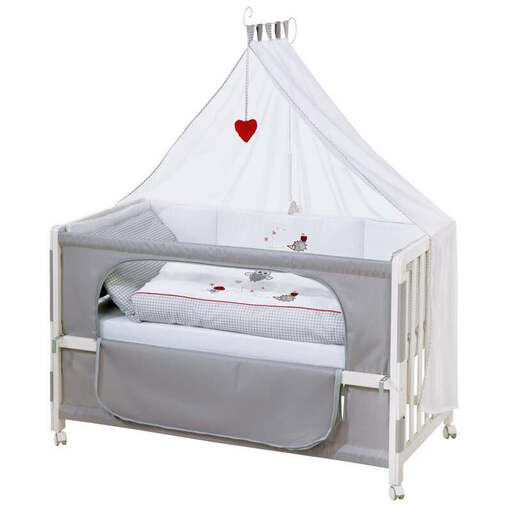
Why this product suits this profile: According to the product details, this complete set can be used as a bedside cot, cradle, cot and junior bed, from birth to approximately four years of age.
The included items are listed as a mattress, bedding, side panels, height-adjustable metal brackets and castors with brakes.
Six height settings, a side zip and a stated maximum load of 25 kg.
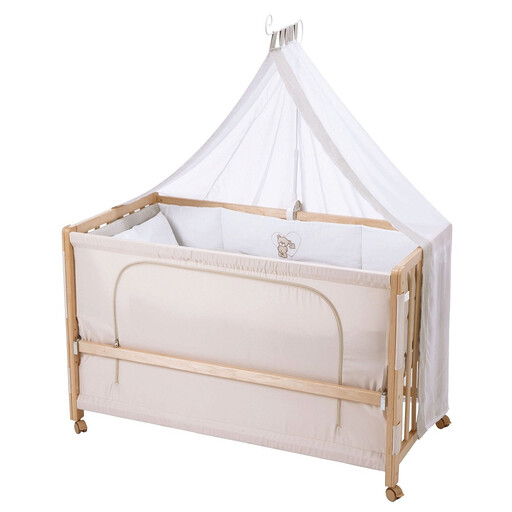
Why this product suits this profile: Families who regularly change sleeping locations get a 3-in-1 cot with four castors with brakes, six height settings and additional side protection.
The recommended mattress size of 60x120 cm is clearly stated, and the cot is attached to the adult bed using adjustable metal brackets.
The mattress, nest, bedding, fabric side and canopy are listed as included.

Why this product suits this profile: This bed combines a 90x190 cm sleeping surface with two drawers, storage shelves and a bench. It is suitable for children's bedrooms where additional storage is needed.
The mattress is explicitly not included; the recommended thickness of 15 cm and maximum load of 120 kg are also clearly stated.
Two 50 cm-deep drawers, 13 cm-deep shelves and flexible installation of the drawers on either the left or right side.
We have put together a complete, regularly updated list of products that fully meet these strict selection criteria and the safety regulations applicable in the EU.
The 60x120 cm size is commonly used for cots and bedside cots. The important thing is that the mattress fits the bed exactly and that the manufacturer explicitly specifies this size.
This depends on the construction, conversion functions, load capacity and stated age range. The roba Roombed models mentioned above are described as suitable from birth to approximately four years of age. The move to a children's bed should also be guided by your child's development and ability to stand up independently.
In addition to the purchase price, costs may include the mattress, bedding, spare parts and, where applicable, additional protective rails. A children's bed with drawers or storage usually has no regular running costs, but suitable spare parts and gentle cleaning in accordance with the care instructions are important.
The Joybuy Product Recommendation Officer selection shows that it is not the longest list of features that matters, but the combination of suitable dimensions, a clear age recommendation, safe assembly and the equipment you actually need.