
Lieferung heute & morgen

Qualitätsgarantie

Willkommens-Angebote freischalten: KOSTENLOSE Lieferung | Bis zu 80 % RABATT | Kostenlose 30-Tage-JoyPlus-Testphase
App herunterladen
A children’s bookcase should keep books visible, organise toys and remain within easy reach of young children. At the same time, it needs to fit into the room and stay stable during everyday use. Many products look similar at first glance, but differ considerably in terms of dimensions, load capacity, anti-tip protection and layout.
A low bookcase is easy for toddlers to reach. However, this alone does not prevent it from tipping over if a child climbs on it or pulls at it. A stable base, evenly distributed contents and fixing it to the wall with suitable anti-tip protection are crucial. The manufacturer’s assembly instructions should be followed both before purchase and after setup.
A total load capacity of, for example, 25 or 53 kg does not always indicate how much weight an individual compartment can hold. Heavy picture books should ideally be stored in the lower sections. With a book and toy storage unit, it is also important to check whether the load needs to be distributed evenly and whether separate specifications are provided for individual compartments.
An open children’s bookcase makes items easy to access and keeps everything in view. However, small building blocks, craft materials and other small items can quickly become visibly scattered. Anyone wishing to sort different types of toys should consider a children’s bookcase with toy storage, a removable box or closed doors.
First, measure the available floor space. In addition to width, height and depth, allow room to open a toy box and walk past safely. A bookcase around 60 to 80 cm high is often suitable for toddlers and pre-school children, while taller models offer more storage space but must be securely fixed to the wall.
The depth determines how far the bookcase extends into the room. A depth of 30 to 36 cm is a practical range for many children’s bedroom bookcases, accommodating picture books and toys. For smaller rooms, a slim children’s bedroom bookcase may be more suitable than a deep model with compartments that are difficult to reach.
When choosing furniture made from MDF or particle board, buyers should check the stated material class. MDF (E1) and PB (E1) describe an emissions class for formaldehyde. This is a technical material specification, not a general guarantee of quality or safety. A painted or melamine-coated surface can generally be cleaned with a slightly damp cloth.
Solid wood components, such as pine legs, can complement the construction. The overall build remains crucial: the joints, base, back panel and anti-tip protection should all be suitable for use in a child’s bedroom.
Rounded edges and carefully sanded surfaces reduce sharp contact points. However, they do not replace safe use. Look for:
A Montessori bookcase is primarily characterised by its child-friendly accessibility. “Montessori” is not a uniform safety standard, however. For this reason, you should also check the specific dimensions, load capacity information and fixing instructions for these models.
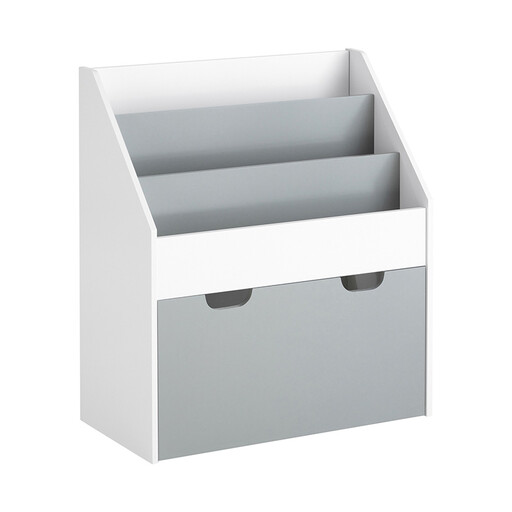
Why this product suits this profile: Measuring approximately 63 × 70 × 30 cm, this compact model combines three compartments with a removable toy box on castors.
The separate sections prevent books and larger toys from being mixed together in a single open compartment. Wall mounting is specified in the product information.
MDF (E1), rounded edges, a stated total load capacity of 25 kg and a mobile box with removable castors.
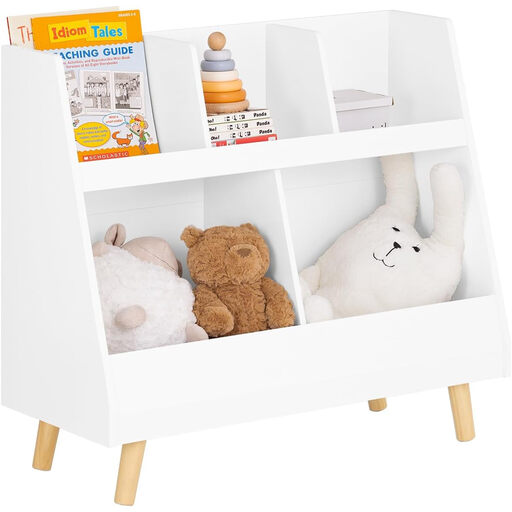
Why this product suits this profile: Five open compartments provide clear separation for picture books, puzzles, toys and soft toys. Its width makes good use of wall space without creating an especially deep unit.
The actual dimensions and stated load capacity of 25 kg are clearly specified. Rounded edges and the intended safety fixing address common safety gaps.
MDF (E1), solid pine legs, painted surface and five compartments measuring 86 × 78 × 36 cm.
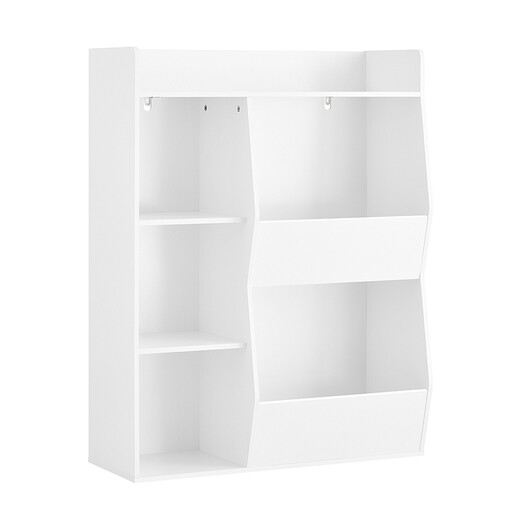
Why this product suits this profile: The five open levels are suitable for families or nurseries wishing to organise books and toys visibly by category.
The compartment layout creates order, while the stated load capacity of up to 53 kg provides a verifiable guide for loading. Wall mounting remains essential.
80 cm wide, 104 cm high, 34 cm deep, with rounded edges and coated E1-class PB panels.
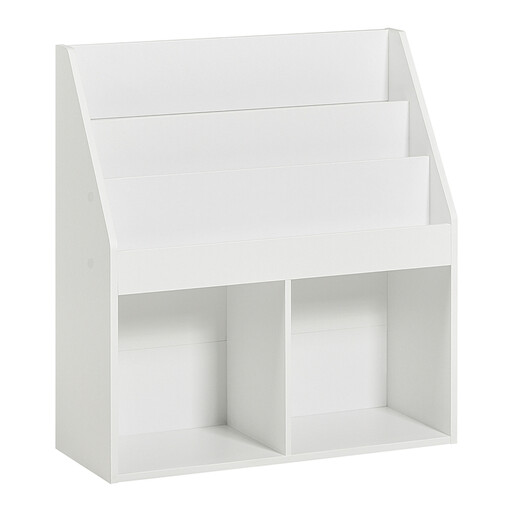
Why this product suits this profile: This model combines three shelves with two open lower compartments and remains relatively compact at around 30 cm deep.
The dimensions make it easier to plan the layout of smaller children’s bedrooms. The safety instructions require even loading and protection against climbing or hanging from the bookcase.
Three shelves and two open compartments, approximately 68 × 68 × 30 cm, combining particle board with a melamine coating and MDF.
We have put together a complete, regularly updated list of products that fully meet these strict selection criteria and the safety regulations applicable in the EU.
After assembly, the bookcase should stand on a level surface and be fixed to the wall according to the instructions. Then check whether it wobbles and whether all screws are securely tightened. Heavy books belong in the lower compartments; lightweight soft toys and frequently used picture books can be stored higher up.
Small components from the assembly process should be kept out of children’s hands. A removable box with castors should also be used in such a way that fingers or feet cannot become trapped. In settings such as a nursery, regular visual checks for loose connections, damaged edges and overloading are also recommended.
The right height depends on the child’s size, reach and room layout. Low models measuring around 63 to 80 cm make it easier for children to access items independently. With taller bookcases, the upper compartments should be reserved for adults, and all models should be secured against tipping over.
Its service life depends on the material, assembly, load, and care. MDF and particle board furniture should be protected from prolonged exposure to moisture. If screws are checked regularly, the stated load capacity is observed and the bookcase is not used as a seat or climbing aid, its connections will remain load-bearing for longer.
A bookcase itself does not require electricity. Ongoing costs mainly arise from cleaning, possible replacement parts and, where necessary, subsequent wall mounting. When making your decision, therefore, consider not only the price but also the contents supplied, assembly effort, material specifications and suitability for the intended load.