
Lieferung heute & morgen

Qualitätsgarantie

Willkommens-Angebote freischalten: KOSTENLOSE Lieferung | Bis zu 80 % RABATT | Kostenlose 30-Tage-JoyPlus-Testphase
App herunterladen
A children’s bookcase should keep picture books within easy reach, provide space for toys and take up as little room as possible. In practice, though, some buying decisions can quickly lead to a piece of furniture that’s barely used: a bookcase that’s too tall is out of reach for toddlers, open shelves can become cluttered in no time, and the lack of an anti-tip fitting can pose a significant safety risk.
This guide explains what parents and grandparents should look for when buying a children’s bookcase. It focuses on practical details such as dimensions, materials, load capacity, storage space and fittings.
A low bookcase can make it easier for children to reach their books. But that alone won’t stop it tipping over if a child pulls themselves up on it or climbs onto the shelves. Look for a wall fixing with an anti-tip device that’s specifically designed for the bookcase. Fit it according to the instructions, using screws and wall plugs that are suitable for your type of wall.
A children’s bookcase with lots of small compartments may be suitable for picture books, but it can quickly prove too small for larger toys. Check that the height and depth of the compartments suit what you actually plan to store. A bookcase and toy storage unit with a removable box may be more practical for building blocks, soft toys or dolls than several narrow shelves.
Descriptions such as ‘Montessori’, ‘sturdy’ or ‘child-friendly’ aren’t enough on their own to make an informed choice. The important details are the material, dimensions, maximum load capacity, weight and fixing instructions. Rounded edges can help reduce bumps against hard corners, but they don’t replace a sturdy construction or an anti-tip fitting.
For toddlers and nursery-age children, low, open shelves are usually easier to use. Models around 62 to 88 cm high can often be positioned so that children can reach their books without help. Taller children’s bookcases, at around 100 cm, offer more storage, but should be secured to the wall with particular care.
The right height also depends on the layout of the room. If the bookcase is going in front of a window, next to a bed or under a sloping ceiling, a compact children’s bookcase with a depth of 30 cm may be a better fit than a deeper piece of furniture.
For models made from coated MDF, chipboard or PB, make sure the edges and surfaces are neatly finished. Smooth surfaces that can be wiped clean with a damp cloth make everyday cleaning easier. Wood-based materials such as MDF (E1) or PB (E1) may be listed in the product details; check the full manufacturer’s information and assembly instructions too.
Plastic models such as those made from PP are often lightweight and can be suitable for flexible storage. If you choose a bookcase on castors, make sure it stands on a level surface and can’t be moved unintentionally.
The stated maximum load capacity doesn’t necessarily apply to each individual shelf. Store heavier books on the lower shelves where possible, and don’t exceed the overall weight limit. A children’s bookcase shouldn’t be used as a seat, ladder or climbing frame. So, with a child-safe bookcase, safe use always depends on the design, correct assembly and how it’s used day to day.
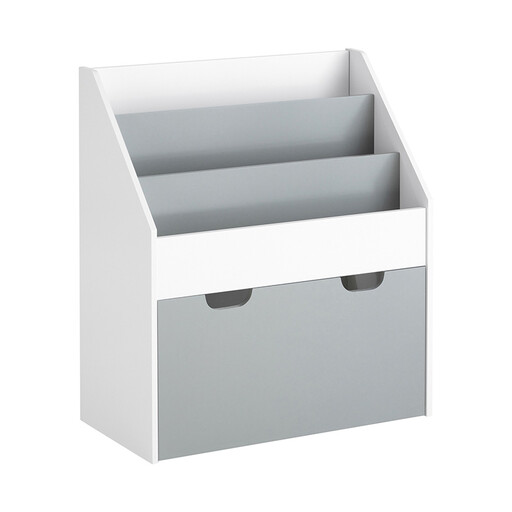
Why this product suits this need: The compact combination of three open compartments and a box on castors is a good fit for small children’s bedrooms and families who want to store books and toys separately. It stands around 70 cm high.
Its low height makes it easier to reach. For safety, the supplied anti-tip device must be fitted according to the instructions.
Three compartments, a removable toy box on castors, rounded edges and a stated load capacity of up to 25 kg.
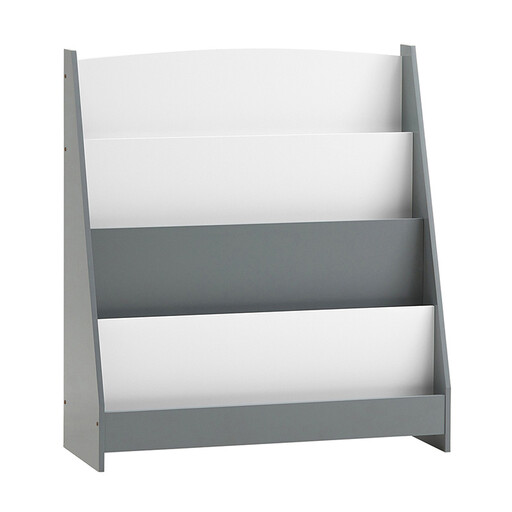
Why this product suits this need: Measuring 80 × 88 × 30 cm, this MDF model has four levels for books in different sizes. Its height lets children reach many of the shelves independently.
The product details specify rounded corners and an anti-tip device. For safe use, it still needs to be securely fixed to the wall.
Four compartments, an MDF construction, a product weight of 11.3 kg and a stated load capacity of up to 20 kg.
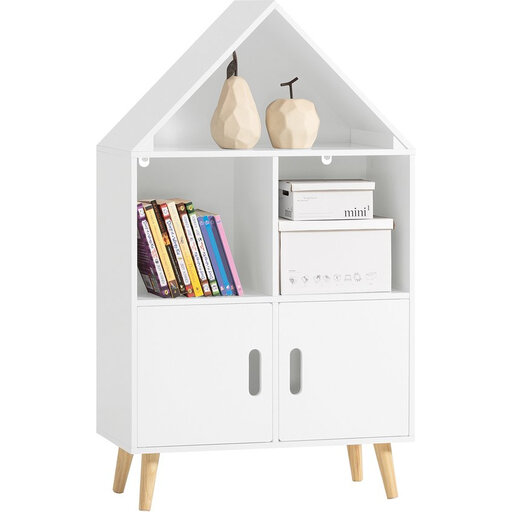
Why this product suits this need: This 103 cm-high bookcase combines three open shelves with two doors. It’s a good choice for families who want to keep books on display while storing toys out of sight.
The different compartments provide a choice of storage options, rather than just small shelves. The supplied anti-tip device must be used to secure it to the wall.
Three open compartments, two doors, MDF and pine, and a stated overall load capacity of up to 70 kg.
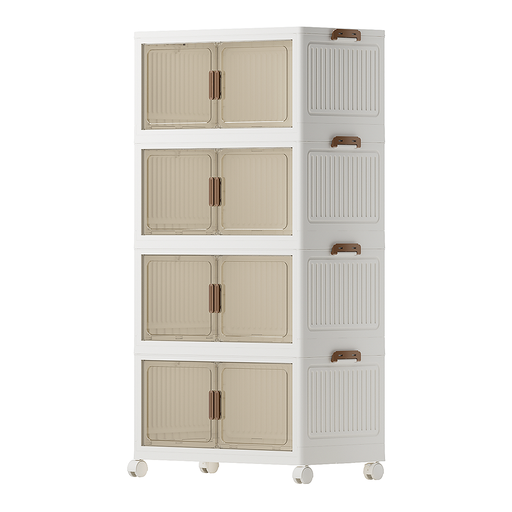
Why this product suits this need: This 55 cm-wide folding plastic unit can be set up without tools and moved between rooms as needed. It works well as extra storage in a child’s room for books, toys or everyday essentials.
The number of compartments and the width are clearly stated. As it has castors, the unit should be placed on a level surface and not overloaded.
Four compartments, 55 cm width, PP plastic, magnetic closures and nylon castors; folds away for space-saving storage.
We’ve put together a complete, regularly updated list of products that meet these strict selection criteria and fully comply with the safety regulations in force in the EU.
Low models around 60 to 80 cm high are often easy for toddlers to reach. An older child may have more storage space with a taller Montessori bookcase. The size of the room, the child’s height and secure wall fixings are all important considerations.
Wall fixings are generally a good idea for freestanding bookcases, especially when children can reach them. Use the designated anti-tip device and check that the fixings are suitable for your type of wall. Children shouldn’t climb on the bookcase or use it for support.
Its lifespan depends on the material, load, assembly and care. Distributing the weight evenly, wiping it with a dry, soft cloth and carrying out regular checks can help keep it in good condition. Without details about how and where it will be used, it isn’t possible to give a reliable general estimate of its lifespan.