
Lieferung heute & morgen

Qualitätsgarantie

Willkommens-Angebote freischalten: KOSTENLOSE Lieferung | Bis zu 80 % RABATT | Kostenlose 30-Tage-JoyPlus-Testphase
App herunterladen
A children’s bookcase with toy box should make books, building blocks and craft supplies easy to reach. But in everyday use, looks aren’t the only thing that matters. For families with toddlers and pre-schoolers, stability, suitable dimensions and ease of use are particularly important.
A low children’s bedroom bookcase is easy for children to reach. That doesn’t mean it can’t tip over, though. Even a toy storage unit that’s 60 to 70 cm tall can topple if a child pulls on it, climbs onto the shelves or sits inside it. That’s why fitting the supplied anti-tip wall fixing is an essential part of assembly.
A large number of compartments may seem practical at first. But if they’re very small, picture books, larger building blocks or art supplies may not fit. Removable boxes and baskets can make things easier to access, but they need enough room to pull out. Before buying, consider which items you actually want to store.
Manufacturers’ maximum load figures don’t always apply to each individual shelf or compartment. It’s best to store heavy books at the bottom to keep the centre of gravity low. Damp rooms or harsh cleaning products can also damage coated MDF surfaces. In a child’s bedroom, a lightly damp cloth and regular checks of the fixings are usually the best way to care for the furniture.
A low design is a good choice for toddlers who should be able to reach picture books and toys on their own. When deciding where to put it, also take account of doorways, radiators and walkways. A depth of around 30 cm may be enough for books and smaller toys, while a larger toy box will need more floor space.
Measure the space in advance and leave enough room in front of removable boxes to pull them out. A toy box on wheels should be able to move fully without bumping into furniture or walls.
A bookcase with storage boxes is a good choice for families who want to sort toys into categories. Open shelves are handy for books that get used often. A removable box can hold larger items and be slid back under the bookcase after playtime.
Look for:
Parents should supervise young children at first when they’re using moving boxes. Fingers or toes could get trapped when the boxes are pushed in.
Several of the furniture options listed are described as being made from E1-class MDF. This refers to the material’s emissions class, but it doesn’t replace checking the rest of the product information. Workmanship, fully tightened fixings and a stable position are just as important.
For a children’s storage unit, fit the wall fixing according to the instructions. Once assembled, check the unit visually and make sure it’s stable. Depending on how often it’s used, check the screws and fixings regularly – for example, every three to six months.
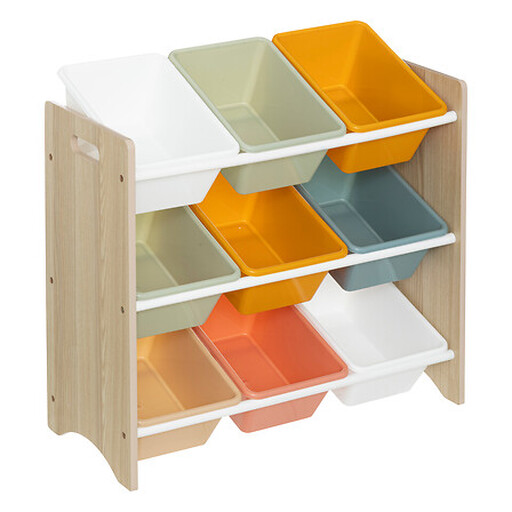
Why it suits this need: This model has nine removable plastic boxes, set out across a footprint of around 60 × 29.5 cm. You can sort toys by colour or category without having to make room for a large piece of furniture.
The nine boxes avoid the need for one large, cluttered toy box. Distribute the weight evenly, and don’t let children climb on the unit or play on it unsupervised.
Nine removable PP boxes, an E1-class MDF frame and a height of around 66 cm.
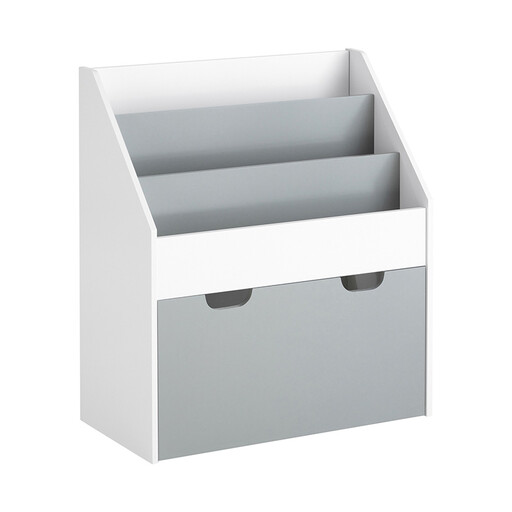
Why it suits this need: Three open compartments and a large box at the bottom combine book storage with space for bigger toys. Measuring around 63 × 70 × 30 cm, this unit will fit into many children’s bedrooms.
The stated dimensions, maximum total load of 25 kg and wall-fixing guidance make it easier to plan where to put it. Store heavy books in the lower sections.
Three book compartments, a removable box on wheels and E1-class MDF.
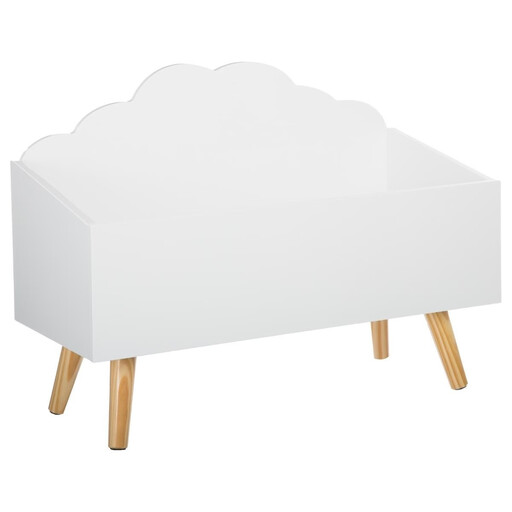
Why it suits this need: This separate box is ideal for families who want to keep a larger number of soft toys, books or playthings together in one place. It measures around 58 × 28 × 45.5 cm.
With no small compartments, there’s less sorting to do. As no maximum load is specified, don’t overfill the box or use it as a seat.
Four wooden legs, a wooden construction and a spacious compartment for storing a range of items.
We’ve put together a complete, regularly updated list of products that meet these strict selection criteria and fully comply with the safety regulations in force in the EU.
Place the bookcase on a level surface and secure it to the wall using the supplied anti-tip fixing. Assemble it according to the instructions. Children shouldn’t climb on the shelves, boxes or furniture. After assembly and during later checks, make sure the bookcase doesn’t wobble and tighten any loose fixings.
Its lifespan depends on the materials, load, assembly and care. Distributing weight evenly, keeping the room dry and discouraging children from climbing or sitting on it can help reduce strain. Check any visible damage, loose fixings or damaged wheels before using it again.
A traditional toy box doesn’t use electricity, so there are no ongoing electricity costs. With models on wheels, you may only need to pay for replacement parts or maintenance. The most important things to consider are suitable dimensions, enough storage space and a design that’s right for how you plan to use it.