
Lieferung heute & morgen

Qualitätsgarantie

Willkommens-Angebote freischalten: KOSTENLOSE Lieferung | Bis zu 80 % RABATT | Kostenlose 30-Tage-JoyPlus-Testphase
App herunterladen
A well-organised kids' room not only fosters independence but also creates a calm and stimulating environment. A suitable children's bookshelf is a key element in achieving this. However, the market is flooded with models that seem practical at first glance but prove unsuitable in daily life. Before you make a decision, it's important to understand the common pitfalls that lead to poor purchases.
Common Pitfalls When Buying Shelves for Kids:
To find a durable and safe solution, you should evaluate three core parameters. These will help you distinguish a functional kids' room shelf from an unsuitable model.
Your child's safety is the top priority. Look for the following features:
A shelf is only useful if the child can use it independently.
A good children's shelf grows with your child's needs or can be used flexibly within the room. Models with castors offer mobility, while modular systems can be expanded later. A neutral colour scheme ensures that the shelf will still match the decor in a few years.
Here are some recommendations tailored to different needs and room situations.
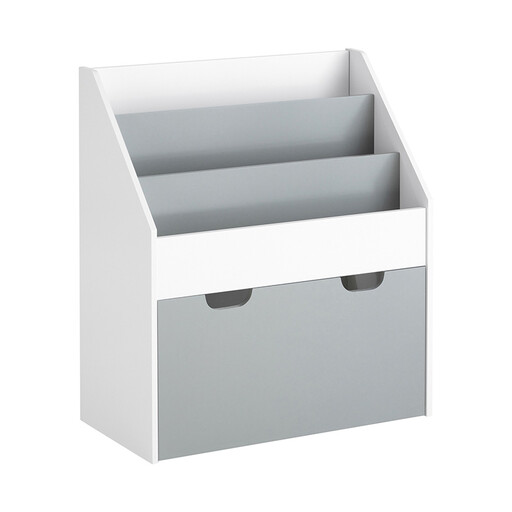
Why it's a great fit: It provides an all-in-one solution for families looking for a functional and affordable starter set for the kids' room. The combination of book compartments and a large toy box covers basic organisational needs.
The 70 cm height is accessible for toddlers. The softened corners and included anti-tip kit directly address safety concerns. The large, removable toy box solves the problem of impractical toy storage.
The toy box is equipped with wheels and can be easily moved by the child, which encourages independent clean-up. The wheels can also be removed if needed.
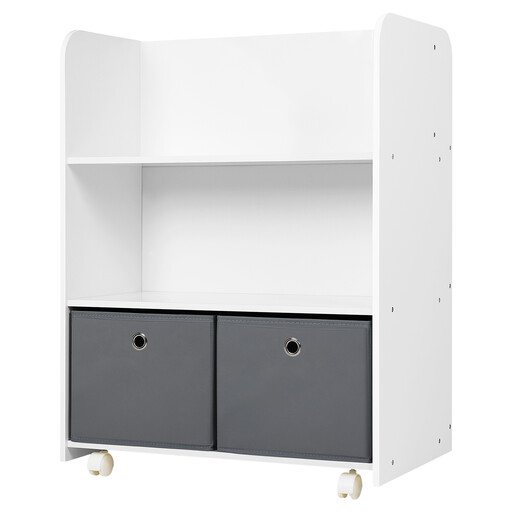
Why it's a great fit: Ideal for dynamic living spaces where furniture needs to be used flexibly. It can serve as a room divider or be easily moved between play and sleep areas.
The double-sided design is extremely practical, avoiding the one-sidedness of many shelves. One side serves as a bookshelf, the other as a toy shelf with compartments and bins. The anti-tip kit is also included for fixed positioning.
The mobility provided by the four castors allows for effortless redesign of the room. The shelf can be wheeled to where the toys are for clean-up and then returned to its place.
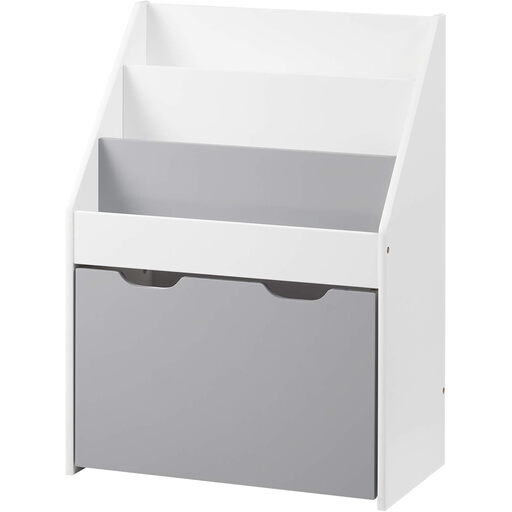
Why it's a great fit: Perfect for kids' rooms where many small items, building blocks, or dolls need a dedicated spot alongside books. The focus is on a large, easily accessible toy box.
The trapezoidal design (wide at the bottom, narrow at the top) ensures high stability and minimises the risk of tipping. The tiered book compartments are practical, while the large, separate toy box solves the problem of insufficient storage space.
The combination of three book compartments of different heights and the large, rolling chest offers clear separation and organisation. This helps children learn to distinguish between books and toys and to keep everything in its place.
We have compiled a complete, up-to-date list of products that fully meet these strict selection criteria and UK/EU safety regulations.
For children aged 2 to 6, a height between 60 cm and 80 cm is optimal. In this range, they can reach all compartments independently and safely, which promotes their autonomy.
Always use the included anti-tip hardware. Follow the manufacturer's assembly instructions precisely. The bracket should be anchored to a solid wall (not a lightweight partition) with appropriate wall plugs and screws to ensure maximum stability.
A Montessori shelf is characterised by displaying books with their covers facing forward. This allows children who cannot yet read to recognise and select books based on the pictures. This type of presentation is particularly stimulating and fosters an interest in reading.