
Lieferung heute & morgen

Qualitätsgarantie

Willkommens-Angebote freischalten: KOSTENLOSE Lieferung | Bis zu 80 % RABATT | Kostenlose 30-Tage-JoyPlus-Testphase
App herunterladen
A children’s bookshelf should display picture books clearly, hold toys and be easy to reach every day. At the same time, it needs to fit into the child’s bedroom, stand securely and be suitable for safe wall mounting. Many products look similar at first glance, but differ considerably in terms of dimensions, load capacity, materials and storage space.
A tall children’s bedroom bookshelf makes efficient use of wall space, but may not be fully accessible to toddlers. With a Montessori bookshelf, it is therefore not just the appearance that matters, but also the height of the lower compartments. Children can choose and put away books more independently when the most important compartments are within reach without climbing.
A large children’s bedroom shelf can still be impractical if books disappear among toys, cuddly toys and craft materials. Open compartments make everything easier to see. Closed doors or a removable box, on the other hand, are useful when you want smaller items to be quickly put out of sight. The key question is whether the layout suits your family’s daily routine.
Rounded edges reduce sharp contact points, but they do not replace proper fixing. A child-safe shelf should be assembled according to the manufacturer’s instructions and secured to the wall using the specified anti-tip system. Children must not climb on the compartments or pull themselves up on them. The load limit must also be observed, with weight distributed as evenly as possible.
First, measure the intended floor space, including skirting boards and the distance from the door. The depth determines how far the shelf projects into the room. For an open children’s bookshelf, the compartment height and handle height are also important.
As a practical guide:
Pay attention to the stated maximum load capacity and check whether it applies to the entire shelf or to individual compartments. Heavy books should preferably be placed in the lower sections. A children’s storage shelf can quickly become heavier than expected once filled with toys. Fabric baskets or lightweight boxes can help organise small items without placing unnecessary weight on the upper compartments.
The models presented use materials including MDF, chipboard, coated surfaces and solid wood components. The labels MDF (E1) or PB (E1) describe the material class stated by the supplier. Also check whether the surface is painted or melamine-coated, and note the applicable care instructions. Smooth surfaces that can be cleaned with a slightly damp cloth are well suited to everyday use.
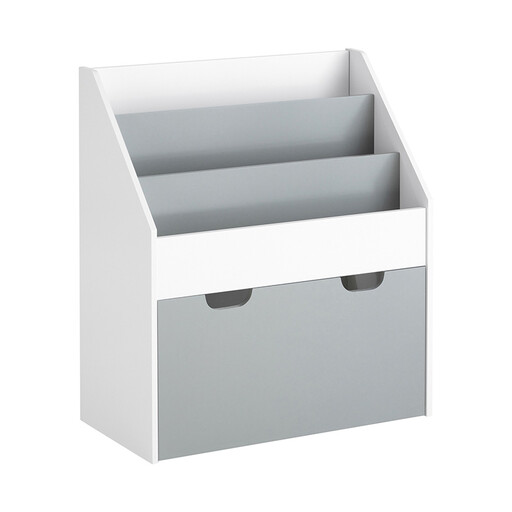
Why this product suits this profile: Measuring approximately 63 × 70 × 30 cm, this compact model combines visible book compartments with a mobile storage box for toys.
The low height makes it easy to reach. The manufacturer’s specifications mention rounded edges, a maximum load capacity of 25 kg and an anti-tip system; wall fixing is required.
Three open compartments, a removable toy box with wheels and an MDF(E1) body.
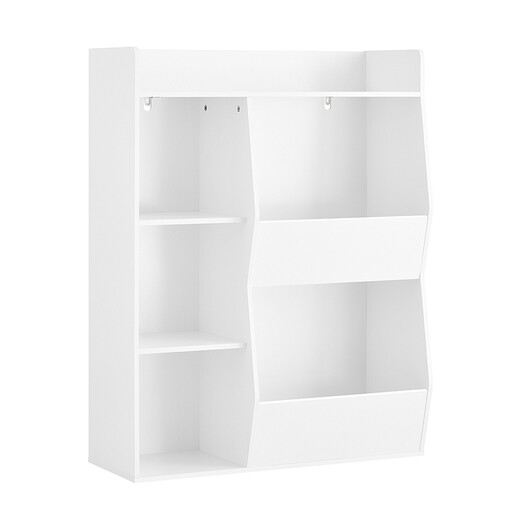
Why this product suits this profile: Measuring 80 × 104 × 34 cm, this model offers five open levels for books, cuddly toys and accessories, making it suitable for families with an extensive collection.
The open layout prevents books from disappearing into one large compartment. Rounded edges and the stated anti-tip system address typical safety requirements; wall mounting is still necessary.
Stated load capacity of up to 53 kg, five open compartments and PB(E1) material.
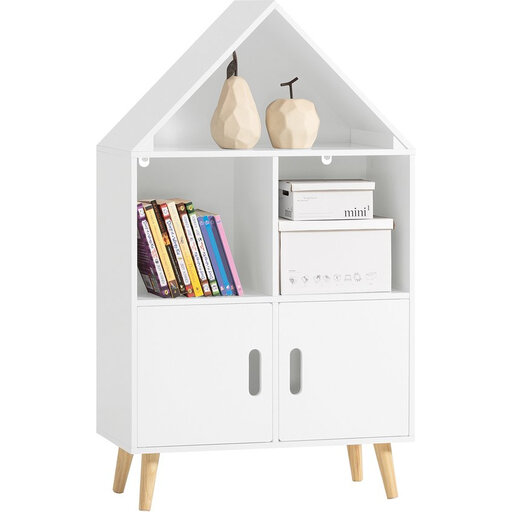
Why this product suits this profile: The combination of three open compartments and two doors is designed for children’s bedrooms, playrooms or nursery areas with varied storage needs.
The separate sections prevent frequently used books from getting mixed up with toys that are needed less often. The supplier mentions rounded edges and an anti-tip device.
MDF(E1) and solid pine wood, stated load capacity of up to 70 kg, plus three open shelves and two doors.
Assemble the shelf fully according to the instructions, then check that it does not wobble. The supplied wall fixing should be installed using fittings suitable for the type of wall. Wall plugs and screws must be suitable for the specific surface. Check the connections regularly, particularly after moving house or if the shelf is used frequently.
A soft, slightly damp cloth is usually all that is needed for cleaning. Avoid prolonged exposure to high humidity and harsh cleaning products unless the manufacturer specifies otherwise. Keep small assembly parts out of children’s reach while putting the shelf together.
We have put together a complete, regularly updated list of products that fully meet these strict selection criteria and the safety regulations applicable in the EU.
Low models are often easier for toddlers and pre-school children to access. However, the child’s height, the available space and how the shelf will be used are all important considerations. Frequently used books should be placed in the lower compartments, where they are easy to reach. A taller shelf offers greater capacity, but must be securely fixed to the wall.
Assemble the shelf according to the instructions and secure it to the wall using the specified anti-tip system. Use fixing materials suitable for the type of wall. Children should not climb on the shelf or pull themselves up on it. The maximum load capacity must not be exceeded.
Its service life depends on the material, load, assembly and care. A simple book and toy shelf can later also be used for magazines, craft materials or organising systems. It is therefore worth checking the dimensions, load capacity and potential use beyond the toddler years before buying.