
Lieferung heute & morgen

Qualitätsgarantie

Willkommens-Angebote freischalten: KOSTENLOSE Lieferung | Bis zu 80 % RABATT | Kostenlose 30-Tage-JoyPlus-Testphase
App herunterladen
A children's bookshelf should keep picture books visible, allow children to access them independently and stand safely in the bedroom or playroom. In practice, however, poor purchases are not caused by price or appearance alone. Reachable dimensions, durable materials and a construction suited to how children actually use it are all crucial.
As a Joybuy Product Recommendation Officer, I filter the most important selection criteria and explain which product features you should pay particular attention to before buying a bookshelf for a child's room.
A classic, tall adult bookshelf offers plenty of storage, but is often impractical for young children. Picture books may be out of reach, while children could try to climb to access the upper compartments. An open children's bookcase with a low profile is usually better for frequently used books.
Even a compact children's bookcase can tip over if a child pulls on it or leans against an edge. An anti-tip device for a children's bookcase should therefore not only be included, but also correctly secured to the wall in accordance with the instructions. Children should also not climb on the furniture or hang from it.
Having lots of compartments does not automatically mean that the bookcase can be loaded with any amount of weight. Check the stated maximum load, how the weight should be distributed and the usage instructions. Heavy items should ideally be placed in the lower compartments. Decorations on top can shift the centre of gravity unfavourably.
For babies, toddlers and pre-school children, compartments at eye and reach height are practical. A Montessori children's bookcase is often designed to display books with their covers facing forwards or in open compartments. This makes choosing easier, without the child having to pull several books out of a narrow compartment.
Look for:
A children's bookcase with storage is particularly useful when one piece of furniture needs to serve both as a picture-book shelf and as toy storage.
For children's furniture, smooth surfaces and neatly finished edges are important practical considerations. Rounded or carefully sanded edges can reduce the risk of painful knocks during everyday use, but they do not replace careful supervision and secure assembly.
For coated wood-based materials, the product description should state the material type. The models featured here include E1-grade MDF. This designation describes a defined emissions class for the wood-based material; it is not a general promise regarding health or therapeutic properties. Also check whether the surface is lacquered or melamine-coated, and whether the care instructions are suitable for your household.
Before buying, compare the width, height and depth with the intended space. A shallow bookcase will fit beside a bed, changing unit or sofa, but may offer less room for large picture-book formats.
For assembly:
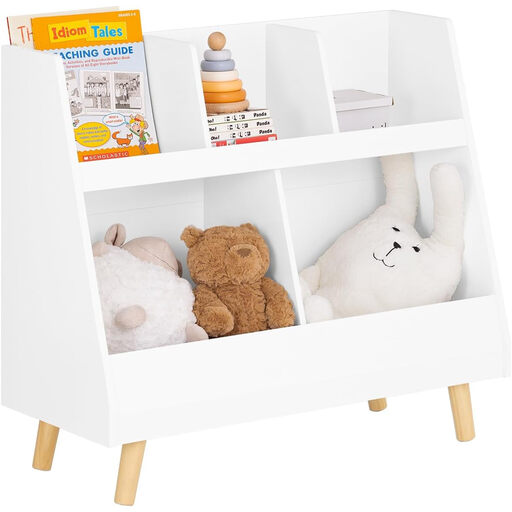
Why this product suits this profile: The combination of five open compartments and a compact footprint is ideal for families who want to store books and smaller toys in one piece of furniture.
The open compartments prevent book rows from being difficult to reach. Rounded edges and the guidance on securing the unit address two common weak points of children's bookcases.
E1-grade MDF body, solid pine legs, five compartments and a stated total load capacity of 25 kg.
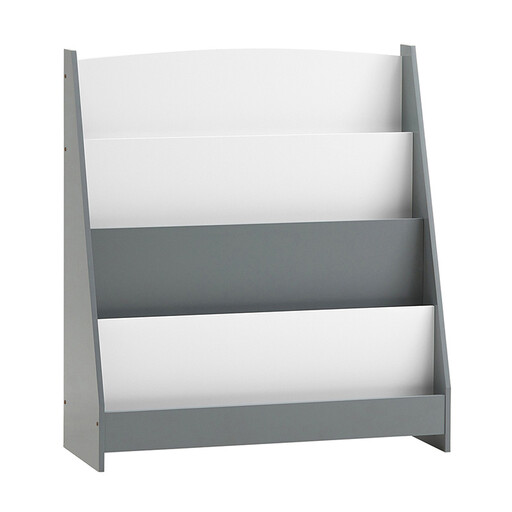
Why this product suits this profile: The four tiered shelves and height of approximately 88 cm are designed to create an easily accessible book area in a child's room.
The low, open design reduces the need to take books from high compartments. The stated anti-tip kit must be permanently secured to the wall in accordance with the instructions.
MDF construction, rounded corners, four shelves, an approximate maximum load capacity of 20 kg and a depth of around 30 cm.
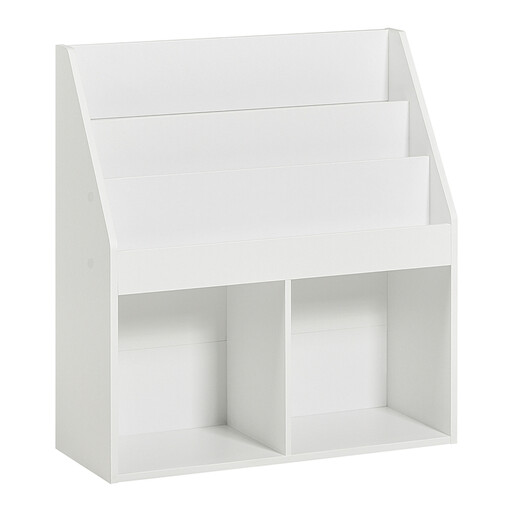
Why this product suits this profile: Three shelves and two larger open areas are suitable for households that need to organise not only books, but also toys, magazines or games.
The combination of compartments and open areas prevents books and toys from being mixed together in one deep shelf. Heavy items should be placed at the bottom and distributed evenly.
Coated chipboard and MDF, five storage areas and a stated load capacity of up to 60 kg when evenly distributed.
We have put together a complete, regularly updated list of products that fully meet these strict selection criteria and the safety regulations applicable in the EU.
The service life of a children's bookshelf depends heavily on its assembly, load and care. Wipe the surfaces with a slightly damp cloth and avoid leaving them exposed to standing water. Harsh cleaning products can damage lacquers or coatings.
Check regularly:
A bookcase should be replaced or taken out of use if it wobbles, shows visible damage or its connections become loose again despite being retightened.
For toddlers and pre-school children, low bookcases with reachable compartments are practical. There is no single ideal height, as children's height and how the bookcase is used vary. The key is that the most important books can be reached without climbing and that the furniture can be securely fixed in place.
Anti-tip protection is strongly recommended, particularly when the bookcase is used in a household with young children. Secure the furniture to a suitable point on the wall in accordance with the manufacturer's instructions. The wall plugs and screws used must be suitable for the wall material.
This depends on the number of items and how the bookcase will be used. A compact bookcase with open shelves is enough for a small collection of picture books. If you also want to store puzzles, building blocks and games, a children's bookcase with compartments or a children's toy storage unit with several sections is a sensible choice. Always check the maximum load capacity and the available floor space.