
Lieferung heute & morgen

Qualitätsgarantie

Willkommens-Angebote freischalten: KOSTENLOSE Lieferung | Bis zu 80 % RABATT | Kostenlose 30-Tage-JoyPlus-Testphase
App herunterladen
A children’s bookshelf should display books attractively, hold toys and give children independent access. In practice, however, the differences often only become apparent after assembly: a shelf is too tall, tips over under load, offers too little space for picture books or is difficult to clean.
For children’s bedrooms, playrooms, nurseries and nursery school settings, it is therefore worth taking a close look at construction, dimensions and usage. The following criteria will help you separate marketing claims from genuinely relevant product features.
Castle shapes, pastel colours and decorative details make a children’s shelf visually appealing. However, they say little about its stability. A child-safe bookshelf should be able to be secured to the wall to prevent tipping. Rounded corners and sanded edges also reduce the risk of children bumping into hard edges during everyday movements.
Important: an anti-tip device only works if it is used in accordance with the assembly instructions. Children should not climb on shelf compartments, hang from them or use the furniture as a step.
Specifications such as “up to 60 kg” or “up to 70 kg” usually refer to the maximum permissible total weight. The load must be distributed evenly. Heavy books should be placed on the lower shelves, while light picture books or soft toys can go on top.
Also check whether the specification applies to the entire piece of furniture or to individual shelves. This information is not always prominently displayed in the product description.
A bookshelf for children should not only offer plenty of storage space, but also suit the child’s height and age. With a tall piece of furniture, the upper shelves may be out of reach for toddlers. A very low model, on the other hand, often lacks space for larger books or toy boxes.
Open shelves make it easier to see what’s there. Doors or boxes are useful for tidying away smaller toys, craft materials or cuddly toys.
For toddlers, low models with easily accessible shelves are practical. The SoBuy shelf with toy box, for example, is around 70 cm high and is therefore aimed at children who should be able to reach books and toys without help. Taller models at 88 or 104 cm offer more storage space, but should be particularly carefully secured to the wall.
Many models are made from MDF of emission class E1, solid wood or coated wood-based materials. E1 is a material classification for formaldehyde emissions and should not be equated with a general statement about the health safety of the entire piece of furniture. Also crucial are:
A lacquered or melamine-resin-coated surface can usually be cleaned with a slightly damp cloth in everyday use. Prolonged exposure to moisture should be avoided with wood-based materials.
A bookshelf with compartments is suitable for picture books, comics and smaller toys. A book and toy shelf with an additional box or cupboard door creates more order, but can be less clear for young children.
Check before buying:
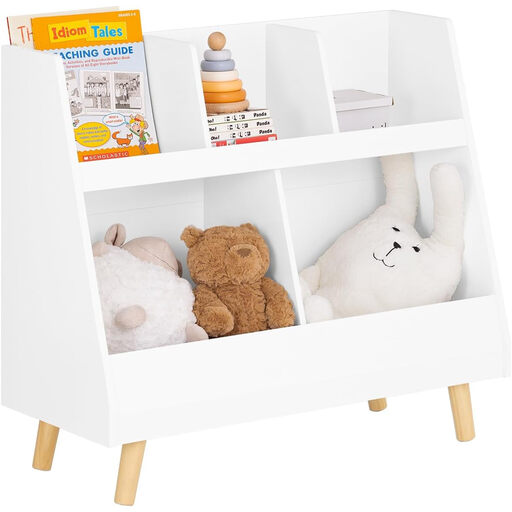
Why this product fits the profile: The five open compartments provide a manageable basic setup for books, puzzles and smaller toys in a child’s bedroom or nursery.
The compartments are open and easily accessible. The stated total load capacity of 25 kg makes even loading predictable; wall fixing remains necessary.
Five compartments, MDF (E1), solid pinewood legs, white lacquered surface and rounded edges.
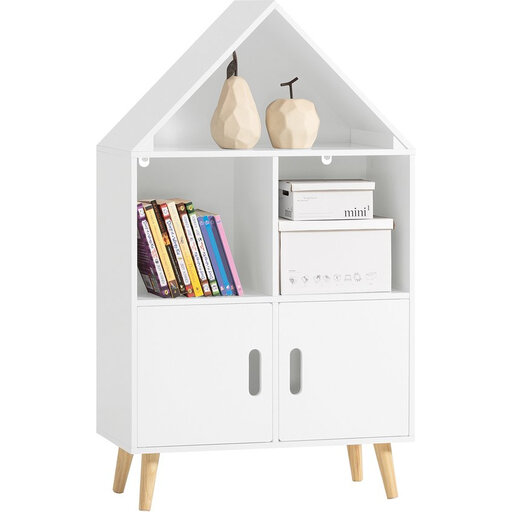
Why this product fits the profile: This model combines open display areas with two doors and is suitable for families who want to store books and less frequently used toys separately.
The construction features rounded corners and an anti-tip device. At 103 cm high, wall fixing should be carried out consistently.
Three open shelves, two doors, MDF (E1) and pinewood, plus a stated load capacity of up to 70 kg total.
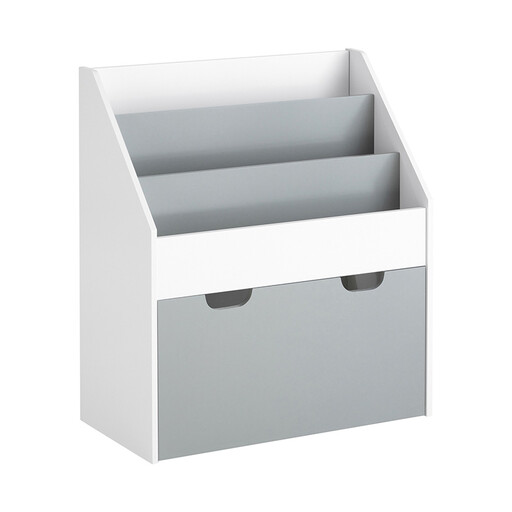
Why this product fits the profile: For households, childminding settings or nursery school areas with regular toy rotation, the removable box is a practical addition to three open compartments.
The height of around 70 cm makes access easier. The box can be used with or without castors; children should be supervised when pulling it out.
Three compartments, removable toy box, MDF (E1), rounded edges and a stated total load capacity of up to 25 kg.
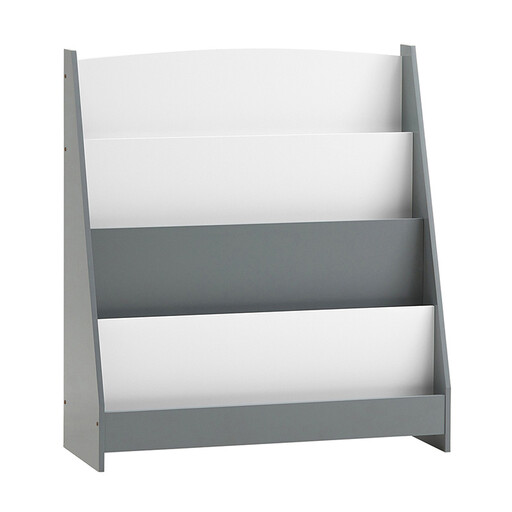
Why this product fits the profile: The four open levels make book covers visible and facilitate a clear arrangement within reach of pre-school children.
The height of 88 cm remains reachable for many children. Rounded edges and the included anti-tip system address typical safety requirements, but do not replace correct assembly.
Four open compartments, MDF (E1), rounded edges, wall fixing and a stated load capacity of up to 20 kg.
Place the shelf on a level surface and check after assembly that it does not wobble. Tighten screws and connections according to the instructions. The wall fixing should be suitable for the wall type and the supplied fixing materials. For very porous walls, additional suitable mounting materials may be required.
For toy storage, a simple arrangement is recommended:
Occasionally check the screw connections on regularly used furniture. Use a soft, slightly damp cloth for cleaning and avoid harsh cleaning products.
We have compiled a complete, regularly updated list of products that fully meet these strict selection criteria and the safety regulations applicable in the EU.
For toddlers, low models around 60 to 80 cm are often easier to access. Depending on their height, pre-school children can also use shelves of around 88 to 104 cm. The key point is that the books used most often are reachable without climbing.
Yes. A freestanding children’s shelf can tip over if a child pulls on it or climbs on it. Use the supplied anti-tip device and check whether the fixing materials are suitable for your wall.
The lifespan depends on the material, load, assembly and care. Even loading, dry cleaning and regular checking of connections can help maintain usability. The manufacturer’s specifications for load and use remain decisive.