
Lieferung heute & morgen

Qualitätsgarantie

Willkommens-Angebote freischalten: KOSTENLOSE Lieferung | Bis zu 80 % RABATT | Kostenlose 30-Tage-JoyPlus-Testphase
App herunterladen
The transition from a milk-only diet to solid foods is a significant milestone for every child—and for their parents. As soon as the first purées appear on the menu, the question of the right tools arises. The range of children's cutlery is vast, and making a choice can be overwhelming. Which material is safe? What shape best supports motor skill development?
This article serves as a guide. We will introduce various types of training cutlery and children's cutlery sets, explaining the key features you should consider when making your selection. Our goal is to provide an objective basis to help you find the perfect cutlery to match your child's needs and developmental stage.
Before you make a decision, a few fundamental considerations can be helpful. The following points summarise the most important criteria that play a role in your choice.
The material is one of the key distinguishing features and largely depends on the child's age.
The shape of the cutlery should be adapted to a child's small hands and motor skills.
Safety is the top priority. Good children's cutlery is characterised by rounded edges. The tines of the fork should be short and blunt to prevent puncture injuries. For toddler knives, a special safety blade that allows them to practise cutting without being sharp is a sensible feature. Always check that the product complies with current European safety standards (e.g., EN 14372).
Based on the criteria mentioned, we have compiled a selection of products that cater to different needs and age groups.
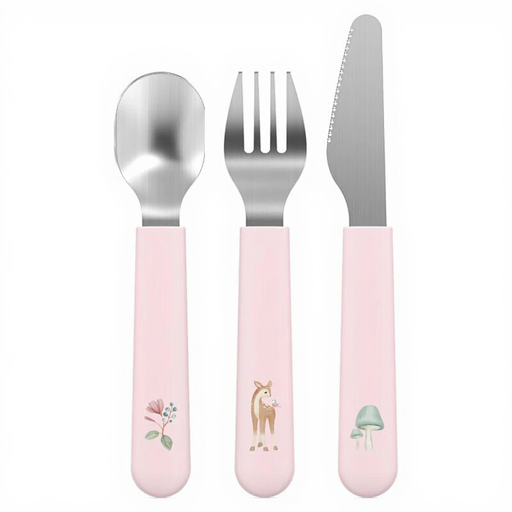
What Makes It Stand Out This three-piece children's cutlery set from Mepal is designed for toddlers taking the next step towards independence. Its standout feature is the knife with a serrated safety blade. It allows the child to practise cutting soft foods while minimising the risk of injury. The combination of rust-proof stainless steel and ergonomic plastic handles makes it a durable companion.
Advantages
Who It's For This set is ideal for children from 12 months who are already confident using a spoon and fork and now want to learn how to cut. It is well-suited for parents looking for a complete and durable set that resembles adult cutlery.

What Makes It Stand Out The set from Kikka boo is specially designed for the very youngest eaters. It is made from 100% food-grade platinum silicone, a particularly high-quality and pure material. This silicone baby cutlery is soft, flexible, and gentle on sensitive gums during the teething phase. The wide handles are easy for small baby hands to grasp, encouraging their first attempts at self-feeding.
Advantages
Who It's For This training cutlery is the perfect choice for babies from 6 months who are starting on solid foods. Parents who place the highest value on safety and an exceptionally soft material for their child's first eating experiences will find this an ideal solution.

What Makes It Stand Out The MiaMia set, with two forks and two spoons, offers a practical setup for daily use. It combines the durability of 18/10 stainless steel with lightweight, ergonomically shaped plastic handles. The fork tines and spoon edges are rounded to ensure safe use. The cheerful design can also help encourage enjoyment at mealtimes.
Advantages
Who It's For This set is suitable for toddlers from 12 months who are already eating independently. It is especially practical for families who need an extra children's fork and spoon set for home, nursery, or on the go.
The products presented here cover the most common use cases. However, if you haven't found the right fit or are specifically looking for a spoon set, you may find more alternatives in our wider selection. Explore different designs and materials to find the ideal solution for your child.
1. When should you start using children's cutlery? Special training cutlery, usually a soft silicone spoon, is useful from the start of weaning at around 6 months. It makes feeding easier for the baby and is gentle on their gums. A complete children's cutlery set made of stainless steel with a fork and spoon is generally recommended from 12 to 18 months, when the child begins to eat more independently.
2. What should I look for in the material of children's cutlery? The material should always be food-grade and free from harmful substances like BPA. Silicone baby cutlery is ideal for beginners, as it is soft and flexible. Stainless steel children's cutlery is a great choice for toddlers because it is robust, hygienic, and durable.
3. How do I clean children's cutlery correctly? Most modern children's cutlery sets are dishwasher-safe, which makes cleaning much easier. However, it is always advisable to follow the manufacturer's specific care instructions. Alternatively, you can wash the cutlery by hand with warm water and a mild dish soap. Avoid abrasive cleaners or metal scourers to prevent damaging the material.