
Lieferung heute & morgen

Qualitätsgarantie

Willkommens-Angebote freischalten: KOSTENLOSE Lieferung | Bis zu 80 % RABATT | Kostenlose 30-Tage-JoyPlus-Testphase
App herunterladen
The right children’s cutlery set makes those first meals easier and helps children practise using a spoon and fork. At the same time, baby cutlery and children’s cutlery differ considerably in terms of size, material and recommended age. Marketing terms such as “extra safe”, “ergonomic” or “suitable for all ages” are not enough to help you make the right choice.
Taking a closer look can help you avoid common buying mistakes: cutlery that is too large is difficult for small hands to hold, hard edges can make eating uncomfortable, and complicated cleaning quickly becomes impractical in busy family life. The following criteria will help you make an informed choice.
Children’s cutlery from 6 months is generally designed for first meals and weaning. A baby cutlery set of this kind often includes a small spoon, a short fork and soft, rounded tips. For children aged 3 and over, sets often include a knife as well as larger spoons and forks.
A 4-piece stainless steel children’s cutlery set may still be too heavy or too long for a toddler, while very soft silicone cutlery may not be suitable for an older child who is learning to cut food. The age recommendation should therefore be considered alongside the child’s motor development and the intended use.
BPA-free children’s cutlery is an important material specification, but on its own it says nothing about the handle size, quality of workmanship or correct use. What matters is whether the manufacturer clearly identifies the material and provides care instructions.
For silicone products, you should also check whether the product description states that the silicone is food-grade. For plastic handles, specifications such as PP or polypropylene are useful. If material or manufacturer information is missing, making a direct comparison is more difficult.
Dishwasher-safe children’s cutlery saves time, but harsh detergents, metal scouring pads and abrasive products can damage surfaces and decorative details. Silicone cutlery should be allowed to dry completely after washing, particularly if it is stored in a travel case.
Before every use, it is advisable to carry out a quick check for cracks, loose parts, deformation or damaged tips. Cutlery with visible damage should no longer be used.
For babies from around six months, short, lightweight cutlery with easy-to-grip handles is a sensible choice. A textured or slightly non-slip handle can make it easier to hold. With cutlery for independent eating, the shape should suit the child’s hand size without the handle being too thick or too long.
From around 12 to 18 months, children can often start practising with their own spoon and fork set. A knife is only suitable once the child can be taught how to use it under supervision. Children’s cutlery from 3 years usually includes a knife with a rounded or lightly serrated edge. It is still a cutting tool, however, and should initially only be used under supervision.
Typical materials include:
For silicone cutlery for babies, temperature specifications are useful if the cutlery is to be used with warm food, in a steriliser or in a microwave. The material’s temperature resistance does not replace checking the temperature of the food before feeding.
A removable or two-part design can make cleaning easier, provided it does not create hard-to-reach gaps. For products with a travel case, the spoon and fork must be clean and dry before being stored.
Anyone preparing several meals each day can benefit from a set with multiple pieces. When out and about, however, a compact baby spoon and fork set with a storage case may be more practical. It is important to follow the manufacturer’s care instructions and remove damaged products from use.

Why this product suits this profile: According to the product description, this two-piece set is intended for babies and toddlers from 6 months and is suitable for early attempts at independent eating.
Rounded, flexible tips and textured silicone handles address the common mistake of choosing cutlery that is too hard or too smooth.
Food-grade silicone and PP, BPA-free according to the product specifications; includes a travel case.
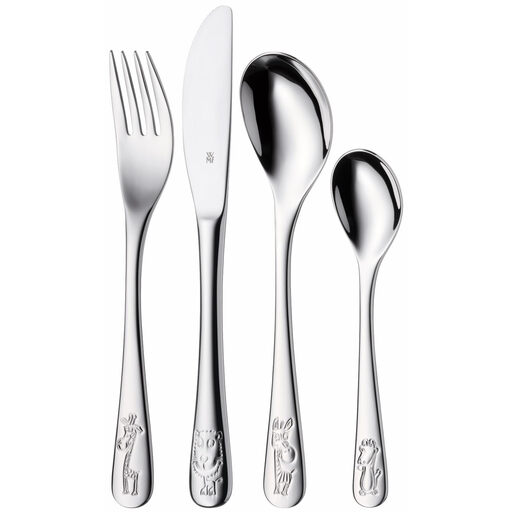
Why this product suits this profile: According to the product specifications, this four-piece set made from Cromargan 18/10 stainless steel is designed for children from 3 years and includes a knife, fork and two spoon sizes.
The age recommendation clearly distinguishes this set from baby cutlery; the short, blunt fork prongs and rounded spoon edges are specifically described.
18/10 stainless steel, polished surface and dishwasher suitability according to the product data.

Why this product suits this profile: A compact silicone baby cutlery set for the weaning stage, when frequent cleaning and flexible use are important.
The product specifications state a recommended age from 6 months, BPA-free platinum silicone and specific care options.
According to the product description, suitable for the dishwasher, microwave and steriliser; temperature range from -40 °C to 230 °C.

Why this product suits this profile: According to the product description, this set is intended for children from around 12 months and provides two spoons and two forks for everyday use.
Rounded spoons, blunt fork prongs and a small, lightweight design are more specific than general claims about ergonomics.
18/10 stainless steel with PP handles, dishwasher-safe according to the product specifications and described as compliant with EN 14372.
We have put together a complete, regularly updated list of products that fully meet these strict selection criteria and the safety regulations applicable in the EU.
According to the manufacturers’ specifications, many of the products mentioned here are intended for use from 6 months. The actual starting age depends on the child’s development and when weaning begins. An adult must always supervise mealtimes. Larger cutlery pieces with a knife are often recommended from 18 months or 3 years.
There is no fixed usage period. It depends on the material, how often the cutlery is cleaned and how it is handled. Silicone should no longer be used if it becomes damaged, develops a sticky surface or shows cracks. Stainless steel pieces should be discarded if they have bent edges, sharp areas or damaged handles. Checking the cutlery before every meal is advisable.
Silicone is soft and flexible for first meals and, depending on the product, can be used in the dishwasher, microwave or steriliser. Stainless steel retains its shape and is more suitable for children who are already becoming confident with a spoon, fork and, later, a knife. For many families, combining soft baby cutlery with stainless steel children’s cutlery for later use is a sensible choice.