
Lieferung heute & morgen

Qualitätsgarantie

Willkommens-Angebote freischalten: KOSTENLOSE Lieferung | Bis zu 80 % RABATT | Kostenlose 30-Tage-JoyPlus-Testphase
App herunterladen
A suitable children’s cutlery set can make the transition from finger food to a child’s first independent meals easier. However, baby cutlery and cutlery for toddlers differ considerably in terms of material, size, recommended age and care. A set suitable for a three-year-old may still be impractical for a six-month-old baby.
If you focus only on an appealing design or the number of pieces included, it is easy to overlook important details. The following criteria will help you choose safe, ergonomic and practical cutlery for babies and toddlers.
A children’s cutlery set with a knife, fork and several spoons may appear complete, but that does not automatically mean it is suitable for babies. Stainless steel cutlery with longer handles and small, hard prongs is often intended for children aged 3 and over. For introducing solid foods from 6 months, softer materials and compact shapes are generally more suitable.
You should therefore check the specific age recommendation provided by the manufacturer. A product intended for children aged 3 and over should not automatically be used as children’s cutlery from 6 months.
BPA-free baby cutlery is a relevant material specification, but on its own it says nothing about the handle size, cleaning requirements or suitability for warm food. You should also check what material the product is made from, whether its components are securely joined together and what care instructions apply.
For silicone cutlery, it should also be clearly stated whether the silicone is food-grade. For stainless steel, the precise alloy and care properties provide useful guidance.
A 4-piece children’s cutlery set with a knife, fork, tablespoon and teaspoon is versatile for older children’s everyday use. For a baby who is initially practising mainly with a spoon, two well-designed pieces may be sufficient. More cutlery also means more parts to clean and store.
Silicone children’s cutlery is soft and flexible, and many models are designed for first meals. Specifications such as BPA-free, dishwasher-safe or suitable for use in a steriliser make choosing easier. When it comes to heat resistance, the manufacturer’s specific instructions are what matter: a product may be suitable for warm food, but you must still check the food’s temperature before feeding your child.
Stainless steel children’s cutlery retains its shape and is suitable for older children’s everyday use. The ZWILLING and WMF models in this selection are made from 18/10 stainless steel or Cromargan 18/10 respectively. These specifications describe the material composition, but they do not replace checking the recommended age. According to the product descriptions, both of these sets are intended for children aged 3 and over.
A handle should not be too long or too heavy. Wider, shorter handles can make it easier for small hands to hold the cutlery. For a baby spoon and fork, rounded edges and softer tips are particularly important features.
A knife for toddlers should not have a sharp, serrated blade if it is intended for learning purposes. Rounded fork prongs can make getting started easier, but they do not replace adult supervision.
Buying dishwasher-safe children’s cutlery can reduce the daily effort involved. Nevertheless, check whether this specification applies to all components. Some storage boxes or handles may need to be washed by hand.
Depending on the manufacturer, silicone models may also be approved for use in a microwave or steriliser. Only use these functions within the specified temperature limits. After washing, the cutlery should be allowed to dry completely before being stored in a box or drawer.

Why this product suits this profile: This two-piece set is intended for babies from 6 months and focuses on those first meals with a spoon and fork.
The age recommendation from 6 months helps prevent a set intended for older children from being used too soon. According to the product description, the material is 100% food-grade platinum silicone and BPA-free.
Two pieces, soft silicone, dishwasher-, microwave- and steriliser-safe according to the manufacturer’s specifications.
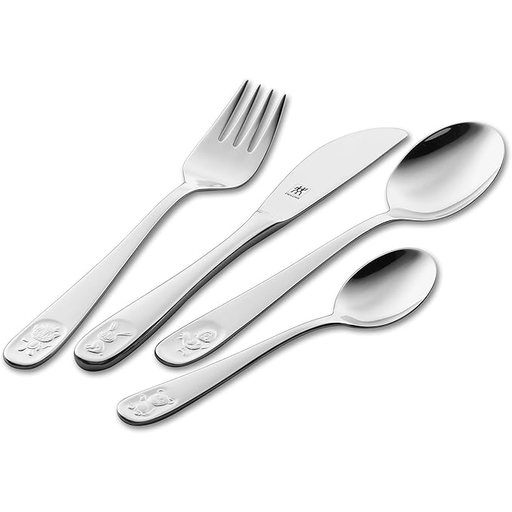
Why this product suits this profile: According to the product information, this set is intended for children aged 3 and over and includes a fork, knife, tablespoon and teaspoon.
The clear age recommendation distinguishes this set from baby cutlery. Rounded edges, rounded fork prongs and a blunt knife are listed as product features.
18/10 stainless steel, four pieces, dishwasher-safe according to the product description, with animal designs on the handles.

Why this product suits this profile: For families who want to use cutlery at home and on the go, the included travel case is practical.
The age recommendation from 6 months and the rounded, flexible tips are designed for first attempts at eating independently. The instructions require the product to be checked before every use.
Silicone and PP components, BPA-free according to the product information, textured handle profile and storage box.
We have put together a complete, regularly updated list of products that fully meet these strict selection criteria and the safety regulations applicable in the EU.
Regardless of the material, a few basic rules apply:
A two-piece silicone set may be suitable for introducing solid foods, while a four-piece stainless steel set may be more appropriate as a christening or birth gift, or for older toddlers. The key considerations are not just design and price, but the combination of age recommendation, material, shape and care instructions.
A set is only suitable from 6 months if the manufacturer explicitly states this age recommendation. For first meals, short handles, soft materials and rounded eating surfaces are important selection criteria. Use must always be supervised.
Both materials serve different purposes. Silicone is soft and flexible and is often used when introducing solid foods. Stainless steel retains its shape and is durable for older children’s everyday use. The specific age recommendation and product information are more important than the material alone.
There is no fixed period of use. The child’s age and development, as well as the cutlery’s condition and size, are what matter. Silicone cutlery should be replaced as soon as it develops cracks or a handle comes loose. With stainless steel cutlery, check whether the size and shape are still suitable for your child to handle.