
Lieferung heute & morgen

Qualitätsgarantie

Willkommens-Angebote freischalten: KOSTENLOSE Lieferung | Bis zu 80 % RABATT | Kostenlose 30-Tage-JoyPlus-Testphase
App herunterladen
A children’s electric motorcycle can be used in the garden, on private grounds or for supervised off-road rides. At first glance, choosing one seems straightforward: a battery, motor, tyres and appealing design may appear to be all that is needed. In practice, however, unclear age recommendations, exaggerated performance claims and missing information about intended use often lead to unsuitable purchases.
This guide from the Joybuy Product Recommendation Officer helps you assess technical specifications objectively and choose a suitable electric motorcycle for children based on age, height and intended use.
A 12V children’s motorcycle is not automatically suitable for every child simply because it uses a lower voltage. Other important factors include the vehicle’s weight, seat height, drive system, speed and surroundings. A three-wheeled 12V model may be easier for younger children to control than a fast two-wheeled vehicle.
A 36V children’s motorcycle, on the other hand, will often deliver considerably more power. This can be useful for off-road riding, but requires a suitable height, confident riding skills and a controlled environment. Voltage alone says nothing about actual safety.
Figures such as 30 or 35 km/h usually refer to the highest riding mode and specific conditions. For beginners, several speed settings, a reduced-speed start mode and, where available, a parental lock function are more important.
Before buying, check the following:
Range depends on factors including the rider’s weight, surface, gradient, temperature and riding style. A manufacturer’s stated range should therefore be treated as a guide only. With a battery-powered children’s vehicle, you should also check whether the battery is removable and which charger is used.
A spare battery or quick-change system can be more practical for regular use. A dry, suitable charging location and compliance with the operating instructions remain essential. The battery and charger should never be left unattended while charging or charged near easily flammable materials.
The recommended age is only a starting point. What matters is whether the child can sit securely, hold the handlebars with both hands and understand how to operate the vehicle. With a children’s motorcycle with stabilisers or three wheels, stability is the main consideration. Two-wheeled models require greater balance and are better suited to children who can control the vehicle confidently.
Pay attention to:
The motor’s power should match the intended use. A small 12V electric motorcycle for children with a low top speed is primarily designed for flat surfaces. A children’s electric dirt bike with a 36V system, suspension and knobbly tyres is designed for selected off-road routes, but requires more space and particularly careful supervision.
Technical details such as wattage, torque and battery voltage should always be considered together. High power is not proof of quality; it mainly changes the riding behaviour, weight and demands placed on the surroundings.
For an electric off-road motorcycle, treaded tyres and suspension are important because they can help absorb uneven ground. Hydraulic disc brakes or disc brakes on the front and rear wheels are objective equipment features, but they cannot replace safe riding practices.
Children should wear a suitable helmet, sturdy footwear, long clothing, knee pads and elbow pads when riding. Public roads and pavements are not intended for many motorised children’s vehicles. The vehicle should only be used on suitable, clearly visible and controlled surfaces. Always observe the applicable local requirements.

Why this product suits the profile: According to the product information, this three-wheeled model is designed for children aged 3 and over. Its relatively simple design makes it suitable for first riding experiences on level ground.
Three wheels reduce the balance requirements. Nevertheless, the age recommendation, safety seat and vehicle equipment should still be checked against the child’s height and abilities before buying.
According to the product description, it features LED headlights, music, a USB port, storage space and a rechargeable battery.
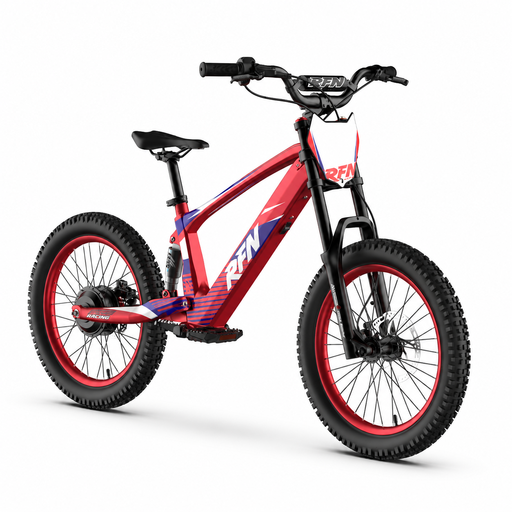
Why this product suits the profile: The specified 20-inch wheels, three riding modes and hydraulic brakes will appeal to users looking for a more technically advanced children’s motocross motorcycle for supervised off-road riding.
The riding modes of 15, 25 and 35 km/h make the power progression clear. Because of its potential top speed, this model is not suitable for unsupervised use or small children.
The specifications state that it has a 36V750W drive system, 270Wh battery, range of up to 39 km, front suspension and hydraulic brakes.
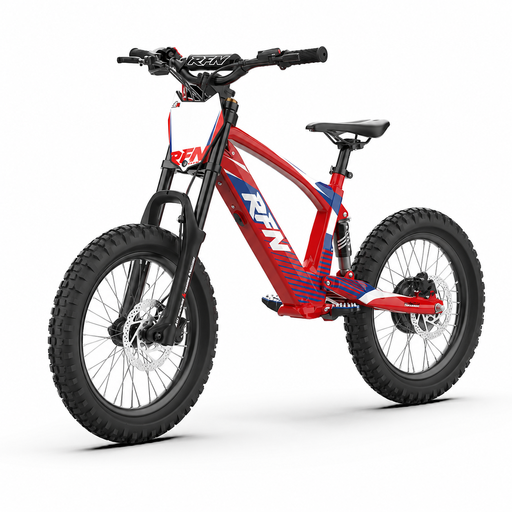
Why this product suits the profile: The 18-inch model is aimed at families looking for a more compact electric off-road motorcycle with several speed settings and a long-lasting battery.
The three modes of 15, 22 and 30 km/h allow the vehicle to be introduced gradually. The stated range of 15 km is more realistic to plan around than general running-time claims without a specified distance.
According to the product data, the model has a 36V500W motor, 18-inch tyres, hydraulic brakes, an LED display and a 5-Ah battery.
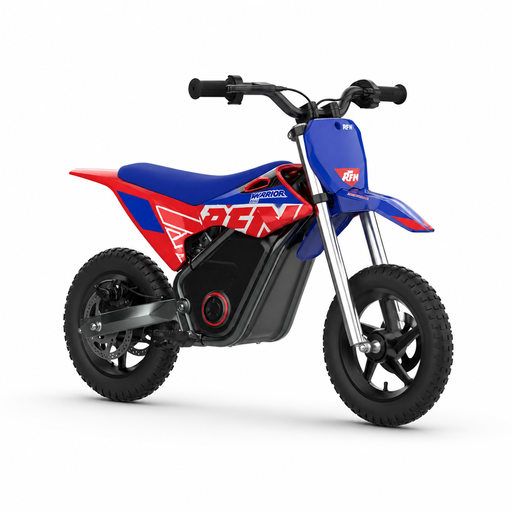
Why this product suits the profile: Its stated seat height of 490 mm and 14-inch design suit families looking for an off-road children’s motorcycle for older children, with a good range.
The specification lists three speed settings and an emergency stop switch. As the product description contains differing motor specifications, check the current product detail page before buying.
The listed specifications include 36V, 350W, a range of 18 km, front and rear brakes, and front and rear suspension.
We have put together a complete, regularly updated list of products that fully meet these strict selection criteria and the safety regulations applicable in the EU.
That depends on the particular model and the child’s height. According to the product information, some three-wheeled vehicles are designed for children aged 3 and over. More powerful children’s motocross motorcycles are generally aimed at taller, more experienced riders. Adult supervision is essential regardless of the stated age recommendation.
There is no single answer for battery lifespan. Charging cycles, storage, temperature and usage all affect the battery. After each ride, charge the battery according to the instructions. If the vehicle will not be used for an extended period, store the battery in a dry place and do not leave it completely discharged.
Running electricity costs generally depend on the battery capacity and local electricity price. A 36V battery with 5 Ah has a nominal capacity of approximately 180 Wh. Charging losses must also be taken into account. Maintenance costs for tyres, brakes and any replacement batteries should be included in the overall cost.