
Lieferung heute & morgen

Qualitätsgarantie

Willkommens-Angebote freischalten: KOSTENLOSE Lieferung | Bis zu 80 % RABATT | Kostenlose 30-Tage-JoyPlus-Testphase
App herunterladen
A children’s electric vehicle can provide varied outdoor activity in the garden or on a suitable private driveway. The choice ranges from electric ride-on cars and tractors for children to children’s quad bikes and electric motorbikes. However, product images and bold marketing claims do not always show whether a model is genuinely suitable for everyday use.
Three common purchasing pitfalls occur particularly often:
For younger children, low speed settings and controlled acceleration are practical features. The stated speed of the 12V tractor described here is 3 to 8 km/h. The children’s vehicle with remote control can therefore initially be operated by an adult before the child starts using the accelerator independently.
You should also check the type of drive system. A model with two motors may behave differently on level asphalt than on grass or sand. Large, hard-wearing wheels are useful on changing outdoor surfaces, but they do not replace a level route free from obstacles. A children’s quad bike or more powerful electric children’s motorbike should only be used where there is plenty of space and reliable supervision.
For a battery-powered children’s vehicle, battery voltage, capacity and charging time are among the key specifications. According to the product data, the 12V tractor uses a 12V-7Ah battery and requires around 8 to 12 hours of charging time. This is important when planning: after a ride, you should not assume the vehicle will be ready for immediate use again if the battery has not been fully recharged.
Check the following before placing your order:
Longer running time cannot be inferred from the voltage alone. The load, inclines, temperature and driving style also affect energy consumption.
A children’s vehicle with a safety belt should have a suitably adjustable seat and easy-to-understand controls. The 12V tractor is specified as having a 2-point safety belt. According to the product description, the two-seater dump truck features an adjustable safety belt, lockable doors, soft start and a 2.4 GHz remote control with an emergency braking function.
You should also check the maximum load. The red two-seater is specified for 50 kg and recommended for children aged 3 to 8 years. However, the maximum load does not automatically mean that two children of any height can use it. The seats, legroom and centre of gravity must be suitable in the individual case.
For product safety, a clear age recommendation, warnings, assembly instructions and conformity information are all relevant. Any CE marking should not be assessed in isolation. Where available, also look for the EU Declaration of Conformity and information on applicable toy safety requirements. During use, supervision, closed-toe shoes and, depending on the type of vehicle, a suitable helmet should form part of your everyday safety routine. Public roads and cycle paths are generally not the intended place for these toy vehicles.
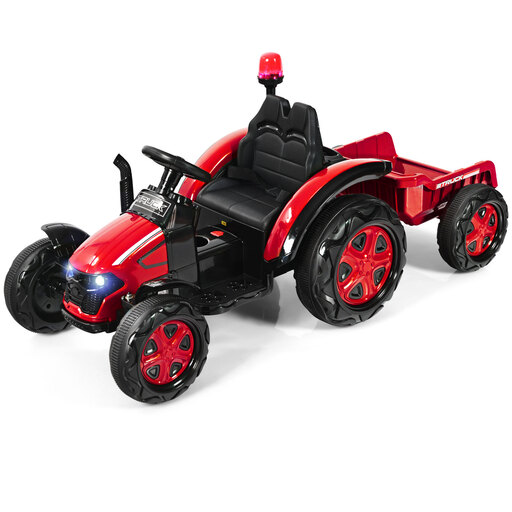
Why this product suits the profile: The tractor is recommended for children aged 3 and over, travels at 3 to 8 km/h and is suitable for families looking for a straightforward vehicle for the garden, asphalt or suitable sandy surfaces.
The specifications state the speed, battery, dimensions, maximum load and charging time. This makes it easier to compare the model with the available space and your everyday requirements.
2-point belt, 2.4 GHz remote control, forward and reverse gears, plus a detachable trailer.
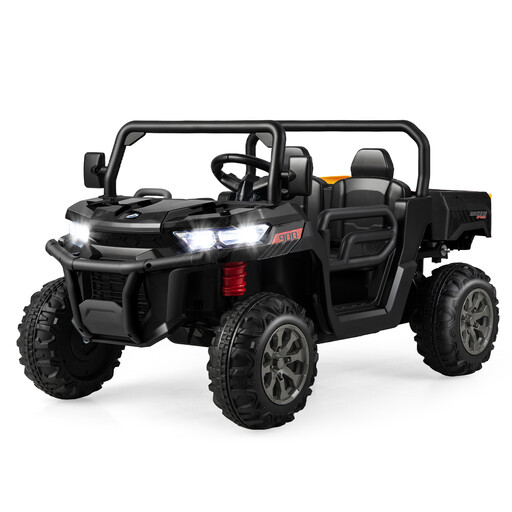
Why this product suits the profile: The two-seater dump truck is aimed at families who value a restraint system, soft start, remote control and additional features for longer-term outdoor use.
The product data states a maximum load of 50 kg, a speed of 3 to 8 km/h, a 12V-7Ah battery and a charging time of 8 to 12 hours. This provides a more practical basis for making a purchase decision than design features alone.
Two seats, wheel suspension, lockable doors, safety belt and remote control with three speed settings.
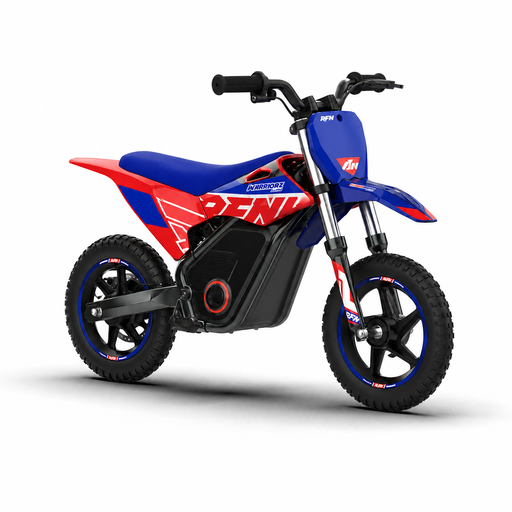
Why this product suits the profile: This electric children’s motorbike is aimed at older or more experienced young riders within the stated height and age ranges. It requires plenty of space, clear rules and constant supervision.
Three speed settings, an emergency stop switch, disc brake and suspension are all listed clearly. However, the top speed of 25 km/h requires a much stricter approach to choosing the riding surface and protective equipment.
36V-5.2Ah lithium battery, 250W motor, stated range of 18 km, plus front and rear suspension.
We have put together a complete, regularly updated list of products that fully meet these strict selection criteria and the safety regulations applicable in the EU.
Before the first ride, the vehicle should be fully assembled and the safety belt adjusted correctly. First test the forward and reverse gears, brake pedal, remote control and emergency stop function without a child on board. The riding area should be free from stairs, ponds, traffic and sharp-edged obstacles.
For a longer service life, we recommend:
The cost of each charge depends on the battery capacity, charging losses and the applicable electricity tariff. With a 12V-7Ah battery, the calculated battery capacity is approximately 84 Wh; actual consumption during charging may be higher. Wear to the battery, tyres and charger is usually more significant for the total cost than the individual charging process.
For an electric vehicle for children aged 3 and over, low speed, a suitable seat height, stable wheels and a parental remote control are important selection criteria. The age recommendation should always be considered alongside the child’s height, weight and ability to operate the vehicle.
There is no single answer for running time. It depends on the battery capacity, load, speed, surface and temperature. Range figures should therefore be understood as manufacturer values under specific conditions, rather than a guaranteed everyday experience.
A remote control enables adults to manage the vehicle’s speed and direction or bring it to a stop. It does not replace supervision or a suitable riding area. Before buying, you should check the range, emergency braking function, remote-control battery type and operating instructions.