
Lieferung heute & morgen

Qualitätsgarantie

Willkommens-Angebote freischalten: KOSTENLOSE Lieferung | Bis zu 80 % RABATT | Kostenlose 30-Tage-JoyPlus-Testphase
App herunterladen
Children’s games and family games should bring people together, have easy-to-understand rules and suit the relevant age group. However, the theme on the box is not the only deciding factor when choosing a game. The recommended age, playing time, materials, number of players and level of difficulty all determine whether a game will actually be used regularly in everyday family life.
Online shoppers in particular can easily make some typical mistakes:
The recommended age is an important guide, but it does not replace an assessment of a child’s individual abilities. For learning games from age 3, the rules should be short, the components easy to handle and the turns quick to understand. If a game contains small parts, the warning about choking hazard must be observed. Products containing such parts are generally not suitable for children under 3.
For children between 5 and 7, adult support may be helpful with more complex children’s board games. Also check whether a game requires an app or whether the app is merely optional. Instructions in English and clear set-up guidance make it easier to get started.
The indication “1 to 4 players” gives families flexibility, as the game can be played alone or with two people. Nevertheless, check whether the playing experience changes with different group sizes.
For younger children, 5 to 10 minutes is often enough. Older children are more likely to enjoy family games for ages 8 and up with longer rounds. When buying a present, therefore, check whether the playing time suits the planned occasion:
Co-operative games have a shared objective. As a result, there is usually no single winner who leaves younger players far behind. For beginners, colour and shape recognition, matching activities or simple team decisions may be more suitable than extensive strategy games.
When assessing materials, sturdy cardboard, neatly finished wooden pieces and easy-to-read cards are practical selection criteria. For plush products, the material, care instructions and dimensions should be clearly stated. The Schmidt Spiele Worry Eater model Pia, for example, is described as featuring plush material, a zip and hand-wash instructions. Its role as a prompt for conversation may be interesting for families, but this should not be taken to imply any therapeutic effect.
Escape games require particular attention: with classic KOSMOS EXIT games, materials are sometimes folded, written on or cut up. Such editions are often intended to be played only once. For buyers who want to give a game as a present more than once or use it repeatedly with different groups, classic board and dice games are often the more suitable choice.
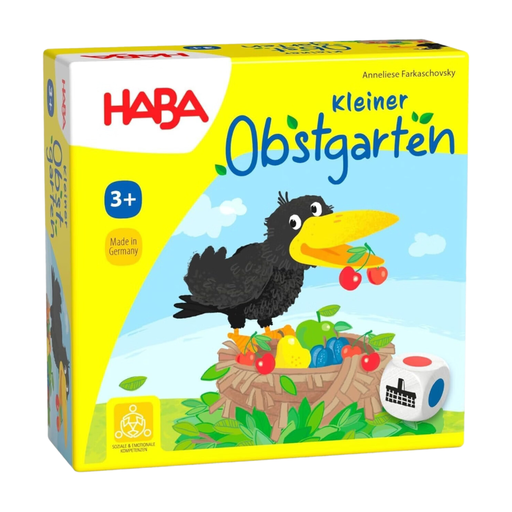
Why this product suits the profile: The game is designed for 1 to 4 children aged 3 and over and uses simple colour and shape recognition activities. Its short playing time of around 5 to 10 minutes is ideal for children’s first games played together.
The age range, number of players and approximate round length are clearly stated. The warning about small parts makes the suitability for children under 3 transparent.
Co-operative dice game, wooden and cardboard components, and no batteries required.
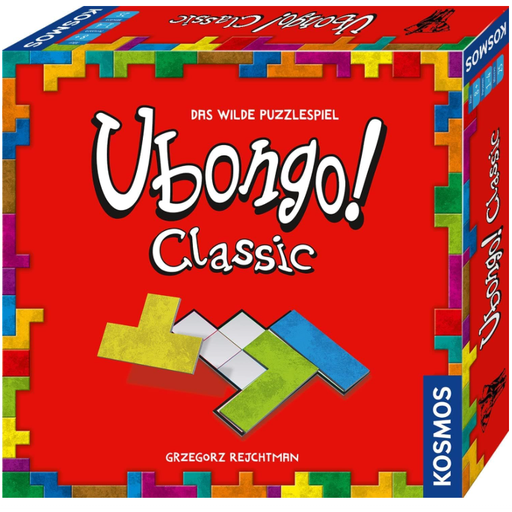
Why this product suits the profile: Ubongo Classic offers 648 challenges, two difficulty levels and games for 1 to 4 players aged 8 and over. This allows children and adults to play at different levels.
The two difficulty levels reduce the risk of a game being permanently too easy or too challenging for everyone playing.
Simultaneous puzzling, 1–4 players and an optional KOSMOS explanation app.
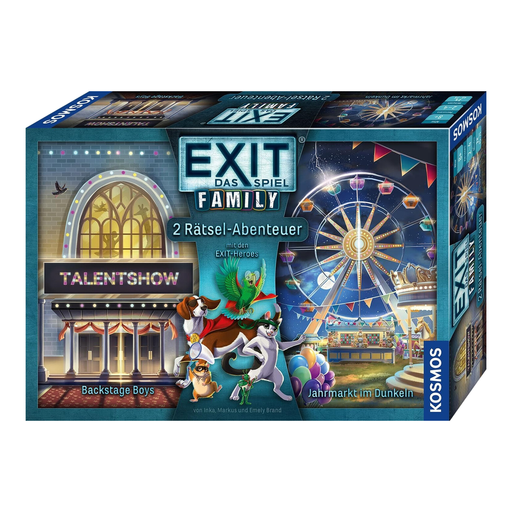
Why this product suits the profile: This box contains two puzzle adventures for 2 to 4 players aged 8 and over. The challenges are designed for solving puzzles together as a family.
The age limit, number of players and optional app use are clearly stated. Buyers should bear in mind that escape-room materials may be altered depending on the challenge.
Two adventures, co-operative gameplay and an app tutorial without requiring app use.
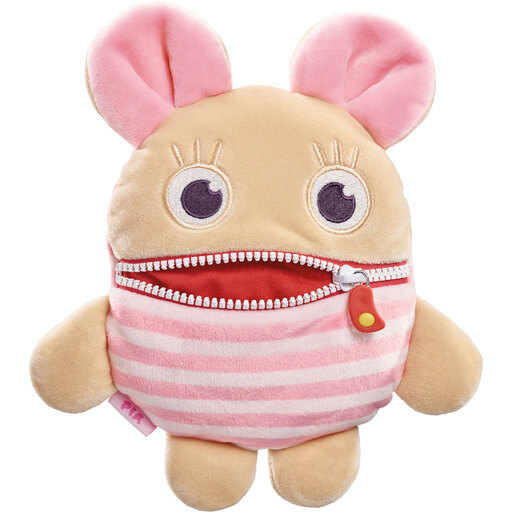
Why this product suits the profile: Pia is not a classic board game, but a soft toy with a zipped mouth. Notes containing worries, secrets or wishes can be symbolically stored inside it.
The product description states dimensions of 23,5 × 21 × 5,5 cm, hand-wash instructions and a recommendation for supervision. This makes it easier to assess care requirements and intended use before buying.
Plush material, a zip and no assembly or batteries required.
We have put together a complete, regularly updated list of products that fully meet these strict selection criteria and the safety regulations applicable in the EU.
For children’s gift ideas from age 3, short dice and matching games are a good choice. With older children, puzzle and detective themes can provide more variety. A game such as “The School of Magical Animals Investigates” is designed for 2 to 4 children aged 6 and over, with a playing time of around 20 minutes.
Fans of fantasy themes may enjoy a Harry Potter board game or a KOSMOS EXIT game with a magical storyline. When buying expansions, however, always check whether a base game is required. The “Monster Box of Monsters” expansion for Harry Potter – Battle for Hogwarts, for example, can only be used together with the base game.
Games with short rules, few steps and clearly recognisable colours or shapes are suitable. HABA Small Orchard is stated as suitable for 1 to 4 children aged 3 and over. Because it contains small parts, the safety warning should be observed.
Lifespan depends on the materials, storage and how the game is used. Sturdy cardboard or wooden pieces generally last longer than thin paper components when stored in a dry place and handled carefully. With EXIT games, buyers should bear in mind that altered materials may restrict repeat play.
Flexible options include games specifically designed for 1 to 4 people. These include HABA Small Orchard, KOSMOS Ubongo Classic and several EXIT editions. Before buying, check whether the rules work just as well in a solo game as they do with a group.