
Lieferung heute & morgen

Qualitätsgarantie

Willkommens-Angebote freischalten: KOSTENLOSE Lieferung | Bis zu 80 % RABATT | Kostenlose 30-Tage-JoyPlus-Testphase
App herunterladen
Children’s games should be entertaining, easy to understand and suited to your family’s everyday life. So when choosing one, don’t just look at colourful illustrations or familiar brands. The key things to consider are the recommended age, number of players, materials, storage and whether the game really suits the situation you have in mind.
“Age 4+” doesn’t automatically mean every child of that age will understand the game without help. Some board games for children involve reading cards, counting to higher numbers or concentrating for longer periods. If you’re buying for a younger child, check whether the rules can be simplified and whether they can handle any small parts safely.
Labels such as “educational” or “supports development” aren’t enough on their own to help you choose. More useful details include the number of pieces, game modes, number of players, materials, playing time and a description of how to play. For educational games for children, it should also be clear whether the child plays alone, with an adult or in a group.
With travel games for children, size and storage are particularly important. Loose figures, cards or counters are more likely to get lost in the car, on a train or on a plane. A practical folding box, bag or built-in compartment can make the difference between a game you use regularly and one that stays in the cupboard.
Compare the manufacturer’s recommendation with how you plan to use the game:
Look for the CE marking, the age recommendation and any warnings on the packaging and product page. The CE marking is a manufacturer’s declaration that the product complies with relevant EU requirements; it doesn’t replace checks by parents.
Things to pay particular attention to include:
Board games for children can involve understanding rules, taking turns, concentrating or thinking spatially. However, this isn’t a medical or therapeutic promise. The actual benefits depend on the child’s age, how the game is played and the support they receive. When choosing puzzles for children, the number of pieces, picture, piece size and a suitable surface matter more than general marketing claims.
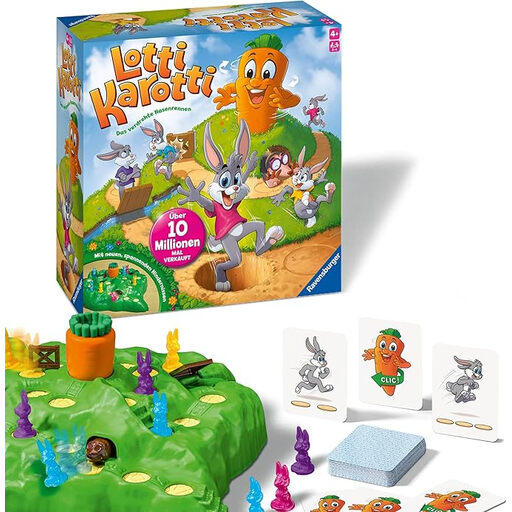
Why it suits this profile: According to the product details, this board game is for children aged 4+ and 2 to 4 players. At around 20 minutes, each game is short enough to make it easy to get started with family play.
The game is explained using cards and a few basic rules. The age recommendation, number of players and product dimensions are clearly stated.
For 2 to 4 players; no batteries required; materials: cardboard and plastic.
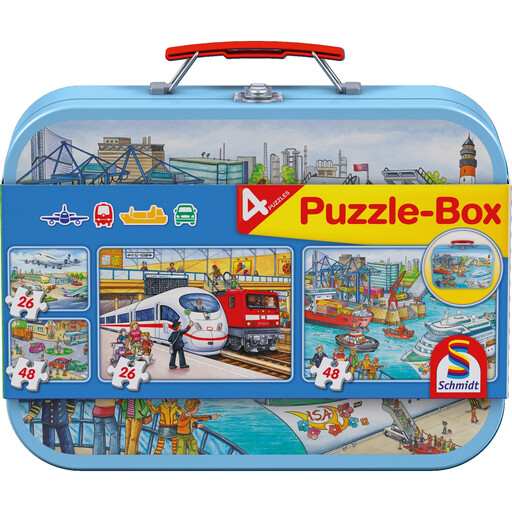
Why it suits this profile: The puzzle box contains four vehicle pictures, with two 26-piece puzzles and two 48-piece puzzles. A metal case and a poster showing the outlines help keep everything organised, while the puzzles are suitable from age 4.
The different piece counts let you choose a puzzle to match your child’s ability. The case also reduces the risk of pieces from different pictures getting mixed up.
Four puzzles; metal storage case; matt finish according to the product description; no batteries required.
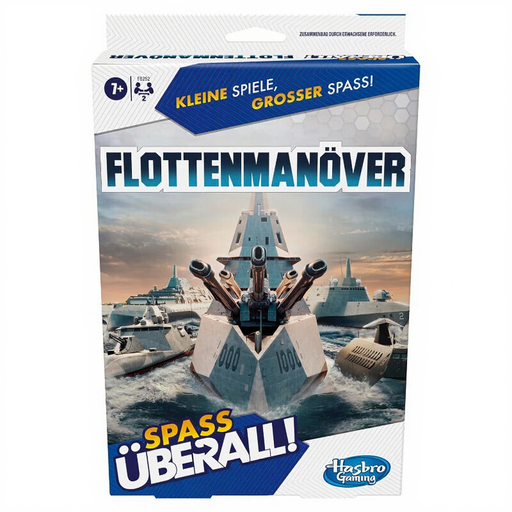
Why it suits this profile: This compact version for two players is ideal for the car, train, plane or campsite. The game unit folds up and doubles as a storage case.
The components can be packed away in the folding game units after each round. The set is designed for easy transport and quick games.
For 2 players; dimensions listed as 4.76 × 15.87 × 25.4 cm; no batteries required; recommended for ages 7+.

Why it suits this profile: This junior version is designed for 2 to 4 players aged 6+. Collecting, trading and building offer children and families an accessible introduction to strategy games.
The junior version features simplified trading rules. An adult can help with the initial set-up and explain the rules.
For 2 to 4 players; no batteries required; materials: cardboard and plastic; recommended for ages 6+.
We’ve put together a complete, regularly updated list of products that meet these strict selection criteria and the applicable EU safety requirements.
Depending on your family’s routine, other children’s games may also be a good choice:
For games for ages 4+, short rounds, a few simple rules and a manageable number of pieces are a good choice. Simple race games, puzzles with 24 to 48 pieces or games with clear matching tasks may be suitable. As well as the age recommendation, take your child’s individual abilities into account.
Their lifespan depends on the materials, how they’re stored and how often they’re played with. Keep cardboard dry, check plastic parts regularly for cracks and make sure all small pieces are put away after use. A case or box can help prevent pieces from getting lost.
Compact sets with built-in storage, few loose parts and quick set-up are handy for travelling. Before you buy, check the external dimensions, weight, number of players and whether you’ll need a flat surface to play on.