
Lieferung heute & morgen

Qualitätsgarantie

Willkommens-Angebote freischalten: KOSTENLOSE Lieferung | Bis zu 80 % RABATT | Kostenlose 30-Tage-JoyPlus-Testphase
App herunterladen
Children’s games should be entertaining, encourage playing together and match the child’s stage of development. In practice, however, choosing the right game is not always easy: a high number of pieces does not automatically mean greater play value, a label such as “educational” is not a protected quality guarantee, and an inexpensive game can quickly become impractical if it has no suitable storage solution.
This buying guide helps parents, grandparents and families choose board games for children, educational toys and family games using clear, understandable criteria.
The age recommendation on the packaging is an important starting point, but it does not replace checking the rules and components. A game for ages 3 and up may generally be intended for this age group, but it may still require direct adult supervision. Small parts also pose a choking hazard.
You should therefore check:
Terms such as educational games, Montessori toys or educational toys do not automatically describe a particular level of quality. More meaningful are specific functions, such as sorting colours, matching numbers, gripping, stacking, logical combination or following simple rules.
It is therefore better to assess objectively what the child actually does, rather than relying solely on marketing claims.
A game with many individual pieces can quickly become incomplete without organised storage. For travelling, compact boxes, integrated compartments or storage bags are practical. In children’s rooms with limited storage space, flat puzzle boxes or magnetic travel games may be more suitable than large game boards.
For games for ages 3 and up, short sequences, simple matching activities and easy-to-grip components are generally suitable. With games for ages 4 and up, children can start playing simple rule-based games, puzzles and dexterity games. Games for ages 6 and up can include several steps and simple strategies. With games for ages 8 and up, longer rounds, planning and tactical decisions are more common.
In addition to the age recommendation, check:
With wooden toys, check the surface, edges and how securely the components are joined. For plastic games, smooth edges and securely enclosed magnets are important features. Strong magnets must not be placed in the mouth or swallowed.
The CE marking indicates that the manufacturer has declared compliance with the applicable EU requirements and assumes responsibility for the corresponding conformity. However, it is not an independent quality seal and, on its own, says nothing about durability or play value. Always compare the warnings on the packaging and product page with the child’s age.
A game is particularly suitable when its objective fits in with the family’s everyday routine. A short board game is ideal for an evening, a single-player puzzle for quiet activities, and a compact travel game for train journeys or holidays. Cleaning requirements are also relevant: cardboard and paper should be stored in a dry place and generally cleaned only with a dry cloth.
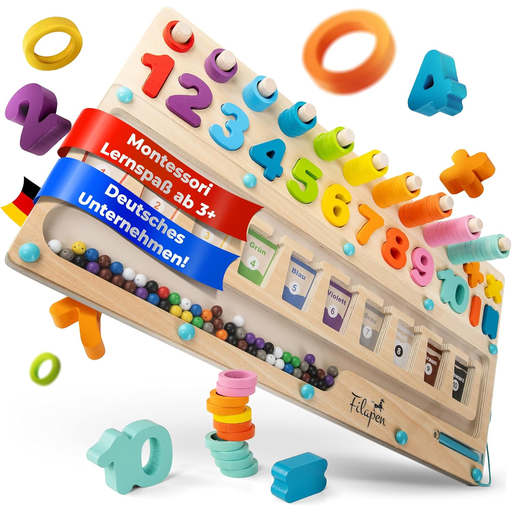
Why this product suits this profile: This wooden board combines a magnetic maze, colour sorting and numbers from 1 to 10. It is intended for children aged 3 and over and does not require batteries.
The product description names specific play activities rather than making broad educational claims. It clearly points out the small parts and the need for supervision.
Solid wood, no batteries, dimensions of 23 × 43,5 × 4 cm and possible use up to around the age of 6, according to the product description.
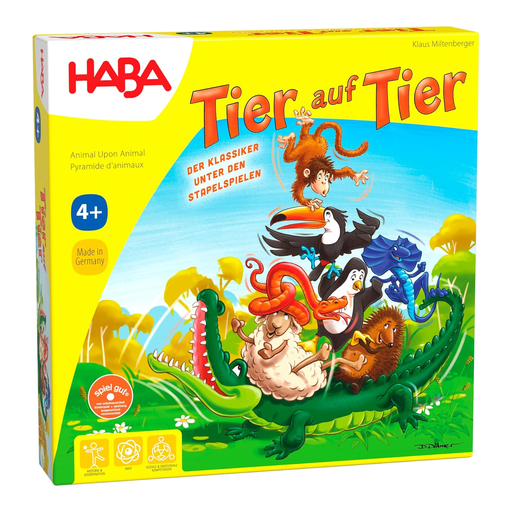
Why this product suits this profile: This stacking game consists of wooden figures and is intended for 2 to 4 players aged 4 and over. According to the product information, it can also be played alone.
The game principle is clear: players stack the animals on top of one another. This makes it easy to assess the actual gameplay before buying.
Wooden components, 2 to 4 players, no batteries and stated dimensions of 22,2 × 22,3 × 4,9 cm.
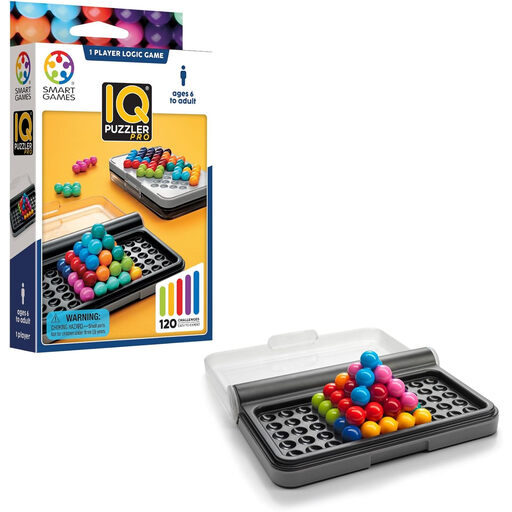
Why this product suits this profile: This single-player game is designed for children aged 6 and over. Its compact format makes it suitable for use both at home and on the go.
The product details specify the number of players, materials, dimensions and 120 challenges in three game modes. This makes the scope clear before buying.
120 challenges, 2D and 3D tasks, 1 player, a compact plastic case and no batteries.
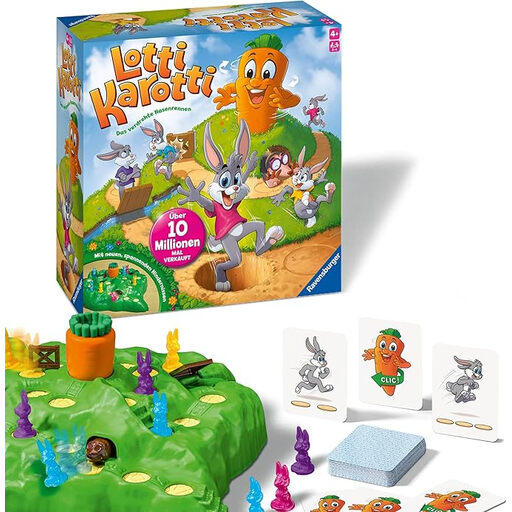
Why this product suits this profile: This board game for children aged 4 and over is designed for 2 to 4 players and, according to the description, takes around 20 minutes to play.
The short, clearly described sequence of play makes it easier to assess whether younger children can manage the rules and pace of the game.
For 2 to 4 players, approximately 20 minutes of playing time, no batteries and gameplay featuring cards, playing pieces and obstacles.
Depending on your everyday situation, the following categories may also be of interest:
We have put together a complete, regularly updated list of products that fully meet these strict selection criteria and the safety regulations applicable in the EU.
Short games with simple rules, easy-to-grip pieces and a manageable number of players are generally suitable. Puzzles with a small number of pieces, stacking games and simple dice or racing games may be good options. The manufacturer’s specific age recommendation and warnings should remain the deciding factors.
Their lifespan depends on the materials, storage and how they are handled. Cardboard game boards should be stored in a dry place, while plastic and wooden components should be checked regularly for damage. A box or bag for individual pieces reduces the risk of accessories getting lost.
Games without batteries do not depend on a power supply, do not incur ongoing battery costs and are often well suited to travelling. Electronic games, on the other hand, may offer light or sound functions. The key consideration is whether these features suit the purpose of the game and the family’s preferred way of using it.