
Lieferung heute & morgen

Qualitätsgarantie

Willkommens-Angebote freischalten: KOSTENLOSE Lieferung | Bis zu 80 % RABATT | Kostenlose 30-Tage-JoyPlus-Testphase
App herunterladen
Children’s games should suit your family, your children’s ages and how you plan to use them. Even so, choosing the right game often leads to disappointing purchases. A game may look versatile on the packaging but be hardly suitable for two children. Or the stated age range may appear appropriate, while the rules are too demanding for younger players.
That is why it is worth checking specific product details before buying, rather than relying on general marketing claims.
“From 4 years” does not automatically mean that every child of that age will understand the game without help. Key considerations include:
Games for children aged 4 and over generally feature simple sequences, colour matching, short rounds or fine-motor activities. Games for children aged 6 and over may already introduce planning and simple strategy. Games for children aged 8 and over often include several rules, note-taking or logical deductions.
A two-player game is not automatically a family game. If you regularly play with siblings, parents or grandparents, check the actual player count. For family sessions, games for 2 to 6 players are flexible, while a game designed solely for two players is mainly suitable for siblings or a parent-and-child match.
The game’s dynamics also matter. With four or more players, long waiting times can arise if every turn involves extensive decision-making.
A travel game should not simply be small. It is important to check whether all components can be stored securely and whether the game can be set up on a limited surface while you are travelling. For travel games for children, integrated storage, a sturdy game board and few loose small parts are practical selection criteria.
The manufacturer’s age recommendation is the first filter, but it does not replace looking at the game mechanics. Children’s dice games with colour or picture symbols are often easier for pre-school children to access than games with lots of text. Children’s educational games should also match the intended learning objective precisely: colour recognition, counting, matching, concentration and language comprehension all involve different requirements.
When buying children’s board games and children’s party games, you should pay attention to the information about materials and safety. A CE mark indicates that the product meets the relevant EU requirements for the product in question. The warnings are also important:
The age rating and warnings on the product packaging take priority over general descriptions online.
For regular family game sessions, the set should fit the table space you have available. A large game board can be comfortable to use at home but impractical when travelling. For train journeys, holidays or waiting times, compact versions with integrated storage are a sensible choice. However, if you are looking for children’s strategy games for longer game nights, you can give greater weight to the rules, number of components and playing time.
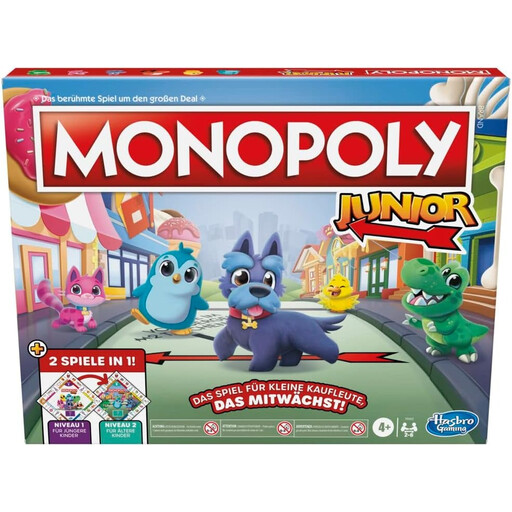
Why this product suits the profile: The double-sided game board offers an easier level for 4- to 5-year-olds and a further level for children aged 6 and over. This means the complexity of the rules can be adapted to the players’ ages.
The two rule levels reduce the risk of buying a game that is either too easy or too demanding. The game is suitable for 2 to 6 players.
Double-sided game board, six playing pieces, play money and age-specific card levels.
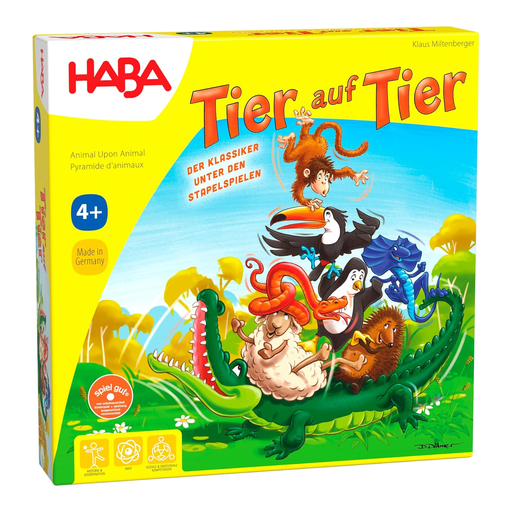
Why this product suits the profile: The wooden figures and straightforward gameplay are ideal for families looking for a hands-on dexterity game without batteries or extensive preparation.
The wooden material and age recommendation of 4 years and over are clearly stated. Small parts nevertheless remain a safety consideration.
Wooden figures, suitable for 2 to 4 players and also playable as a solo game.

Why this product suits the profile: This compact version is designed for children aged 8 and over and groups of 3 to 6 players. It is intended for travel, family holidays and longer journeys.
The product details specify a compact storage box and list the included components. This makes it easy to put loose parts back together after the game.
Travel box with game board, cards, figures, dice and notepad; no batteries required.
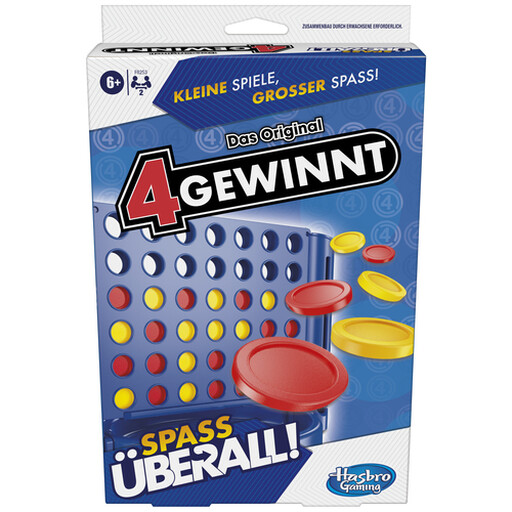
Why this product suits the profile: Two children, or a parent and child, can play directly against each other. The compact design is made for short games at home or on the go.
The game is clearly limited to two players. The foldable grid with integrated storage saves space and reduces the risk of losing counters.
42 playing counters, foldable grid, age recommendation of 6 years and over, and no batteries.
We have put together a complete, regularly updated list of products that fully meet these strict selection criteria and the safety regulations applicable in the EU.
Games for children aged 4 and over should use short rules and clearly recognisable symbols or figures. Colour dice, simple movement mechanics and dexterity tasks can make it easier to get started. Small parts require particular care, so always follow the manufacturer’s warnings.
For families with several children, games for 2 to 6 players offer flexibility. If there are only two players, a game specifically designed for two may be the better choice. Also check whether the pace of the game changes with the maximum number of players and whether waiting times arise.
Cards, cardboard pieces and game boards should be stored somewhere dry and clean, preferably in the original packaging. For travel games, a box with separate compartments is recommended. Before each use, check small parts for damage.