
Lieferung heute & morgen

Qualitätsgarantie

Willkommens-Angebote freischalten: KOSTENLOSE Lieferung | Bis zu 80 % RABATT | Kostenlose 30-Tage-JoyPlus-Testphase
App herunterladen
Children’s games should suit their age, attention span and family routine. In practice, however, the wide choice can quickly lead to unsuitable purchases: a puzzle may be too difficult, a board game may take too long, or important small parts may end up incomplete in a drawer after just a few rounds. As a Joybuy Product Recommendation Officer, I therefore filter the key product details and match them to specific usage scenarios.
With a children’s puzzle, the number of pieces is not the only deciding factor. For children aged 3 and over, 12 or 15 large, sturdy pieces may be more suitable than a challenging picture with lots of small elements. If the difficulty level is too high, the child may be unable to complete the task independently.
Look out for:
Terms such as “educational game” or “brain training” do not automatically indicate a proven educational benefit. By contrast, the game mechanics and the activities they require can be assessed objectively: sorting, matching, counting, planning, remembering or logical reasoning.
When choosing educational games for children, you should therefore check what the child actually has to do during the game. For example, a logic game for one player is suitable for independent play, while a cooperative board game requires players to make decisions together.
A game for 2 to 4 players is not automatically suitable for every family. Check whether it accommodates the actual group size and whether the playing time fits the time available. For a short activity while travelling, compact travel games for children are often more practical than a large board game with lots of individual pieces.
The recommended age provides useful guidance, but does not replace supervision by an adult. Products with small parts must not be used by children under 3 if the manufacturer warns of a choking hazard. Even with games for children aged 3 and over, supervision is advisable if the child has little experience with puzzle or game pieces.
The information may vary from one product to another. According to its product description, the Ravensburger 15-piece frame puzzle “Peppa on the Computer” is intended for children aged 3 and over. Ravensburger “My First Puzzle – Cute Pets”, on the other hand, is listed for children aged 2 and over and contains several puzzles with increasing levels of difficulty. The safety information on the relevant product page and packaging is always decisive.
Sturdy cardboard is important for children’s puzzles and board games because pieces are often handled, sorted and put away again. A coated or particularly thick construction can make the pieces easier to handle. Even so, puzzles should be stored in a dry place and, if necessary, cleaned carefully with a dry cloth only.
For games with plastic parts, it is also sensible to check that everything is complete after each round. An integrated box or compact case reduces the risk of pieces being lost in the children’s bedroom or in your luggage.
The game mechanics determine how a game is best used:
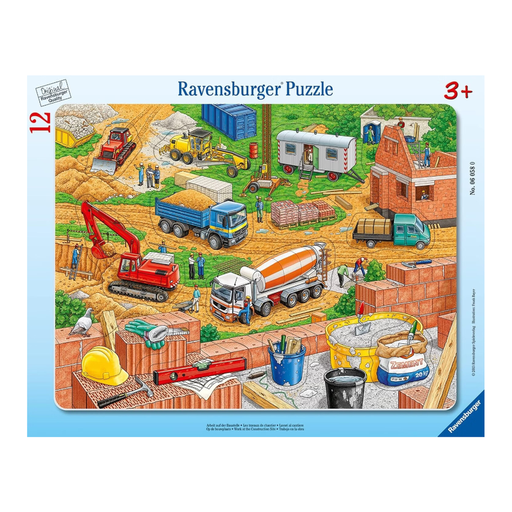
Why this product suits the profile: This 12-piece frame puzzle is designed for children aged 3 and over, making it a manageable introduction to puzzling.
The outlines in the frame help children match the pieces. This keeps the task clearly defined rather than making it seem challenging simply because it has lots of pieces.
12 sturdy cardboard pieces, a construction-site picture, no batteries and intended use from age 3.
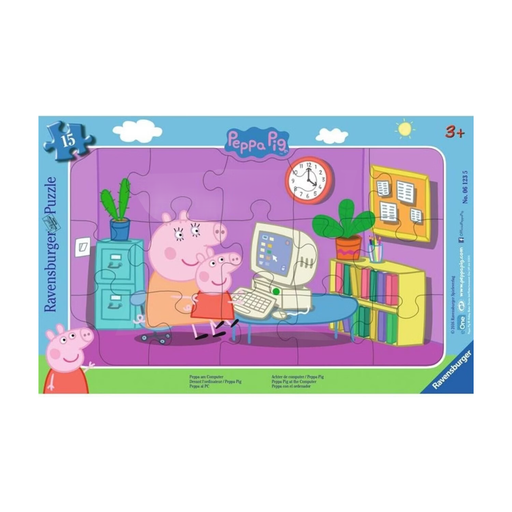
Why this product suits the profile: This frame puzzle combines a child-friendly Peppa Pig picture with extra-thick material and 15 pieces for children aged 3 and over.
The recommended age, number of pieces and frame outlines are clearly stated. This makes it easier to assess the difficulty level before buying.
15 pieces, frame format measuring 25,00 × 14,50 cm, extra-thick construction and manual play with no batteries.
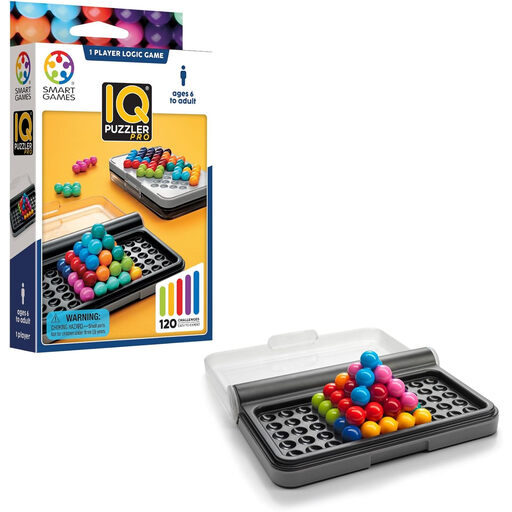
Why this product suits the profile: This compact solo game for ages 6 and over is designed for use at home or on the go, offering 120 challenges in three game modes.
The number of challenges and the three modes are clearly specified. This makes it easier to judge whether a single game will offer enough variety over time.
120 challenges, 2D and 3D tasks, a playing area for one person and a compact format measuring 3,82 × 1,10 × 5,67 cm.

Why this product suits the profile: This cooperative board game for children aged 6 and over encourages joint decision-making and is designed for 1 to 4 players.
The cooperative mechanics mean that the enjoyment does not depend solely on one player winning. Younger children may initially need help understanding the rules and setting up the game.
1 to 4 players, rotating game board, event cards and a shared objective, with no batteries required.
We have put together a complete, regularly updated list of products that fully meet these strict selection criteria and the safety regulations applicable in the EU.
For games for children aged 3 and over, manageable frame puzzles or simple board games with just a few rules are suitable. Ravensburger Zoo Adventure with 15 pieces and the Peppa Pig puzzle are examples of a good starting point.
From around age 4, 24-piece puzzles with search activities or short family games may be appealing. The Ravensburger “A Day at the Dock” puzzle adds the task of finding ten picture elements to the process of putting the puzzle together. For a family game night with a short playing time, “Lotti Karotti” for 2 to 4 players is another option.
For games for children aged 6 and over, more complex rules and logic-based challenges become available. Catan Junior is listed for 2 to 4 players aged 6 and over, combining resources, trading and building. For travelling, compact products such as “Guess Who Grab And Go” or a SmartGames logic game are good choices. For older children aged 7 and over, UNO may also be an option for 2 to 10 players.
Compact games with few individual pieces and a short set-up time are practical for car journeys, train trips or holidays. SmartGames IQ-Puzzler PRO is designed for one person and contains 120 challenges. Compact Hasbro travel games can also be stored in their designated box after the round.
Their lifespan depends on the materials, how often they are used and how they are stored. Extra-thick cardboard pieces are less prone to damage with regular use than thin individual pieces. Store games in a dry place, clean them according to the manufacturer’s instructions and check the contents after every use.
No. The term alone is not enough to assess a game. Check which specific activity is required, such as matching, planning, counting or logical reasoning. A suitable age range, easy-to-understand rules and playing time that fits the child and family are equally important.