
Lieferung heute & morgen

Qualitätsgarantie

Willkommens-Angebote freischalten: KOSTENLOSE Lieferung | Bis zu 80 % RABATT | Kostenlose 30-Tage-JoyPlus-Testphase
App herunterladen
A children’s high chair becomes part of daily life for many families from around six months. It should help at mealtimes around the family table, be easy to clean and remain usable for as long as possible. At the same time, models differ significantly in terms of seating position, harness, adjustability, material, weight capacity and storage.
As Joybuy’s Product Recommendation Officer, I’ve filtered the key details from the product descriptions to show what families in the UK should look out for before buying.
A model marketed as a “growing high chair” can have different weight limits at different stages. A 6-in-1 high chair, for example, isn’t necessarily suitable as a classic high chair right up to school age. What matters is which function can be used at which body weight.
So check:
An adjustable children’s chair can adapt the seat and footrest. But without a suitable backrest, stable base or correctly positioned foot support, the number of positions doesn’t mean much.
For children from six months, a stable footrest, appropriate seat depth and secure support are particularly important. With a high chair that includes a dining tray, you should also check that the tray leaves enough space from the body and cannot be used as a climbing aid.
A folding high chair saves space, but needs a secure locking mechanism in daily use. Before each use, check the folding joints, standing surfaces and harness. A removable cover is only practical if it’s actually washable.
For spilled food, smooth surfaces, removable trays and easily accessible corners are helpful. Wooden surfaces, on the other hand, shouldn’t stay wet for long.
A high chair with a 5-point harness keeps the shoulders, hips and upper body in the correct seating position better than a simple lap belt. The harness must be adjusted correctly and must not be twisted. Children should never be left unsupervised in a high chair.
In the product information provided, several models reference the European standard EN 14988:2017 + A1:2020. This covers requirements for stability, restraint systems and construction of children’s high chairs. Always check the details on the packaging and instruction manual of the specific model as well.
A growing high chair should be adaptable to the child’s height and the table height. With wooden models in particular, multiple positions for the seat and footplate are important.
An ergonomic seating position is a practical description of adjustability, not a medical promise.
A wooden high chair can blend nicely into the living area and, with the right construction, be used for a long time. FSC-certified wood indicates a certification for the wood’s origin. However, it doesn’t say anything about any other product feature.
Plastic and metal models are often easier to wipe clean. With a folding high chair, consider the folded dimensions and weight. For small kitchens or transporting to grandparents’ house, this can be a deciding factor.
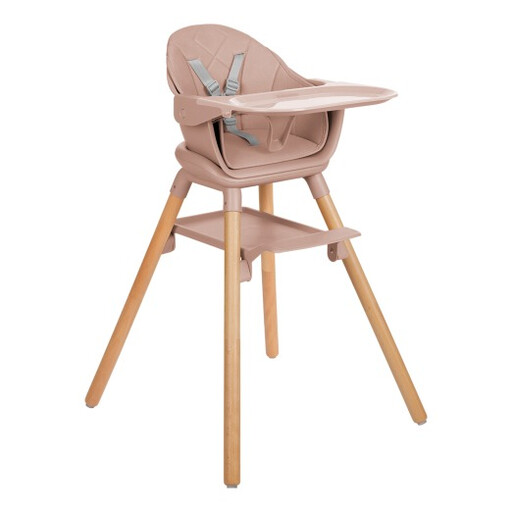
Why it fits: The six usage modes cover high chair, small chair and junior stool. This model is intended for children from when they can sit independently up to around six years, depending on the respective weight limit.
The product description lists the weight limits separately: up to 15 kg as a high chair and up to 25 kg as a junior chair. A 5-point harness and non-slip standing surfaces are specified.
Double tray, footrest, wipe-clean cover and six configurations with a product weight of 5.4 kg.
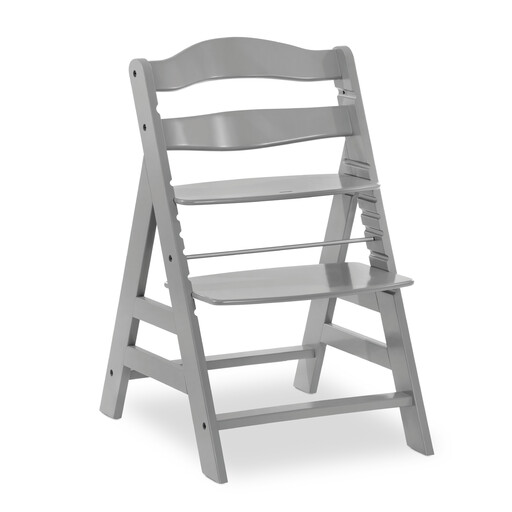
Why it fits: This high chair made from European, FSC-certified beech wood is aimed at families looking for an adjustable seating solution for childhood and later use.
The seat and footplate are adjustable. The stated maximum load is 90 kg. The product is described as coming with a 5-point harness, crotch strap and front bar.
European beech wood with FSC certification, adjustable seating position and use up to a stated weight capacity of 90 kg.
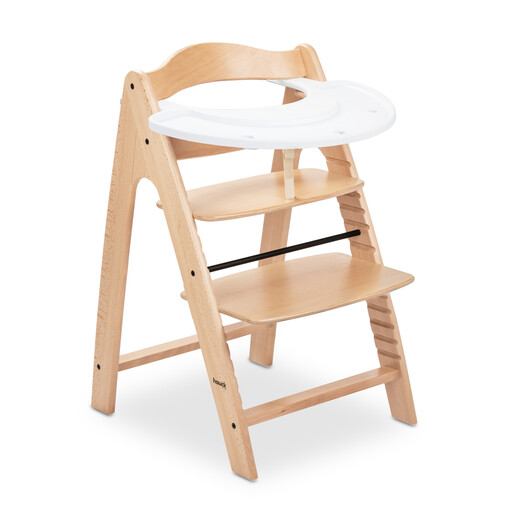
Why it fits: The combination of 13 adjustment levels, activity tray and a stated weight capacity of up to 130 kg is designed for long-term use.
The age and weight details should be considered separately. For the high chair, use from six months is stated; the high weight capacity refers to the later seating function.
FSC-certified beech wood, 5-point harness, safety bar, activity tray and 13 positions for seat and footrest.

Why it fits: The folding function and relatively light weight of 4.85 kg are practical when the children’s high chair needs to be stored or transported regularly.
The product details mention a one-hand folding function, a 5-point harness and a maximum load of 15 kg. This keeps the intended use clearly limited to early childhood.
Removable XL tray, storage basket, wipe-clean cover and, according to the product description, a machine-washable cover at 40 °C.
In the full selection you’ll find more models to compare – suited to your safety requirements, living situation and desired length of use.
The age recommendation alone isn’t enough. The child must be able to sit independently and without support. In addition, the harness system, backrest and footrest must be correctly adjusted. Always follow the instruction manual and the age and weight limits of the specific model.
That depends on the construction. A classic baby high chair is often intended for up to around 15 kg. Models like the Hauck Alpha Plus, Hauck Arketa or roba Sit Up Flex can, according to the information provided, be loaded up to 70, 90 or 130 kg respectively in later functions. These values don’t automatically apply in high chair mode.
Yes, provided the chair can be securely locked and stored away space-savingly after each use. Check the dimensions in both the unfolded and folded state before buying. For daily meals at the family table, a solid wooden chair can be more practical; for changing rooms or visits, a folding high chair offers more flexibility.