
Lieferung heute & morgen

Qualitätsgarantie

Willkommens-Angebote freischalten: KOSTENLOSE Lieferung | Bis zu 80 % RABATT | Kostenlose 30-Tage-JoyPlus-Testphase
App herunterladen
By the Joybuy Product Recommendation Officer, August 28, 2026
Choosing a night light for your child's room might seem like a simple task at first glance. However, the market is flooded with products whose features often over-promise and under-deliver. The wrong model can disrupt a child's sleep rather than promote it. As the Joybuy Product Recommendation Officer, I'm here to help you distinguish essential features from superfluous ones and make an informed decision.
Many parents invest in a night light only to find it creates more problems than it solves. Here are three common pitfalls to avoid:
A good night light serves as a gentle sleep aid for children, a convenient nursing light for babies, or a subtle orientation light for late-night trips to the bathroom. To find the right model, understanding a few technical basics is key.
To avoid a poor investment, you should check three core parameters. These will determine whether a night light fulfills its purpose as a soothing slumber light or not.
The quality of the light is the most important criterion. An LED night light is energy-efficient and generates very little heat. However, two values are crucial:
The type of power source affects how and where you can use the night light.
In a child's room, safety is the top priority. Pay attention to the following points:
Based on these objective criteria, we have identified several models that are well-suited for different needs and households in the UK.

Why This Fits Their Persona: Ideal for parents seeking a straightforward and reliable solution. This set of two plug-in night lights is perfect for equipping both the child's room and the hallway with a subtle orientation light.
The plug-in power source eliminates worries about dead batteries. The dusk-to-dawn sensor ensures the light is only active in the dark, preventing unnecessary disturbances or energy consumption.
Automatic dusk-to-dawn sensor; 3-level dimmable warm white light (2700K); very low energy consumption.

Why This Fits Their Persona: For parents looking for a comprehensive sleep aid. This model combines a projector night light, soothing sounds, and a smart sensor to create a complete bedtime ritual companion.
The projection is gentle and not overstimulating. A 23-minute auto-shutoff timer prevents the light and sound from running all night and disturbing deep sleep. The housing is soft and child-safe.
Underwater light projection; 4 soothing sound options; adjustable sound sensor that reactivates when the baby cries; rechargeable via USB-C.
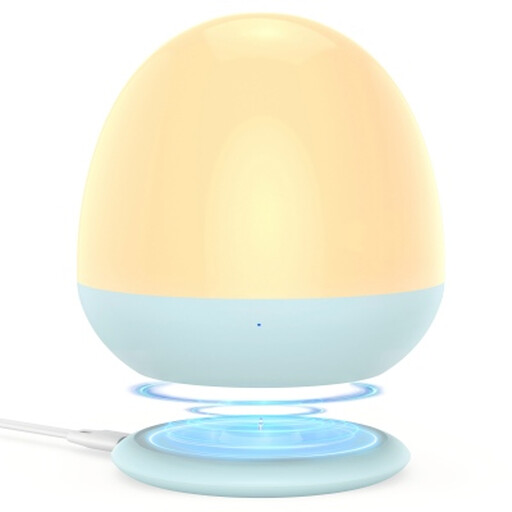
Why This Fits Their Persona: Perfect for tech-savvy families who value design and convenience. The combination of wireless charging and intuitive touch controls makes this night light exceptionally user-friendly.
The stable charging base prevents cable clutter by the bed and reduces the risk of frayed wires. The housing, made of ABS and PC plastic, is durable and free of sharp edges, making it safe for young children.
Dual charging options (wireless and USB); intuitive touch controls; integrated timer function; safe, egg-shaped design.
We have compiled a complete, real-time list of products that fully satisfy these strict selection criteria and UK safety regulations.
For a night light intended to support sleep, warm white light with a colour temperature of around 2700 to 3200 Kelvin is the right choice. This reddish-yellow light does not interfere with the body's natural production of the sleep hormone melatonin. Cold, blue-toned light should be strictly avoided as it has a stimulating effect.
Rechargeable night lights from reputable manufacturers that carry the CE marking are safe for use in a child's room. They operate on low voltage, and the batteries are typically built-in. Be sure to charge the device with the supplied or a compatible charging cable and do not cover it while charging to ensure adequate ventilation.
A newborn isn't yet afraid of the dark and therefore doesn't necessarily need a night light to sleep. However, for parents, a dim, portable nursing light or orientation light is extremely practical. It allows for night-time feeding, changing, or comforting without turning on the bright overhead light, making it easier for both baby and parents to fall back asleep.