
Lieferung heute & morgen

Qualitätsgarantie

Willkommens-Angebote freischalten: KOSTENLOSE Lieferung | Bis zu 80 % RABATT | Kostenlose 30-Tage-JoyPlus-Testphase
App herunterladen
A children's night light should provide orientation without lighting the room unnecessarily brightly. When choosing one, many parents initially focus on animal shapes, colours or a low price. In everyday use, however, other factors matter: power supply, brightness, material, heat generation and the right automatic function.
Ceramic, porcelain or decorative plastic housings can look attractive in a children's bedroom. However, they are not automatically suitable for play. Several decorative models in the Premier Housewares Ola Kids range explicitly state: This product is not a toy. A night light placed securely should therefore be kept out of the reach of young children.
An LED night light can emit cool white, neutral white or warm white light. Colour temperature is measured in Kelvin:
A 6500 K model should therefore not automatically be classed as a warm-white night light. The manufacturer's technical specification is what matters, not just the wording in the product title.
A sensor night light can be practical if parents do not want to search for a switch during the night. A dusk sensor responds to the ambient light level, while a motion sensor must also detect movement. A rechargeable night light can be used flexibly in a children's bedroom, hallway or while travelling, but it needs to be charged regularly.
For a baby night light beside the cot or changing area, low brightness is usually sufficient. For stairs, hallways or the bathroom, automatic guide lighting may be more suitable. Specifications such as lumens, watts and Kelvin help with comparisons:
An Aigostar model is specified as 1 W, 40 lm and 6500 K. According to the product data, it switches on when the light level falls below 20 lux and switches off again during the day. This makes it suitable for functional orientation, but its light colour should be distinguished from that of a warm-white baby night light.
A plug-in night light is always available and does not need charging. However, it occupies a socket and should be positioned so that the cable and housing cannot be reached. For battery-powered models, parents should check the battery type and how easy the batteries are to replace. The Premier Housewares Ice Cream LED Light, for example, requires three AA batteries.
A rechargeable night light is portable. The Atmosphera Children Night Light is powered by an integrated lithium battery and comes with a USB cable. This means it can be moved from the bedroom to the hallway.
For indoor use, IP20 is a common protection rating in dry conditions. It does not mean that the product is protected against water. A bathroom night light should therefore not be placed near splashing water or damp areas unless a higher protection rating is specified.
With ceramic and porcelain models, parents should also ensure that the surface is stable. The Ola Kids Whale, Giraffe and Bear models are made of porcelain and should be cleaned with a soft cloth. The Bear model is designed for wall mounting. Before installation, check the condition of the wall, the fixing materials and a position that children cannot reach.
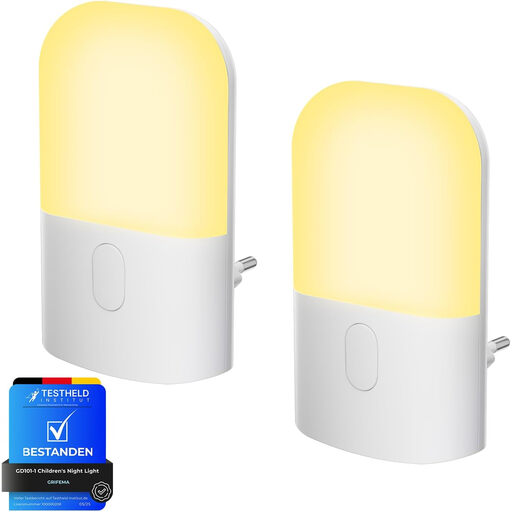
Why this product suits this profile: Two plug-in lights with dusk sensors are suitable for children's bedrooms, hallways or stairs when simple automatic lighting is required.
The stated 2700 K colour temperature is warm white. Three brightness levels mean you are not limited to simply choosing between “on” and “off”.
Automatic switching on and off, three brightness levels and a stated consumption of 0.5 W.
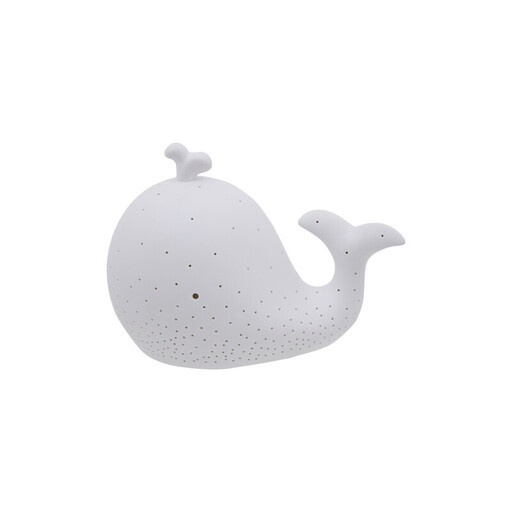
Why this product suits this profile: The white porcelain design with perforated dots is intended as a decorative night light for a permanent surface in a child's bedroom.
The product data specifies the material, dimensions of 22 × 12 × 16 cm and an E14 fitting with up to 25 W. The required bulb is not included.
Sturdy porcelain housing, dotted light distribution and a clearly recognisable decorative design.
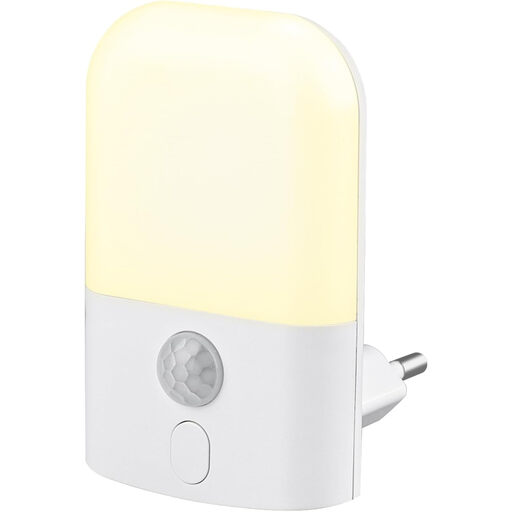
Why this product suits this profile: For hallways, stairs or moving around at night, this model combines a dusk sensor with a motion sensor.
The automatic switch-off after 60 seconds limits unnecessary operating time. The sensor range is specified as up to 3 metres and 120°.
Five brightness levels, 2700 K warm-white LED light and a power consumption of 0.5 W according to the product specifications.
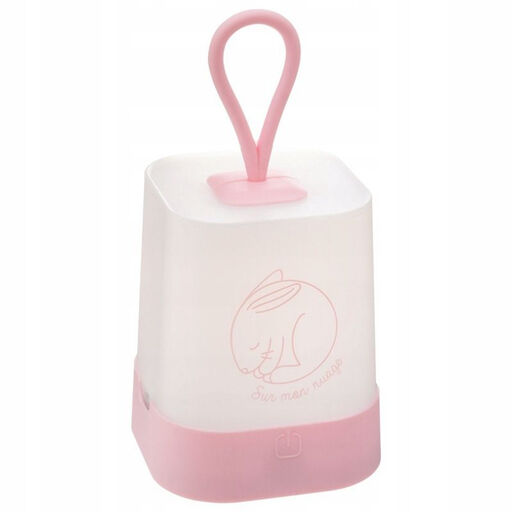
Why this product suits this profile: Measuring 8 × 8 × 9.8 cm, this compact model can be used without a socket wherever it is placed in the children's bedroom or hallway.
The USB solution reduces reliance on a wall socket. Before buying, check the charge level and safe positioning regularly.
Integrated lithium battery, USB cable and a low weight of 0.21 kg according to the product description.
For permanent guidance lighting in a hallway, a plug-in night light with a dusk or motion sensor is usually suitable. For a cot or changing area, a low warm-white brightness setting is a sensible choice. A decorative ceramic night light is suitable for a permanent surface, but should not be treated as a children's lamp to handle or play with. If you need lighting in different places on a regular basis, you may prefer a rechargeable night light.
Also look out for:
We have put together a complete, regularly updated list of products that fully meet these strict selection criteria and the safety regulations applicable in the EU.
That depends on how it will be used. 2700 to 3000 K is classed as warm white and is often suitable for bedrooms. Other colour temperatures can also be used for simple orientation. Check the Kelvin specification in the technical data.
Consumption depends on the power rating and operating time. A 0.5 W model running for 24 hours theoretically uses 0.012 kWh per day. With sensor operation, the actual running time may be shorter. Battery-powered models also incur the cost of replacing batteries, while rechargeable versions need to be charged regularly.
The night light should be stable, dry and out of the baby's reach. It must not be covered by blankets, fabric or toys. Plug-in models must not be connected to damaged sockets; chargers and USB cables should be positioned so they cannot be pulled or chewed.