
Lieferung heute & morgen

Qualitätsgarantie

Willkommens-Angebote freischalten: KOSTENLOSE Lieferung | Bis zu 80 % RABATT | Kostenlose 30-Tage-JoyPlus-Testphase
App herunterladen
A children’s night light should provide orientation at night without unnecessarily brightening the room. However, requirements vary depending on where it is used: in a baby’s room, simple operation during night-time care is important; in the hallway, sensors are practical; and beside the bed, a dimmable model with a timer may be useful.
Many unsuitable purchases are not caused by the design, but by unclear technical specifications. Parents should check three common pitfalls before buying:
For a night light in a child’s room, baby’s room or hallway, low, controllable brightness is often more practical than maximum light output. The unit lumen (lm) describes luminous flux. A model with 40 lm may be sufficient as an orientation light, while a brighter lamp is more suitable for briefly illuminating the room.
Colour temperature is also relevant:
A dimmable night light offers more flexibility. Continuously adjustable brightness in warm white, or a choice of several brightness levels, is particularly useful.
A night light with a dusk sensor switches on depending on the ambient light level. According to the product specifications, the Aigostar model activates below 20 lux. A night light with a motion sensor, on the other hand, responds to movement and can switch itself off again after a set period.
This is practical in the hallway or on the stairs, but may cause unnecessary activations in a baby’s room. You should therefore check:
A night light with a timer is suitable for set switch-on times or automatic shut-off. Some models also offer touch control and colour changing.
Ceramic models are decorative, but heavier and more susceptible to damage if dropped than lights made from ABS, PC or silicone. A ceramic lamp should therefore be placed securely on a raised surface that is out of children’s reach. With portable models, rounded shapes and a stable base are important.
You should also pay attention to:

Why this product suits this profile: This two-piece set is designed for hallways, stairs, bathrooms or baby’s rooms and, according to the specifications, does not require batteries. The dusk sensor switches the light on when it gets dark.
Three brightness levels and 2,700 K warm white reduce the risk of lighting that is too strong or too cool.
Two lights, 0.5 W power consumption and automatic activation at dusk.
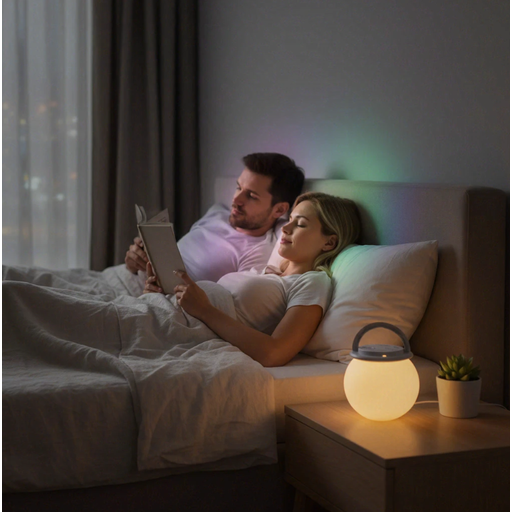
Why this product suits this profile: This LED night light combines warm white, seven RGB colours, continuously variable dimming and a timer function in a compact ABS and metal housing.
The technical specifications state the colour temperature, 40 lm luminous flux, CRI above 85 and the sensor threshold of no more than 40 lux.
Built-in battery, USB charging at 5 V/1 A and warm white with continuously adjustable brightness.
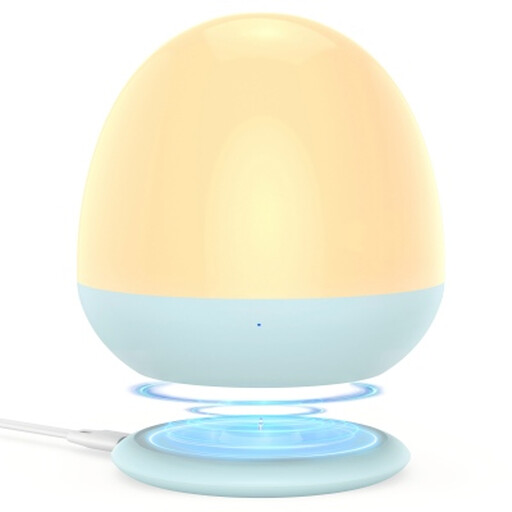
Why this product suits this profile: This egg-shaped light is designed for baby’s rooms, children’s rooms, travel and night-time care. Touch control and the charging pad make it easy to use on the go.
The charging methods are clearly specified: USB cable or wireless charging via the sturdy charging station. A timer prevents unnecessary continuous operation.
ABS and PC housing, touch control, timer and two charging options.
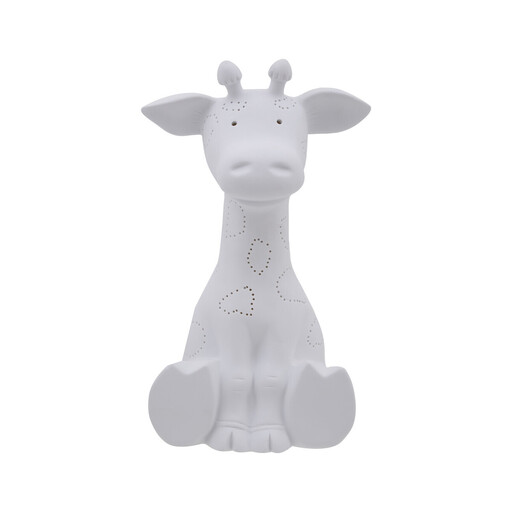
Why this product suits this profile: The white ceramic giraffe with perforated light openings is designed as a decorative accent for a child’s room.
The product information expressly states that this is not a toy and that the E14 bulb is not included.
100% porcelain, dimensions of 18 × 15 × 30 cm and light distribution through small openings.
We have put together a complete, regularly updated list of products that fully meet these strict selection criteria and the safety regulations applicable in the EU.
A night light for babies should be placed outside the bed and out of the child’s reach. Cables must not run across walkways or be placed where they can be pulled. Plug-in models should be connected to suitable, undamaged sockets and must not be covered.
The following basic rules also apply in a child’s room:
That depends on how it will be used. Low light levels are often sufficient for orientation and night-time care. As a reference value, the rechargeable LED night light described above provides 40 lm. A dimming function is more useful than choosing a fixed brightness level, as it allows the light to be adjusted to the size of the room and the activity.
A motion sensor can be practical in the hallway, on the stairs or in the bathroom. In a baby’s room, however, any movement may trigger the light. For night-time breastfeeding or changing, a dimmable night light with a timer and manual control is often more predictable. The detection range, switch-off time and the option of preventing the sensor from being accidentally covered are key considerations.
The cost depends on its power consumption, operating time and electricity tariff. With a consumption of 0.5 to 1 W, power usage is relatively low. A night light with a dusk sensor or timer can further limit its daily operating time. With rechargeable and battery-powered models, you should also factor charging intervals or battery consumption into the total cost.