
Lieferung heute & morgen

Qualitätsgarantie

Willkommens-Angebote freischalten: KOSTENLOSE Lieferung | Bis zu 80 % RABATT | Kostenlose 30-Tage-JoyPlus-Testphase
App herunterladen
A children's night light should provide orientation at night, help during nappy changes or serve as a gentle light for settling your child to sleep. In practice, however, some models quickly disappoint: the brightness can barely be adjusted, the battery lasts only a few hours or the decorative casing is unsuitable for everyday use in a child's bedroom.
Before buying, it is therefore worth looking at the technical specifications rather than relying solely on design promises. The following criteria will help you choose a suitable LED night light for children for a nursery, child's bedroom or use on the go.
Claims such as “up to 100 hours” often refer to the lowest brightness setting. At full light output, the runtime may be significantly shorter. Both figures are therefore relevant when making your decision:
A rechargeable night light with a USB-C port is practical for everyday use because you do not need to buy batteries regularly. However, the actual runtime depends on brightness, colour mode and battery condition.
Warm light alone says little about how practical a product is for everyday use. A different brightness level is often needed for breastfeeding, bottle-feeding or changing nappies than for settling your child to sleep. Several settings or stepless adjustment are therefore useful.
A dimmable night light with warm white light can be used as a bedside lamp in a child's bedroom, without having to switch on the main light every time. Colour-changing effects can be decorative, but are not essential for every situation.
An animal shape or soft silicone night light can make handling easier. However, this does not automatically mean that the product is intended to be used as a toy. Parents should follow the guidance on age suitability, water, heat, cables and placement.
A CE marking indicates that the manufacturer declares the product to comply with the applicable EU requirements. It is not an independent quality assessment. For mains-powered lamps, you should also check the power supply, voltage and operating instructions.
For night-time care, warm white or warm yellow light is generally more practical than cool white light. Check whether the brightness can be adjusted to at least two or three levels. An LED night light with a children's design should not rely solely on a conspicuous colour-changing function if it is to be used regularly beside the bed or changing area.
Product descriptions may use terms such as “flicker-free” or “low blue-light content”. Such claims should be understood as product features stated by the individual supplier and should not be equated with a medical effect.
A rechargeable night light should specify its capacity and charging time. USB-C is widely used in households and makes recharging easier. Check whether the cable is included and which power source may be used.
For travel or moving between the bed, hallway and changing area, a portable children's lamp without a fixed mains connection offers particular flexibility. With battery-powered models, you should take replacement batteries and a securely closed battery compartment into account.
Silicone feels soft and can generally be cleaned with a slightly damp cloth. ABS and PP are often used for the internal construction. It is essential that the model is not immersed in water, placed near heat sources or used with a damaged cable.
The dimensions also matter: a small night light will fit on a bedside table, while larger ceramic or glass models are more suited to being used as permanent decorations. Heavy or fragile lamps should be kept out of the reach of young children.

Why this product suits the profile: This compact lamp combines a child-friendly sloth design with three brightness levels and a rechargeable 1200-mAh battery. It is suitable for families looking for a straightforward solution for bedtime and finding their way around at night.
The stated runtime is up to 6 hours at maximum brightness. The supplier also specifies a charging time of around 3 hours and a USB-C port.
Three brightness levels, warm yellow light, 15.8 × 12.3 × 7.1 cm and a casing made from ABS, PP and soft silicone.
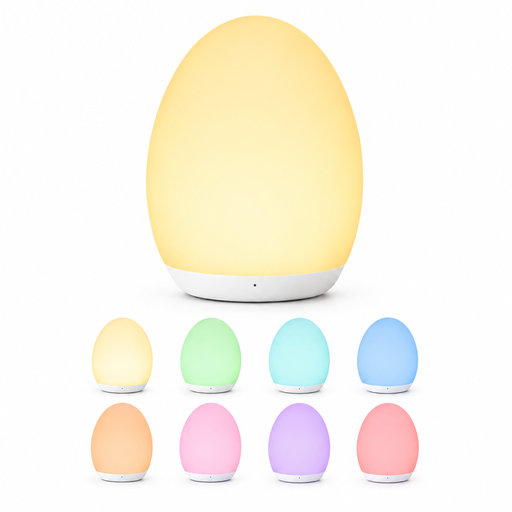
Why this product suits the profile: This baby night light features touch controls, warm white dimmable light, eight colour modes and a timer function. This allows you to adjust it for night feeds, nappy changes, bedtime routines and travel.
The stated runtime is broken down by brightness level: around 7 hours at maximum brightness and up to 100 hours at the lowest setting. The supplier points out that the maximum figure does not apply to night-light mode.
2000-mAh battery, 1-hour timer, memory function, touch control and compact dimensions of 9.2 × 9.2 × 11 cm.
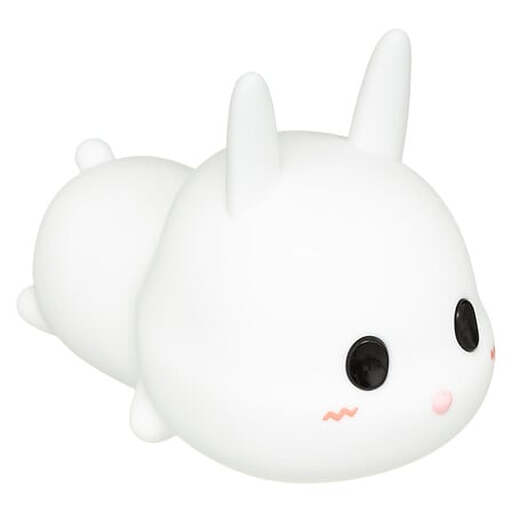
Why this product suits the profile: This portable children's lamp is designed to be moved between the bed, changing area and travel bag. Warm white LED light with three intensity levels makes it easy to adapt the lamp to different situations.
The description explicitly states the light colour, three intensity levels, rechargeable lithium-ion battery and maximum power consumption of 0.5 W.
Soft silicone and ABS casing, warm white LEDs, 15.8 × 8.7 × 11 cm and a weight of 156 g.
We have put together a complete, regularly updated list of products that fully meet these strict selection criteria and the safety regulations applicable in the EU.
Place the lamp on a stable, level surface, not directly in the bed or somewhere that cables can be reached. For babies and toddlers, the night light should be positioned outside the sleeping area. With a model featuring a timer, the light can switch off automatically once your child has fallen asleep.
Before using it for the first time, you should:
Warm white or warm yellow light is often chosen for night-time care because it feels less harsh than cool white light. Adjustable brightness, placement and your individual requirements in the nursery remain the key considerations.
This depends on the battery capacity, brightness and operating mode. Runtime at the lowest brightness is usually considerably longer than at full power. Always compare the runtime for the usage scenario you prefer.
LED lights often have low power consumption. With rechargeable models, electricity is mainly used during charging. For battery-powered lamps, you should also allow for the cost and effort of replacing batteries.