
Lieferung heute & morgen

Qualitätsgarantie

Willkommens-Angebote freischalten: KOSTENLOSE Lieferung | Bis zu 80 % RABATT | Kostenlose 30-Tage-JoyPlus-Testphase
App herunterladen
A children’s night light should provide orientation without unnecessarily brightening the room. For parents, several factors usually matter at once: a pleasant light colour, easy operation, low energy consumption and a casing that works reliably in everyday life with a baby or toddler.
However, product descriptions often highlight individual features particularly strongly. This can lead to unnecessary spending due to three common purchasing misconceptions:
For night-time breastfeeding, changing nappies or brief orientation, a low light setting is usually more practical than bright room lighting. A warm white night light of around 2700 to 3000K is considered more discreet by many families. It is also important to check whether the brightness can be adjusted.
A dimmable night light offers greater flexibility than a lamp with just one fixed setting. The Grifema model with two lights, for example, has three brightness levels at 2700K. The VAVA model offers stepless adjustment in warm light mode, as well as eight additional colour modes.
With decorative lamps, parents should check whether the design actually provides sufficient light for orientation. An LED lamp with ten small LEDs can create decorative accents, but that does not automatically make it suitable for night-time care or a dark hallway.
A sensor night light switches on depending on the ambient brightness or movement. A dusk sensor is suitable for continuous low-level lighting. A motion sensor can be more practical when light is only needed when getting up or entering the hallway.
The Grifema night light with motion sensor is specified with a range of up to 3 metres, a detection angle of 120° and automatic shut-off after 60 seconds without movement. For a nappy-changing area, however, a timer night light may be useful so that the lamp does not remain switched on all night.
Touch controls, remote controls and automatic switching each have different advantages and disadvantages. Touch control is quick to access beside the bed, while a plug-in lamp with a dusk sensor operates without any manual input.
A permanently plugged-in LED night light for a child’s bedroom requires neither batteries nor regular charging. The Aigostar model is specified with a power consumption of 1W, an operating voltage of 220–240V, IP20 protection for indoor use and a PC casing. It must not be covered or used in damp areas.
A rechargeable night light, on the other hand, can be moved flexibly between the child’s bedroom, hallway and luggage when travelling. You should check the battery capacity, charging time, charging connection and actual run time at each brightness level. The VIVREAL football model, for example, uses a 1200-mAh battery, a USB-C connection and offers up to 6 hours at maximum brightness according to the product details.
A night light for babies should be positioned outside the cot and beyond the child’s reach. A soft silicone casing does not automatically make a lamp a toy. Charging cables, plugs and hot surfaces must also remain out of reach.
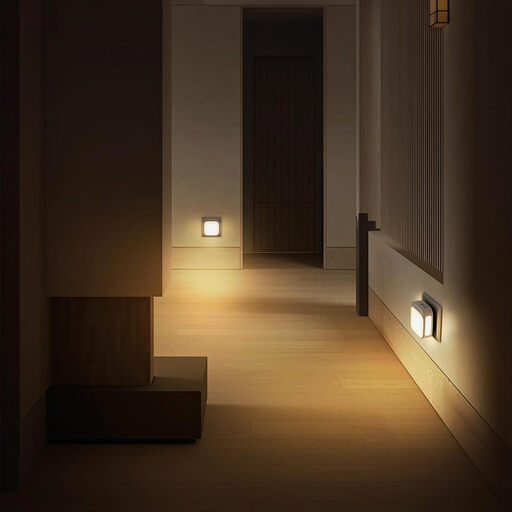
Why this product suits the profile: This two-piece set can cover the child’s bedroom and hallway, for example, while using little power at 0.3W per light. The automatic light sensor handles switching on and off.
The specifications state 2800–3000K, 20 lm and stepless dimming from 10 to 100 per cent, rather than giving only a general brightness description.
Two lights, light sensor, warm white light and compact dimensions of 7 × 2.5 × 6.12 cm each.
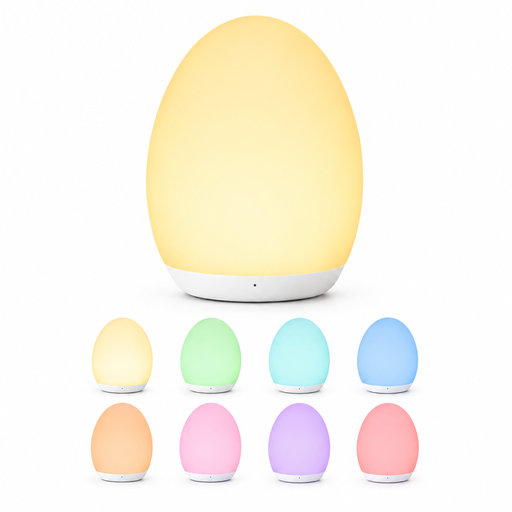
Why this product suits the profile: This portable lamp is designed for night-time feeds, changing nappies and travelling. Touch control, a memory function and a 1-hour timer reduce the need for additional adjustments.
Battery life is differentiated by brightness: approximately 7 hours at maximum brightness and up to 100 hours at the lowest setting.
2000-mAh battery, warm white dimmable light, eight colour modes and compact dimensions of 9.2 × 9.2 × 11 cm.

Why this product suits the profile: For hallways, stairs and getting around at night, this plug-in lamp switches on when movement is detected in dark surroundings and switches off after 60 seconds without movement.
The product specifications state the detection range, shut-off time and five brightness levels. This makes it easier to adapt the light to its position.
Motion and dusk sensor, 20 to 100 per cent brightness, 0.5W power consumption and warm white 2700K light.
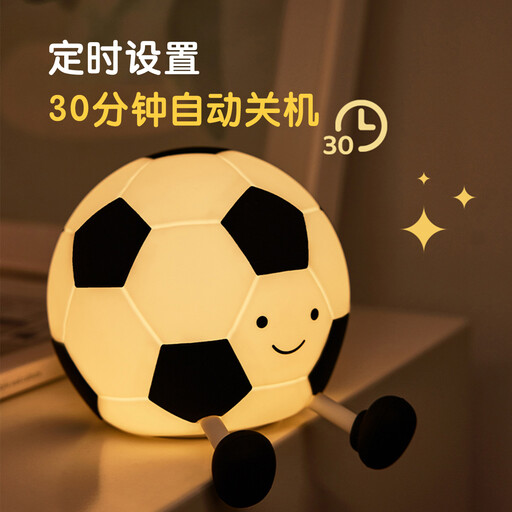
Why this product suits the profile: The football design works well in children’s bedrooms with a sporty theme. Thanks to its integrated battery, the lamp can be placed independently of a socket.
Brightness can be adjusted across three levels, rather than being defined solely by the decorative shape. Battery life is stated as up to 6 hours at maximum brightness.
1200-mAh battery, USB-C charging connection, three brightness levels and a casing made from silicone, ABS and PP.
We have put together a complete, regularly updated list of products that fully meet these strict selection criteria and the safety regulations applicable in the EU.
Low brightness settings are often sufficient for orientation and night-time care. Look for a dimming function and specific details such as lumens or brightness levels. Bright main lighting is usually not necessary for short trips around the room or hallway.
A plug-in model is suitable for fixed locations and regular use, as it does not need charging. A rechargeable night light is more flexible and can be used in the child’s bedroom, hallway or while travelling. The right choice therefore depends mainly on where it will be positioned and how much portability you need.
LED models generally have low power consumption. A device using 0.3W or 0.5W consumes less during operation than many conventional light sources. With battery-powered lamps, you should also consider how often they need to be charged and the brightness level at which the stated battery life applies.