
Lieferung heute & morgen

Qualitätsgarantie

Willkommens-Angebote freischalten: KOSTENLOSE Lieferung | Bis zu 80 % RABATT | Kostenlose 30-Tage-JoyPlus-Testphase
App herunterladen
A children's night light should help you find your way around without lighting up the room more than necessary. However, many models on the market look similar in product photos but offer very different features. For parents, it’s not just the design that matters: brightness, power supply and ease of use should all suit the intended location.
RGB colours, touch controls, a timer and a motion sensor can all be useful. But in a baby’s room, a warm white night light that stays dimly lit is often what you need. A model that constantly changes colour is better suited to decoration or older children. Before buying, check whether you can switch off individual features as needed.
Lumens (lm) measure luminous flux. An LED night light rated at 20 lm gives off noticeably less light than a 40 lm model. More light may be useful in a hallway or on the stairs, while a lower output may be enough on a bedside table. Dimming is important too: even a moderate maximum brightness can feel too strong right next to the bed.
A plug-in night light doesn’t need recharging, but it does need a suitable socket. A rechargeable night light can be placed more flexibly, but you’ll need to charge it regularly. With a night light with a motion sensor, the detection range and switch-off time should suit its surroundings. A sensor that keeps activating in a hallway can use more energy and trigger unnecessary flashes of light in a bedroom.
Colour temperature is measured in kelvins. Warm white light, at around 2600 to 3200 K, looks less cool than neutral or daylight white. According to the product specifications, the “Light Sensor Night Light Warm White” is rated at 2800–3200 K, 20 lm and 0.5 W.
A dimmable night light is useful if you need different settings for different situations: a lower setting overnight and a brighter one when you need to find your way around briefly. RGB models should also have a fixed warm white setting. Colour-changing effects are an extra feature and don’t automatically provide the right light for nighttime.
A light sensor responds to the brightness around it, while a motion sensor detects movement. These are different features:
According to the product description, the GRIFEMA model has five brightness levels, a motion sensor and a dusk sensor, and switches off after 60 seconds without movement. Its stated detection range is up to 3 metres at 120 degrees.
ABS plastic and metal are used in several of the lights featured here. The quality of the finish is what matters: the casing should stand securely, ventilation openings should not be covered, and the product should be kept away from water and damp areas unless it is specifically designed for them.
For a rechargeable night light, check the charging details. According to its description, the product with 12 SMD LEDs charges via USB at 5 V and 1 A and has a built-in battery. Only use compatible chargers, and don’t leave one plugged in unnecessarily. For battery-powered lights, use only suitable battery types and remove the batteries if the light won’t be used for a long time.
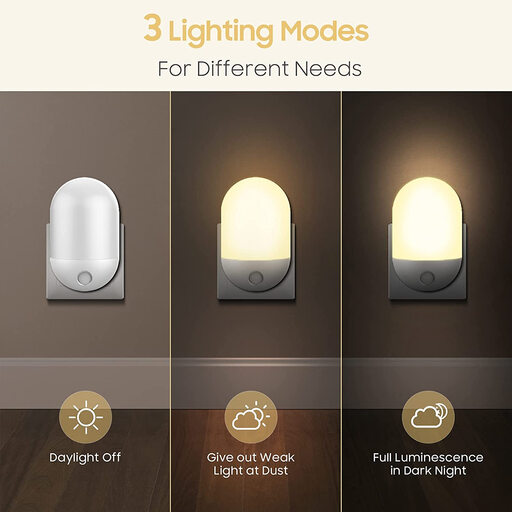
Why this product suits this profile: This plug-in light focuses on warm white illumination and automatically responds to the ambient brightness. It’s suitable for a bedroom, hallway or baby’s room if you don’t need lots of extra features.
The stated figures of 20 lm, 0.5 W and 2800–3200 K make the light output and colour temperature clear, rather than relying on a vague claim of “soft light”.
Warm white LED lighting, light sensor, 0.5 W power consumption and compact plug-in design.
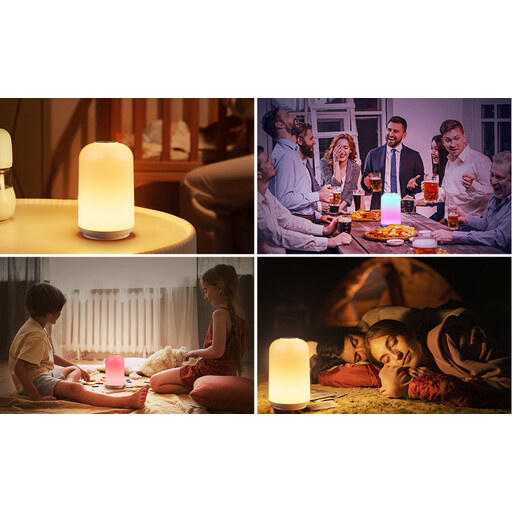
Why this product suits this profile: This model combines warm white light with seven RGB colours, stepless dimming and cordless use. It’s a good fit for families looking for a flexible light for a bedside table, shelf or child’s bedroom.
The Warm White, Off and RGB modes are listed separately. This means you can avoid colour changes when you want consistent lighting.
40 lm, CRI above 85 according to the product specifications, built-in battery, USB charging at 5 V/1 A and stepless dimming in Warm White mode.

Why this product suits this profile: For hallways, stairs, bathrooms or children's bedrooms, this plug-in model switches on automatically when it detects movement in dark surroundings.
The 120-degree detection angle, range of up to 3 metres and switch-off after 60 seconds give you clear details about how the sensor works.
Five brightness levels, 2700 K warm white light, 0.5 W power consumption and no batteries required.

Why this product suits this profile: With eight colour-changing modes, dimming, a one-hour timer and touch controls, this portable children's night light is a flexible choice for family use.
The timer limits how long the light stays on, while the dimming function lets you adjust the brightness for use in a child’s bedroom or your own.
Rechargeable, with eight colour modes, dimming, touch controls and a one-hour timer according to the product specifications.
We’ve put together a complete, regularly updated list of products that meet these strict selection criteria and fully comply with the safety regulations in force in the EU.
Consumption depends on the power rating and how long the light is on. A 0.5 W model running for ten hours uses 5 Wh by calculation. With a sensor or timer, the actual time the light is on may be shorter. Running costs therefore depend on the wattage, usage time and your electricity tariff.
Warm white light with a colour temperature of around 2700 to 3200 K is often chosen for bedrooms and baby’s rooms. You should also look for low brightness, a stable position and safe placement out of your child’s reach. Follow the instruction manual and safety advice provided by the manufacturer.
The lifespan of LED lights is usually given in operating hours. However, a specific figure is only meaningful if it’s included in the product information. For rechargeable models, battery capacity and ageing also matter. Clean the casing with a dry cloth, keep it away from moisture and use only compatible chargers with USB models.