
Lieferung heute & morgen

Qualitätsgarantie

Willkommens-Angebote freischalten: KOSTENLOSE Lieferung | Bis zu 80 % RABATT | Kostenlose 30-Tage-JoyPlus-Testphase
App herunterladen
A children's night light should help you find your way around at night without making the room unnecessarily bright. Parents also want a light that's easy to use and suited to where it will be placed – beside the cot, on the changing table, in the hallway or along the route to the loo.
However, a few common marketing pitfalls can lead to the wrong choice:
A dimmable night light can be adjusted for different situations. A low brightness setting may be enough for night feeds or nappy changes. A hallway or staircase may need brighter lighting.
With an LED night light, the light colour and controls matter too:
Lumens indicate the amount of light produced. A higher lumen rating isn't automatically better: a light that's too bright can be disruptive as a baby night light or a lamp in a child's bedroom.
A night light with a timer switches itself off after a set time. This can be useful as part of a bedtime routine or when you need to care for your child briefly during the night. Check whether the switch-off time is fixed or adjustable.
A night light with a motion sensor is particularly useful in hallways, on stairs and on the way to the bathroom. Check:
A plug-in model doesn't need recharging, but its position is limited by the location of the socket. A rechargeable night light gives you more flexibility on a bedside table or changing area.
Round casings made from ABS or PC have no protruding sharp edges. Even so, electronic products shouldn't be used by young children without supervision. This is especially important for lights with a charging port, battery or removable parts.
When it comes to the power supply, check the following:
For bathrooms, kitchens and damp rooms, follow the manufacturer's guidance. A night light without a stated level of protection against moisture should not come into contact with water.

Why it suits this profile: This rechargeable egg-shaped light combines touch controls, dimming and a 1-hour timer. It's a good choice for parents looking for several essential features in one compact children's night light.
The product details list specific functions rather than simply promising a decorative lighting effect: eight colour modes, dimming and automatic switch-off are all clearly stated.
USB charging, touch controls and a 1-hour timer, according to the product name.
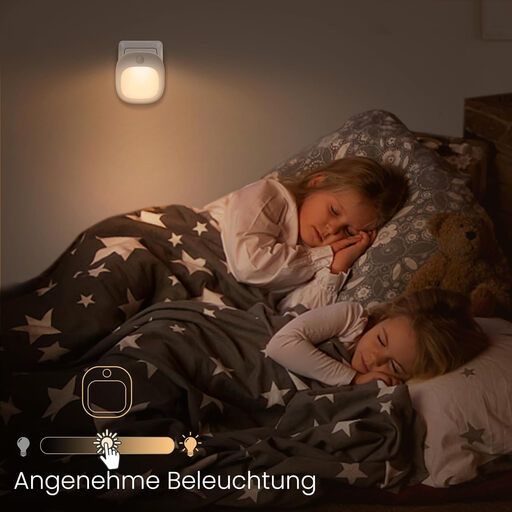
Why it suits this profile: Two rechargeable lights, each with a motion sensor, three colour temperatures and five brightness settings, can be used in different areas such as a nursery, hallway or bedroom.
The sensor is described in more detail than many vague motion-sensor claims, with a stated range of 3 to 5 metres and operation at dusk.
500-mAh battery, USB charging, 30 lm, five dimming levels and three colour temperatures, according to the product details.

Why it suits this profile: This plug-in model is designed for areas where you want a light to respond automatically to movement, such as a hallway, staircase, children's bedroom or bathroom.
It switches off automatically after 60 seconds without movement, limiting how long it stays lit. It also has five stated brightness settings.
2700 K warm white light, 0.5 W power consumption, detection range of up to 3 metres and a 120° angle, according to the product description.
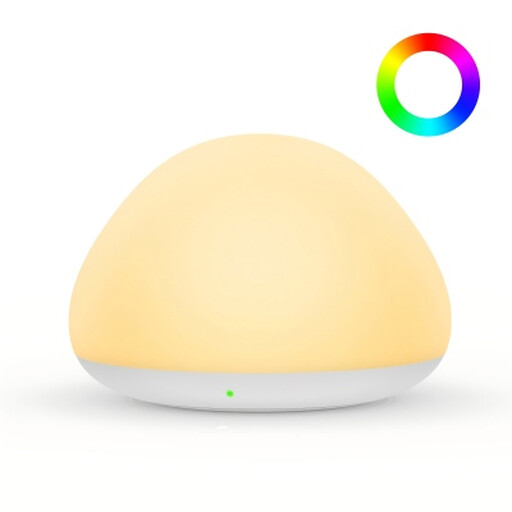
Why it suits this profile: The silicone design combines RGB lighting, USB charging, a timer and touch controls, making it suited to use by the bed and as part of night-time routines.
The timer and dimming function mean you don't have to keep the colour-changing mode on if you prefer more subdued lighting.
USB-rechargeable battery, touch controls, timer and dimmable RGB light, according to the product name.
We've put together a complete, regularly updated list of products that meet these strict selection criteria and fully comply with the safety regulations in force in the EU.
Consumption depends on the light's power, how long it's on and which mode it's using. Models rated at 0.5 to 1 W use relatively little power when left on continuously. A timer or motion sensor can reduce the actual time the light is on. Rechargeable lights also need to be charged, with the amount depending on the battery and how you use it.
It depends on where you place it. Automatic activation can be handy by the door or on the way to the bathroom. By the bed, however, a sensor may be triggered too often. Check the range, angle, dusk sensor and switch-off time. With plug-in models, make sure the socket is in a safe, suitable and accessible position.
There's no single answer. It depends on factors such as the battery, charging cycles, how long the light is used and its surroundings. Check the stated run time per charge and use only compatible USB chargers. Keep the casing dry and don't open it unless the manufacturer expressly says you can.