
Lieferung heute & morgen

Qualitätsgarantie

Willkommens-Angebote freischalten: KOSTENLOSE Lieferung | Bis zu 80 % RABATT | Kostenlose 30-Tage-JoyPlus-Testphase
App herunterladen
A children’s night light should help you find your way at night without lighting up the room too brightly. In practice, however, models vary considerably in brightness, controls, power supply and safety. A decorative design alone tells you little about whether a children’s lamp is really suitable beside the bed, in the hallway or for night-time care.
A high light output isn’t always useful. A low, warm-white setting is often enough as a bedtime light. By contrast, a very bright LED night light in a child’s bedroom can make it harder to fall asleep or feel unpleasant at night. Brighter lighting may be more practical in a hallway or on the stairs.
Look for multiple brightness settings, a dimming function or clear lumen ratings. Products with 20 to 40 lm are better suited to gentle, low-level lighting, while 400 lm is considerably brighter for a small bedroom night light.
A colour-changing night light can look decorative, but it doesn’t always offer practical benefits. What matters is whether you can also set a steady, calming warm-white light. RGB colours can add a decorative touch, but shouldn’t be the only lighting mode.
A rechargeable night light is easy to move around, but it needs regular charging. So check the battery capacity, charging method and stated run time. A model with a USB connection can be charged on the go using a suitable mains adapter, laptop or power bank. For a baby night light, make sure it has a stable charging position and keep the cable out of your child’s reach.
Warm-white light in the region of 2,700 to 3,200 K is often chosen for bedrooms and living areas. Neutral or cool-white light can be more practical in hallways, bathrooms or changing areas because it shows colours more clearly.
A dimmable night light with several settings lets you adjust the brightness to suit different situations: low for falling asleep, medium for a quick check and brighter for night-time care. Check whether you adjust the settings using buttons, touch controls or a remote control.
A night light with a motion sensor switches on only when it detects movement. Check the following:
A sensor with a range of up to 3 m and a 120° detection angle may be suitable for a hallway, stairs or children’s bedroom. By the bed, position the light so that every small movement won’t keep activating it.
When choosing a children’s lamp, consider its casing, stability and ease of cleaning. Silicone is soft and easy to wipe clean, while ABS, PC, metal and ceramic have different properties when it comes to stability and weight. A ceramic lamp, for example, works well as a decorative item but isn’t designed to be a toy.
For mains-powered models, make sure the socket is undamaged. Rechargeable lights should be charged using the supplied USB cable or compatible charging accessories. Keep electric night lights away from water, and don’t let young children take them apart or use them continuously without supervision.
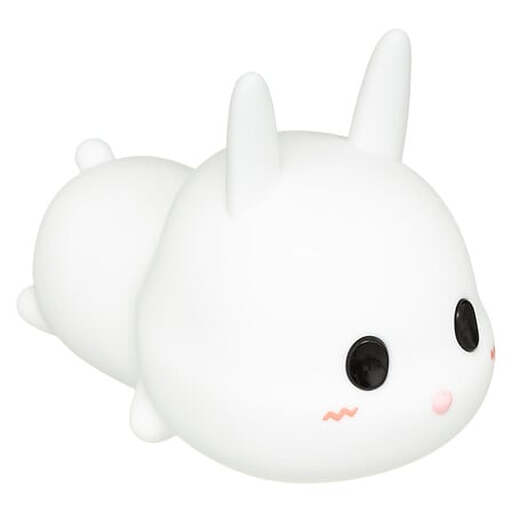
Why it’s a good fit: The compact rabbit design is made for a bedside table and doesn’t need to be plugged in. Three warm-white brightness settings make it easy to adjust the light.
The three brightness settings mean you’re not stuck with a fixed level that could be too bright. The rechargeable 18650 lithium-ion battery also reduces the need for disposable batteries.
12 warm-white LEDs, three brightness settings, a silicone and ABS casing, and dimensions of 15.8 × 8.7 × 11 cm.

Why it’s a good fit: This two-piece set is suitable for several areas, such as a nursery, hallway or bedroom. Motion-activated and standard modes give you two ways to use the lights.
You’re not limited to a single brightness or colour temperature. Five dimming levels and three colour temperatures let you tailor the settings to the situation.
30 lm, five-level dimming, 2.800–5.500 K, USB charging and a stated run time of up to 10 hours in sensor mode.

Why it’s a good fit: This plug-in model is designed for a fixed position in a hallway, by the stairs, in a bathroom or in a child’s bedroom, and doesn’t need batteries.
The built-in motion and dusk sensor prevents the light from staying on during the day. According to the product information, it switches off after 60 seconds without movement.
Five brightness settings, 0,5 W power consumption, 2.700 K warm-white light, and detection up to 3 m and 120°.
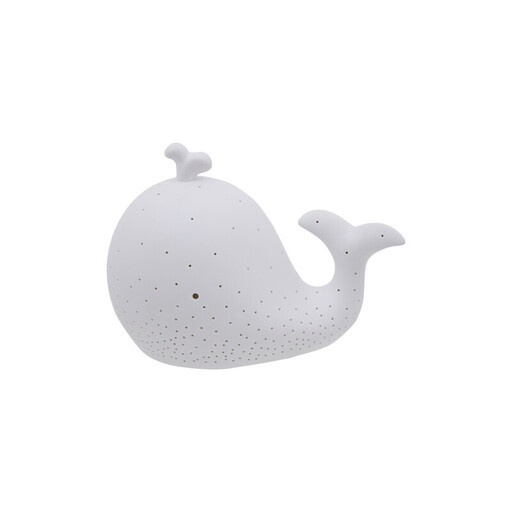
Why it’s a good fit: The white ceramic whale makes a decorative light for a chest of drawers or shelf in a child’s bedroom.
The product information clearly states that a bulb isn’t included and that an E14 bulb of up to 25 W is required. This lets you choose the bulb and light colour to suit your needs.
Ceramic body, 22 × 12 × 16 cm, and a perforated surface for indirect light. According to the product information, it isn’t a toy.
We’ve put together a complete, regularly updated list of products that meet these strict selection criteria and comply fully with the safety regulations in force in the EU.
A low, warm-white setting is usually enough at bedtime. A brighter setting can be useful for changing, feeding or walking through the hallway. A dimming function is more practical than lighting that’s always bright, as it lets you cater for different everyday situations.
Run time depends on the brightness, sensor use and battery capacity. The two-light set mentioned above is stated to last up to 10 hours in sensor mode, while the football model is stated to last up to 6 hours at maximum brightness. These figures come from the manufacturer and may vary depending on use.
That depends on where you place it and how the sensor works. A model with a short switch-off time can be useful in a hallway or by the stairs. In a sleeping area, don’t point the sensor directly at the bed, so the light won’t switch on with every movement. Keep sockets, cables and chargers out of reach of young children too.