
Lieferung heute & morgen

Qualitätsgarantie

Willkommens-Angebote freischalten: KOSTENLOSE Lieferung | Bis zu 80 % RABATT | Kostenlose 30-Tage-JoyPlus-Testphase
App herunterladen
A children’s night light should provide orientation at night without making the sleeping area unnecessarily bright. For parents, it is not just the shape and colour that matter. The key considerations are the charging method, brightness control, heat generation, materials and intended location.
However, many product descriptions place particular features front and centre. This can make important details easy to overlook. The following points will help you avoid common purchasing mistakes and choose a night light that suits your family’s routines.
A runtime of many hours sounds practical at first. However, it is only meaningful if it is clear at which brightness level it was measured. For example, the VAVA VA-CL009 is advertised as offering up to 100 hours at the lowest brightness, while maximum brightness lasts around seven hours. These figures cannot be compared directly.
You should therefore check:
A night light with a motion sensor can be useful in a hallway, on the stairs or in the bathroom. In a child’s bedroom, however, it may be disruptive if it suddenly switches on. A night light with a light sensor switches on and off depending on the ambient brightness, but does not respond to movement.
Before buying, you should establish whether the light:
A decorative children’s bedroom lamp is not automatically suitable as a toy. Materials such as silicone may feel soft, but children should still not be allowed to handle charging ports, cables or mains plugs unsupervised. For wall-mounted or plug-in lights, installation, cable routing and distance from water are also important.
A CE mark indicates that the responsible supplier complies with relevant EU requirements. However, it is not a quality mark for brightness, durability or a particular quality of light. You should therefore always check the specific product details and safety instructions as well.
A low light setting is usually sufficient for night-time care or getting up. A night light with dimming function offers more flexibility than a lamp with just one fixed brightness level. Three settings are sufficient for many everyday situations; five settings or stepless adjustment allow for more precise control.
A warm white night light typically falls within the range of around 2,700 to 3,000 Kelvin. It appears visually less cool than light with a temperature of 6,500 Kelvin. According to the product details, the Aigostar plug-in light in this selection uses 6,500 Kelvin and white light. It is therefore better suited to providing orientation in a hallway or stairwell than to creating deliberately warm bedside lighting.
A rechargeable children’s lamp can be used flexibly beside the bed, on a changing table or when travelling. Charging time and actual usage time are important factors. With a plug-in model, there is no need to recharge it, but its location is tied to the position of the socket.
You should also note the following:
With a motion sensor, the detection angle and range should suit the size of the room. According to the product details, the GRIFEMA model detects movement from up to three metres away and within an angle of 120 degrees. It switches off after 60 seconds without movement. This setting can be practical for a quick trip through the hallway.
A light sensor with a threshold value, such as 20 lux, responds to the brightness in the room. Furniture, curtains or objects placed directly in front of it can affect its operation. The sensor should be kept unobstructed.

Why this product suits this profile: This compact model offers straightforward operation with three brightness levels and is suitable for a child’s bedroom, bedroom or as a gift.
The runtime is not simply stated as a general figure: according to the product details, up to six hours are available at maximum brightness. The USB-C port makes recharging easier.
1200-mAh battery, three brightness levels, silicone surface and a charging indicator with red and green signals.
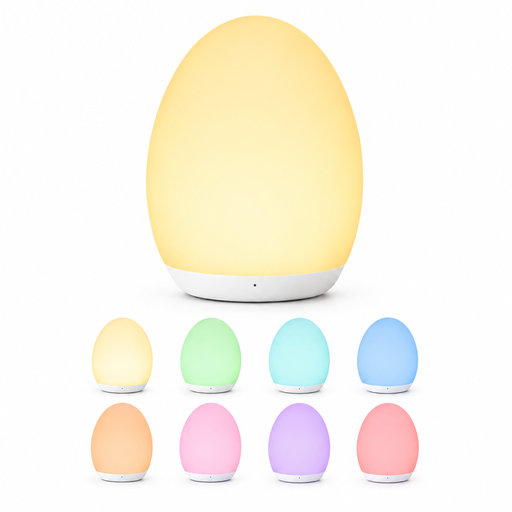
Why this product suits this profile: For parents looking for a baby night light for night-time feeds, nappy changes, bedtime routines and travel, this model combines several control options.
According to the description, the maximum runtime of up to 100 hours applies at the lowest brightness. Around seven hours are stated for the highest setting.
Dimmable warm white light, eight colour modes, touch control, one-hour timer and 2000-mAh battery.

Why this product suits this profile: This plug-in light is designed for hallways, stairs, children’s bedrooms or bathrooms where light is only needed in darkness and when movement is detected.
Automatic shut-off after 60 seconds limits unnecessary operating time. According to the product description, the motion sensor and dusk sensor work together.
Five brightness levels, 2700 Kelvin warm white light, detection range of up to three metres and power consumption of 0.5 watts.
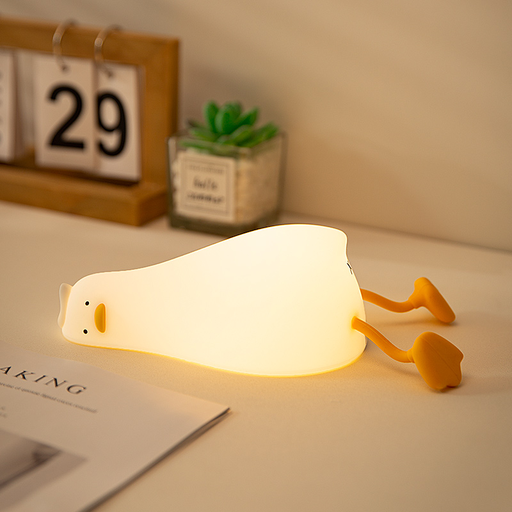
Why this product suits this profile: The soft duck shape is designed as a decorative children’s bedroom lamp for the bed, shelf or bedside table, and can be placed without installation.
It uses an integrated rechargeable battery rather than permanently connected batteries. A soft, slightly damp cloth is recommended for cleaning.
1200-mAh battery, soft silicone, portable design and warm, softly dimmed LED light.
We have put together a complete, regularly updated list of products that fully meet these strict selection criteria and the safety regulations applicable in the EU.
A low brightness setting is usually sufficient for night-time breastfeeding, feeding or nappy changes. A model with a dimming function is recommended so that the lighting can be adjusted to suit the situation. The light should help you see around the room, rather than illuminate it fully.
Runtime depends on the battery, brightness level and operating mode. Figures such as “up to 100 hours” often refer to the lowest brightness setting. You should therefore always compare the runtime at maximum brightness with the charging time. For the VIVREAL models mentioned, around three hours of charging time and up to six hours at maximum brightness are stated.
That depends on how you intend to use the light. In a hallway or on the stairs, a sensor light can illuminate the way automatically. In a sleeping area, it may be undesirable for the light to switch on with every movement. For a baby night light beside the bed, manual operation, touch control or a selectable continuous low brightness setting is often easier to predict.