
Lieferung heute & morgen

Qualitätsgarantie

Willkommens-Angebote freischalten: KOSTENLOSE Lieferung | Bis zu 80 % RABATT | Kostenlose 30-Tage-JoyPlus-Testphase
App herunterladen
A children's night light should provide enough light for orientation without unnecessarily brightening the room. For parents, it is not just about choosing a cute design. Power supply, ease of use, heat generation, cleaning requirements and whether the model is suitable for its intended location are all important considerations.
Many disappointing purchases result from three common marketing traps:
Before buying, it is therefore worth checking the specific technical details rather than relying solely on product images.
For a children's bedroom or baby's room, a low light output is often sufficient for orientation. Look for details such as lumens, wattage and colour temperature. Warm white light around 2700 Kelvin is generally perceived as less cool than neutral white light.
A dimmable night light offers particular flexibility: a low setting can be used in the sleeping area at night, while a higher setting can be helpful when changing a nappy or tidying up. With RGB models, check whether a permanently available warm white setting is included or whether the light only offers coloured programmes.
An automatic timer switch-off can reduce unnecessary operating time. However, a timer does not replace safe positioning and should not be regarded as a safety feature.
A rechargeable night light can be used on a bedside table, in the hallway or when travelling without needing a power socket. Important details include the battery capacity, charging connection and whether the light can be operated while charging. A USB cable is not automatically compatible with every power adapter; only use suitable chargers.
Plug-in models with a dusk sensor switch on when it gets dark and off during the day. Models with a motion sensor can also switch off after a certain period without movement. This is practical in hallways and on stairs, although an overly sensitive sensor may switch on repeatedly in a child's room.
For battery-powered models, check the battery type and battery compartment. Batteries must be kept out of the reach of small children. If the light will not be used for an extended period, removing the batteries may be advisable, provided the manufacturer recommends this.
A children's night light is not a toy unless the manufacturer explicitly states that it is. Ceramic models can be decorative, but they are fragile and should be placed securely, away from the reach of small children. For textile or soft silicone surfaces, follow the manufacturer's cleaning instructions.
The IP rating is relevant for bathrooms, kitchens and other damp areas. Unless the manufacturer expressly confirms that the device is suitable for moisture, it should not be used there. A night light for a children's room must not be covered either, so that heat does not build up.
You should also check for:
For example, the ceramic Ola models from Premier Kids specify that an E14 bulb of up to 25 W is required and that the bulb is not included. This should be taken into account before buying.
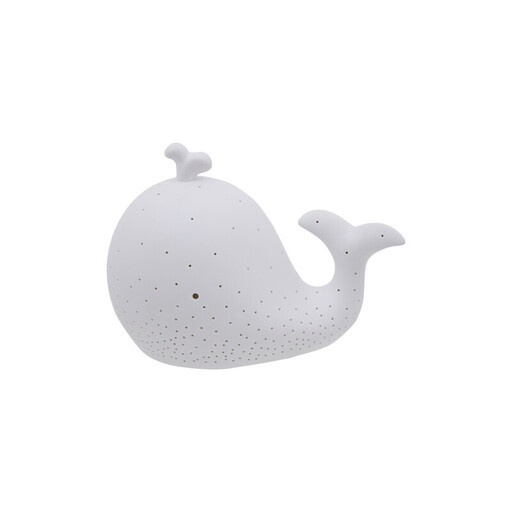
Why this product suits this profile: The decorative whale shape and white ceramic finish are ideal for families looking for a simple, freestanding children's bedside lamp with a homely appearance.
The product details clearly specify the material, dimensions and required E14 fitting. This allows you to check before buying whether the lamp is suitable for its intended location and whether you have the right bulb.
Ceramic housing, 22 × 12 × 16 cm and a perforated surface for diffusing the light. According to the product details, this model is not a toy.
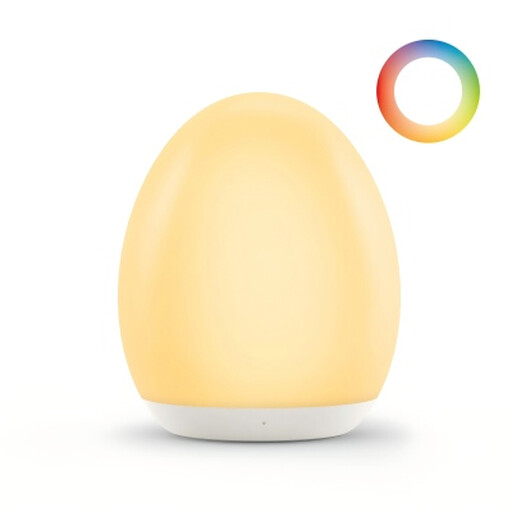
Why this product suits this profile: This model combines rechargeable operation with touch control, dimming, eight colour-changing modes and a one-hour timer.
The features are clearly specified rather than promoted with a vague promise of colour changing. The timer can limit operating time during the night.
Rechargeable design, touch control, dimming and a 1-hour timer. The exact battery life should also be checked before buying.
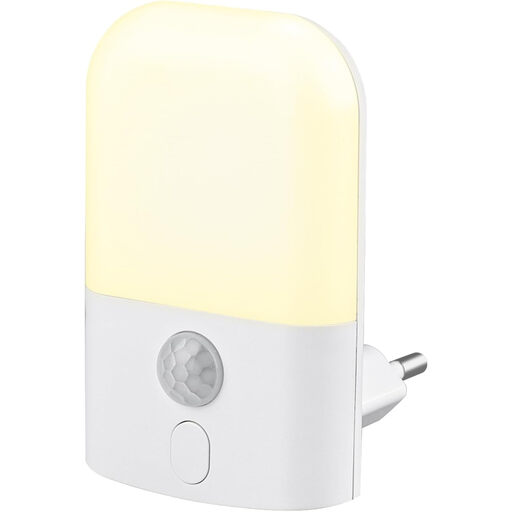
Why this product suits this profile: For hallways, stairs, bathrooms or the route to a child's room, this plug-in model offers both motion and dusk sensors.
According to the product description, the sensor only operates in darkness and switches off after 60 seconds without movement. The detection range is specified as up to 3 m and 120°.
Five brightness levels from 20 to 100 per cent, warm white light at 2700 K and a power consumption of 0.5 W.
We have put together a complete, regularly updated list of products that fully meet these strict selection criteria and the safety regulations applicable in the EU.
The cost depends on the power rating, daily operating time and electricity tariff. A 0.5 W model running continuously uses significantly less electricity than a conventional 25 W lamp. The simple calculation is: Power in kW × operating hours × electricity price. Rechargeable and battery-powered models also involve charging or replacement costs.
It can be useful in the hallway or along the route to the baby's room. In the sleeping area, parents should check whether the child's movements repeatedly activate the sensor. A safe power socket, an unobstructed sensor area and compliance with the manufacturer's instructions are also important. Automatic activation is no guarantee of a child-safe environment.
When used correctly, LEDs generally have a long service life. However, the actual lifespan of the entire device also depends on the battery, switch, sensor and charging electronics. In rechargeable models, battery capacity decreases with charging cycles and age. Alongside the LED specification, you should therefore also consider the warranty, spare-part information and care instructions.