
Lieferung heute & morgen

Qualitätsgarantie

Willkommens-Angebote freischalten: KOSTENLOSE Lieferung | Bis zu 80 % RABATT | Kostenlose 30-Tage-JoyPlus-Testphase
App herunterladen
A children's night light should provide reassurance and orientation without unnecessarily brightening the room. To parents, grandparents and gift-givers, many models look similar at first glance: gentle light, cute designs and extra features such as colour changing or timers. However, the differences often only become apparent in everyday use.
Three typical purchasing and marketing pitfalls are particularly relevant:
For a baby night light or a night lamp for a child's bedroom, warm white light is often a good choice. Colour temperatures between around 2,600 and 3,200 Kelvin are classed as warm white. However, colour temperature is not the only deciding factor: the actual amount of light is important too.
The unit lumens (lm) describes luminous flux. A model with 20 lm is suitable for gentle orientation in a baby's room in a different way from a 40 lm product, which can illuminate a larger area. A dimmable night light or continuously adjustable dimming function makes it easier to adapt the light for breastfeeding, changing nappies, reading stories or walking to the door at night.
With RGB models, check whether the brightness can also be adjusted in colour mode, or only for the warm white light. Touch controls are convenient, but young children may activate them accidentally. A control surface that is easy to reach yet protected is therefore a sensible choice.
A rechargeable night light can be used flexibly on a bedside table, in your luggage or next to the changing area. Look out for:
A plug-in night light is more suitable for hallways, stairs and fixed points where orientation is needed. Models with a dusk sensor switch on automatically as the ambient light level falls. With plug-in lamps, the sensor should remain unobstructed and the housing should not block neighbouring sockets.
A children's night light is not a toy unless it is explicitly labelled as such. Warnings such as “not suitable for children under three years” or “use only under supervision” must be taken seriously. Electronic components, small controls and lithium batteries should not be left in the hands of unsupervised children.
Smooth, easy-to-wipe surfaces are practical for a child's bedroom. Ceramic or porcelain can be decorative, but is more vulnerable to impact and should be placed securely out of reach. In a bathroom or directly beside water, a night light may only be used if the manufacturer explicitly confirms that it is suitable for this purpose.
Also check the product labelling, manufacturer information, the EU responsible person and the safety instructions. A CE mark is a legally required conformity marking, but it is not an independent quality seal. Information such as “flame-retardant plastic” or specific sensor values should come from the product description or instructions and should not be applied generally to other models.

Why this product suits this profile: Two lights with warm white light, three brightness levels and a dusk sensor cover several areas, including children's bedrooms, hallways and stairs.
The sensor reduces the need to switch the light on and off manually. Three brightness levels prevent the lamp from shining more brightly than necessary for extended periods.
Two-pack convenience, 2,700 K warm white light, three adjustable brightness levels and automatic activation at dusk.

Why this product suits this profile: The egg-shaped model combines touch controls, dimming, eight colour-changing modes and a one-hour timer.
The timer limits how long the light stays on. Battery operation avoids having a cable beside the bed; the age guidance and charging instructions should be followed.
Rechargeable battery, touch controls, eight colour modes, dimming and automatic shut-off after one hour.
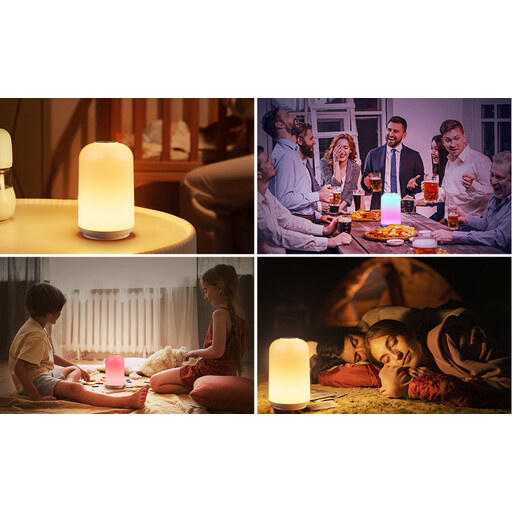
Why this product suits this profile: The compact LED night light is designed for bedside tables, shelves or children's bedroom furniture. It provides warm white light as well as seven RGB colours.
The stated continuous dimming in warm white mode allows finer adjustment than simple on-off lights. According to the product information, the ambient light sensor operates at up to 40 lux.
12 SMD LEDs, 40 lm, 2,600–2,800 K warm white light, seven RGB colours, USB charging at 5 V and 1 W power consumption.
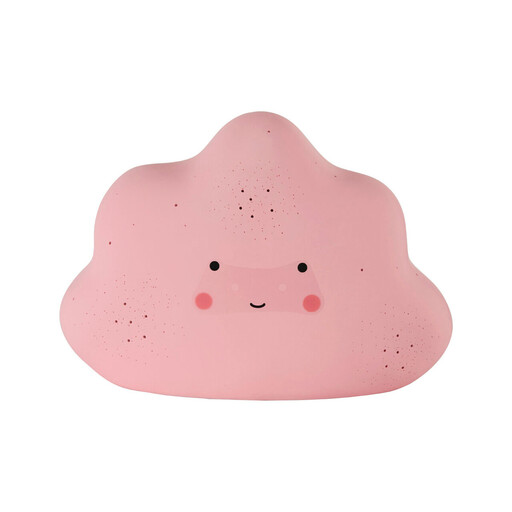
Why this product suits this profile: The cloud-shaped decorative children's lamp is aimed at buyers who value the material, shape and fixed design more than sensor or rechargeable battery features.
The product information specifies battery operation with three AA batteries and cleaning with a soft cloth. This means you can factor in the ongoing maintenance before buying.
Ceramic body, cloud shape, perforated light openings and portable use with three AA batteries.
We have put together a complete, regularly updated list of products that fully meet these strict selection criteria and the safety regulations applicable in the EU.
That depends on where it will be used. A low, dimmable light level is usually sufficient for a baby's room. A higher brightness may be needed in a hallway or on the stairs. Lumen specifications help with comparisons, but they do not replace checking the actual distance and room size.
A dusk sensor switches the lamp on depending on the ambient light level. A motion sensor responds to movement and can be practical in a hallway or on the stairs. For a child's bed, permanently dimmed light or a night light with a timer is often simpler, as it will not be activated by every small movement.
Running costs depend on the power rating and how long the light is used each day. A model with 0.5 to 1 watt uses comparatively little energy when operated for short periods. Rechargeable and battery-powered models also incur charging cycles or replacement battery costs. As well as the purchase price, check the stated power consumption and the length of time you intend to use the light.