
Lieferung heute & morgen

Qualitätsgarantie

Willkommens-Angebote freischalten: KOSTENLOSE Lieferung | Bis zu 80 % RABATT | Kostenlose 30-Tage-JoyPlus-Testphase
App herunterladen
A night light for children should help them find their way at night without making the room unnecessarily bright. For babies, it can provide light for night feeds; in the hallway, it can mark the way to the bathroom; and in a child's bedroom, it can offer a gentle source of light. The choice ranges from a simple plug-in night light to a rechargeable children's night light with a timer, dimmer or motion sensor.
However, not every model is right for every setting. An appealing shape, a range of colours or a low price says little about ease of use, light control or how well a product fits into everyday life. Before buying, it’s worth knowing about a few common pitfalls.
A very bright night light can be disruptive in a bedroom. For night feeds, changing nappies or quick checks, a low brightness setting is usually enough. A dimmable night light with a warm colour temperature of around 2,700 to 3,200 Kelvin is a practical choice. Warm white light is often perceived as gentler than very cool white light.
Colour-changing lights can be decorative, but they aren’t automatically suitable for every situation. What matters is whether you can set the light to stay on in warm white at a dimmed brightness.
A night light with a motion sensor shouldn’t stay on every time there’s a small movement. Check the detection range, detection angle and whether the sensor works only in the dark. A dusk or light sensor prevents the light from switching on unnecessarily during the day.
A sensor night light can be handy in a hallway. In a baby’s room, however, a constant low light or manual touch control may be more suitable if you want to avoid movement in the room triggering the light.
For a rechargeable night light, the charging method, battery capacity and run time should be clearly stated. A USB port makes charging easier, but you should still check that you’re using a suitable power adapter. Plug-in night lights should also be designed for dry indoor use only, and must never be plugged into a damaged socket.
Electronic night lights aren’t automatically toys. Check the age guidance, supervision advice and water protection information before buying and when using the product.
For a child’s bedroom, choose a night light with adjustable brightness. Warm white light at around 2,600 to 3,200 Kelvin can work well as a guide light or for night feeds. A more neutral light may be more practical in a hallway or bathroom, as it makes objects and steps easier to see clearly.
Also check the stated light output in lumens. Lower levels, such as 20 to 40 lumens, are intended for subtle accent lighting and shouldn’t be confused with full room lighting.
Rounded shapes can reduce the risk of sharp edges, but they don’t automatically make a product suitable for every age. According to the product details, the Jolywell egg night light is made from ABS and PC and is specifically not intended for children under three. Keep electronic devices dry and clean them only with a soft, dry cloth.
For models with a battery, don’t run the charging cable under duvets or pillows. Keep plug-in models away from direct contact with water or splashes.
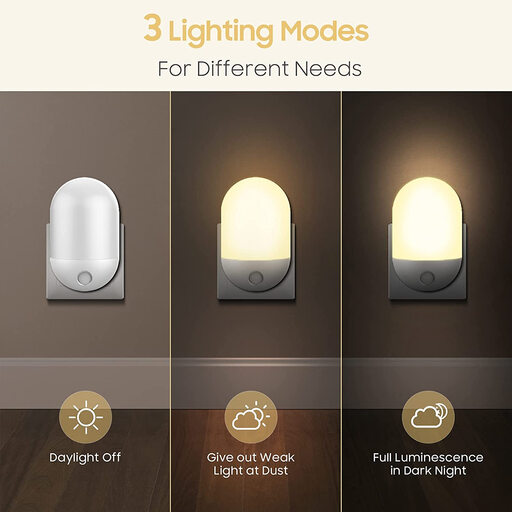
Why this product suits this need: This compact model is a good choice if you’re looking for a simple warm white guide light for a baby’s room, bedroom or hallway.
The built-in light sensor means you’re less likely to need to switch the light on and off manually at night. The stated colour temperature is 2,800 to 3,200 Kelvin.
SMD LED with 0.5 W and 20 lm; ABS metal casing for indoor use.
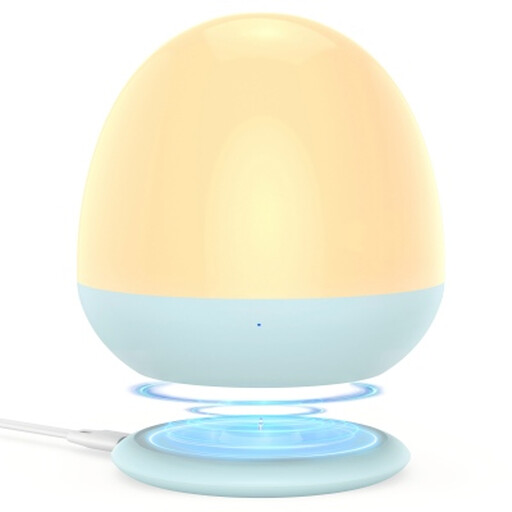
Why this product suits this need: Its portable design, touch controls and charging station make it a flexible choice for families who want to use a night light in a child’s room or for night feeds.
The timer can help prevent the light from being left on continuously by mistake. The product details list both USB charging and wireless charging via a stable charging station.
Touch controls and an ABS-PC casing with a rounded egg shape; stated as unsuitable for children under three.
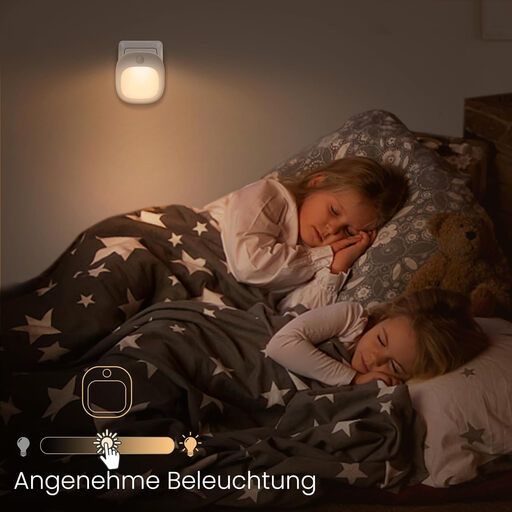
Why this product suits this need: The two portable lights are a flexible way to illuminate a bedroom, hallway or bathroom.
The motion and light sensor is designed to switch the light on automatically in the dark. Five brightness settings let you adjust it to suit the room.
USB charging, three colour temperatures, five dimming levels and, according to the product details, up to ten hours of run time in sensor mode.

Why this product suits this need: This plug-in model is designed for fixed locations in hallways, on stairs or in a child’s room, so there’s no battery to charge.
The motion and dusk sensors work together: the light comes on when movement is detected in a dark environment and, according to the product details, switches off after 60 seconds without movement.
Five brightness settings, warm white LED light at 2,700 Kelvin and a stated power consumption of 0.5 W.
We’ve put together a comprehensive, regularly updated list of products that meet these strict selection criteria and the applicable EU safety regulations.
Energy use depends on the power rating, how long the light is on and whether it’s controlled by a sensor. Models rated at 0.3 to 1 W use relatively little power while operating. A light sensor or timer can reduce the amount of time the light is on each day. To work out the specific running costs, calculate the power consumption using your own electricity tariff and usage time.
It depends on how you want to use it. A sensor night light can be useful if you only need a little light to find your way at night. Check the detection range, switch-off time and brightness, though. Keep the device out of an infant’s reach and use it in line with the manufacturer’s instructions. Don’t leave a rechargeable model charging within the child’s reach unattended.
Run time depends on battery capacity, brightness setting, light colour and sensor use. That means a specific figure is only meaningful for the model in question. When buying, check the stated run time and charging method, and whether the light can also be charged via USB while in a fixed position.