
Lieferung heute & morgen

Qualitätsgarantie

Willkommens-Angebote freischalten: KOSTENLOSE Lieferung | Bis zu 80 % RABATT | Kostenlose 30-Tage-JoyPlus-Testphase
App herunterladen
A night light for a child’s bedroom should help you find your way around without making the room unnecessarily bright. For parents, it’s not just about shape and price. The key considerations are how it’s powered, its light colour, sensors, cleaning requirements and whether it’s suitable for the place you plan to use it.
Many products look similar at first glance, but differ in important ways. Three common buying mistakes can mean a child’s night light ends up barely being used:
A rechargeable night light is easy to move between your child’s bedroom, the hallway and your own bedroom. Check the stated battery capacity and charging connection. For example, the VIVREAL model is listed with a 1200 mAh battery and a USB charging connection.
A mains-powered night light doesn’t need its batteries changing and is suitable for areas where you want a permanent light. However, the socket needs to be in a suitable position and must not be covered or exposed to damp. Battery-powered models such as the Chicco Dream Light Blue don’t rely on a socket, but need two AAA batteries, which are sold separately.
If you’re looking for a baby night light or a subtle guide light for the bedroom, warm white night lights are a popular choice. The Kelvin rating gives you a better basis for comparison than descriptions such as “soft” or “soothing”. According to the product details, the GRIFEMA model gives off 2700 Kelvin warm white light and offers five brightness levels, from 20 to 100 per cent.
A dimmable night light is handy if you want to use the same product for settling your child to sleep, changing a nappy or finding your way around at night. Check whether the brightness adjusts in set steps or continuously, and whether the last setting is saved.
A motion-sensor night light switches on when it detects movement. Some models, however, only activate when the surrounding light is low. The GRIFEMA night light is listed with motion and dusk sensors, a range of up to 3 metres and automatic shut-off after 60 seconds without movement.
If you’re using a light in a bathroom, cellar or other damp area, check its specific IP rating. The Aigostar NL01, for example, is listed as IP20 and, according to the product description, is for indoor use only. IP20 does not indicate water protection. So, even if you choose a sensor night light, keep it away from water.

Why it suits this need: Mains power means there are no batteries to replace or rechargeable battery to worry about, while the five brightness levels make it a good choice for a child’s bedroom, hallway or stairs.
The product details specify the dimming levels, sensor range and 60-second shut-off, rather than simply describing it as automatic.
2700 Kelvin warm white light, five brightness levels, motion and dusk sensors, and a stated power consumption of 0.5 watts.
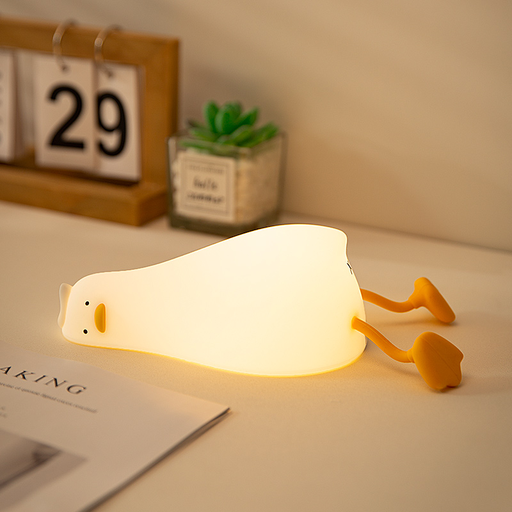
Why it suits this need: This portable model combines soft silicone with USB charging and a stated battery capacity of 1200 mAh.
The product information covers the material, battery and cleaning instructions. It also clearly warns against fire, high temperatures and immersion in water.
Soft silicone, USB charging, a portable design and the option to use it as a bedside or children’s bedroom night light.
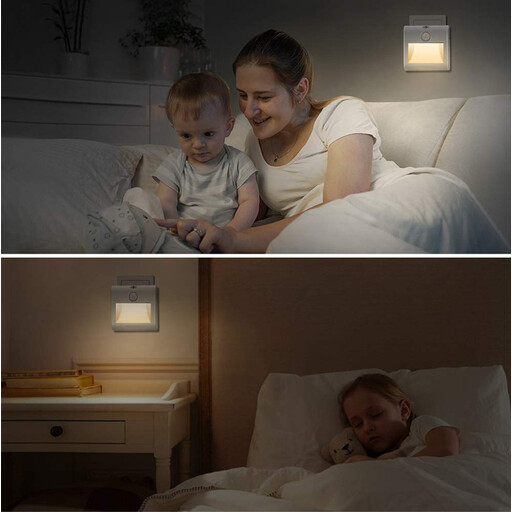
Why it suits this need: This two-pack is a good choice if you want to light several areas around your home, such as the bedroom, hallway or bathroom.
You can use the constant light and sensor mode separately. Touch dimming with a memory function saves you from having to adjust the brightness each time.
Two lights, a stated power consumption of 1 watt per unit, sensor activation at up to 3 to 5 metres and continuously adjustable brightness, according to the product details.
We’ve put together a complete, regularly updated list of products that meet these strict selection criteria and fully comply with the safety regulations in force in the EU.
It depends on its power consumption and how long you use it. Product details may list figures such as 0.3 watts, 0.5 watts or 1 watt. A motion or dusk sensor may reduce the actual operating time, but not all models switch on and off under the same conditions.
For a subtle guide light, warm white at around 2700 to 3000 Kelvin is a popular choice. The right brightness depends on whether you need the light simply to help you find your way around or also to help with changing nappies and reading. A dimming function makes it more versatile.
Its lifespan depends on the LED components, rechargeable battery or replaceable batteries, and how well it’s cared for. For rechargeable models, battery capacity is another factor. Mains-powered models don’t need regular charging, but the sensor and light should still be used only in a dry indoor environment and in accordance with the instructions.