
Lieferung heute & morgen

Qualitätsgarantie

Willkommens-Angebote freischalten: KOSTENLOSE Lieferung | Bis zu 80 % RABATT | Kostenlose 30-Tage-JoyPlus-Testphase
App herunterladen
A children’s painting set should encourage creativity while remaining practical for everyday family life. However, with eye-catching packaging, large colour assortments and extensive arts and crafts sets, it is not always immediately clear which product is right for a child’s age, surroundings and intended use. For parents, nurseries and schools, clear information about age guidance, materials, washability, accessories and surfaces is therefore more important than advertising claims.
A children’s painting set with 24 or more shades may seem comprehensive. For younger children, however, a smaller selection of easy-to-grip colours and simple applications is often more suitable. What matters is whether brushes, a mixing palette, activity cards or a storage container are included. If essential accessories are missing, extra costs can arise and the set may be used less often.
Washable pens or children’s paints cannot necessarily be removed completely from every surface. Washability may depend on skin, the type of fabric, how long the paint has been left and the temperature. Fabric paints also often require fixing. You should therefore read the specific manufacturer’s information before buying and before use.
A children’s painting set for children aged 3 and over is not automatically suitable for two-year-olds. Small fasteners, beads, paint bottles or accessories may pose a choking risk. Even with age-appropriate products, adult supervision is particularly advisable for toddlers. Always compare the age guidance on the packaging and product page with the child’s stage of development.
For children aged 2 to 4, large pens, sturdy paint containers and straightforward applications are usually suitable. Finger paints for children or thick dot markers can be used without precise brush control. From around the age of 4, more extensive gouache paints for children, mixing palettes and different brushes may be appealing. A window colour set for children aged 6 and over is more suitable for children who can understand outlines and longer drying times.
Look for specific information such as water-based, alcohol-free, low-odour or non-toxic, where stated by the manufacturer. Such information does not replace supervision and is not a licence for skin or mouth contact. With paints for children, you should also check whether they are intended for paper, card, wood, textiles, glass or several different surfaces.
When cleaning, the exact application matters. Fresh paint stains can often be treated more easily with water and soap than dried-on stains. Nevertheless, clothing, tables and floors should be protected with a wipe-clean covering.
Do not just compare the number of paint pots; check their contents too. A set with six 25 ml containers may be more practical for regular school or craft projects than one with lots of very small tubes. The included brushes, mixing palette, painting cards, sheets or storage system are also relevant. Organisations should additionally consider refill options and the durability of the packaging.
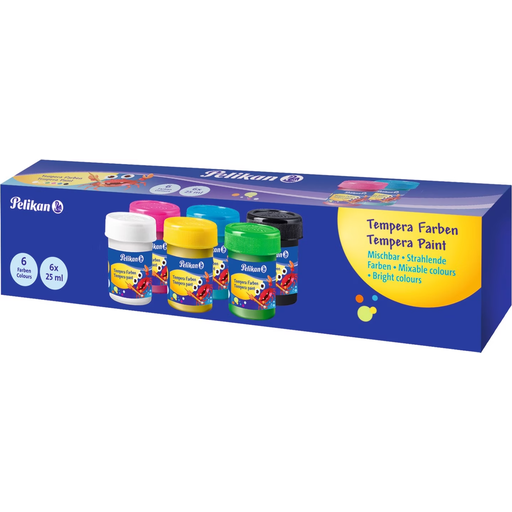
Why this product suits the profile: Six colours of 25 ml each, a brush and a mixing palette provide a manageable introduction for children aged 3 and over.
The contents are straightforward and already include essential accessories. The age guidance of 3 and over and the warning about small parts should be observed.
Six opaque tempera paints; stated as suitable for paper, card, wood and ceramic.
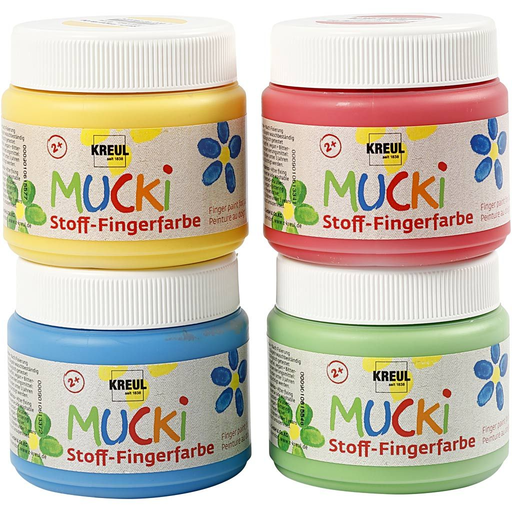
Why this product suits the profile: The four water-based colours are designed for children aged 2 and over and for creative textile projects.
The product is clearly intended for finger or brush painting on cotton and blended fabrics containing up to 20 per cent synthetic fibres. Fixing is required for washability up to 40 °C.
Four colours at 150 ml each; according to the product information, free from parabens, gluten, lactose and nuts, as well as vegan.
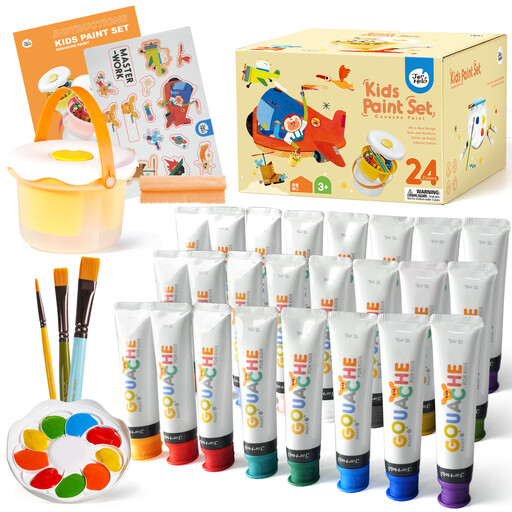
Why this product suits the profile: Children aged 4 to 12 receive a comprehensive set for regular painting and craft projects at home or in educational settings.
The storage bucket, palette in the lid and rinsing cup keep all the accessories together. This means brushes and paints do not need to be sourced separately.
24 gouache colours, three brushes and portable storage; according to the product description, water-soluble and made from non-toxic materials.
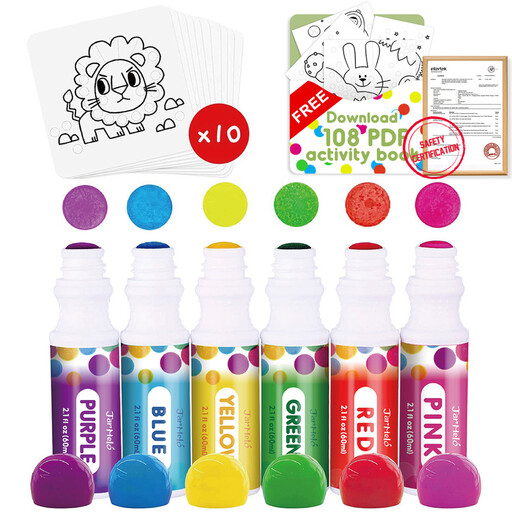
Why this product suits the profile: The six large-format markers are designed for little hands and are ideal for dots, lines and large areas.
No cup of water or brushes are needed. According to the product information, the ink is 90 per cent washable from skin and most fabrics; fresh stains should nevertheless be treated immediately.
Water-based, alcohol-free and odourless ink; includes activity sheets and access to additional PDF pages.
A window colour set is a good choice when you want to decorate windows, mirrors, tiles or sheets. The KREUL 42752 contains ten shades of 80 ml each, including outline and fluorescent paints, as well as sheets, templates, glass beads and instructions. It is intended for children aged 6 and over.
The order of application is important: apply the outlines first, then fill in the areas and allow the design to dry completely. According to the product information, liquid paint can be removed with lukewarm soapy water; dried paint may permanently stain textiles, however. The work surface should therefore be prepared in advance, and younger children should be supervised.
We have put together a complete, regularly updated list of products that fully meet these strict selection criteria and the safety regulations applicable in the EU.
This depends on the specific product. Some finger paints are intended for children aged 2 and over, while many paint boxes, marker sets and craft sets are only approved for children aged 3 and over. Window colour products are often aimed at children aged 6 and over. The manufacturer’s information on the packaging is decisive.
If containers are tightly sealed, stored in a dry place and protected from frost or direct sunlight, paints can remain usable for a long time. Pens should be closed fully after every use. Dried paint, changes in consistency or damaged packaging are reasons not to continue using the product. Any specific best-before date should be checked directly on the packaging.
No. “Washable” is not a guarantee for every fabric and every stain. Removal depends, among other things, on the material, how long the stain has been left and the washing temperature. Stains should be treated with water as soon as possible. With fabric paints, you must also follow the required fixing process.