
Lieferung heute & morgen

Qualitätsgarantie

Willkommens-Angebote freischalten: KOSTENLOSE Lieferung | Bis zu 80 % RABATT | Kostenlose 30-Tage-JoyPlus-Testphase
App herunterladen
Children’s play equipment should encourage movement, fit into your living space and be reliable in everyday use. Product descriptions often list numerous features, while important details receive little attention. Before buying, it is therefore worth taking a close look at the recommended age, weight capacity, space required and cleaning effort.
The stated maximum load does not always apply to several children or dynamic movement. With a children’s climbing frame, you must also check whether only one child may climb at a time. Children’s trampolines also commonly permit single-person use only and have a limited weight rating.
A piece of play equipment may generally be suitable for use indoors and outdoors without being designed to withstand continuous exposure to rain, UV radiation or damp ground. A children’s bouncy castle also requires a blower to run continuously. After using any water feature, the pool area and air channels must be dried completely.
A 5-in-1 or 6-in-1 play unit may sound versatile, but once assembled it often takes up more space than expected. Before buying, consider the footprint, height, safety clearances and potential trip hazards. This applies to a children’s slide just as much as to a Montessori climbing frame or an indoor play area for children.
The recommended age is a key safety parameter. For toddlers, low, softly padded elements with manageable climbing heights are suitable. A foam play set, for example, can be arranged as a crawling, climbing and balancing landscape. Older children may benefit from more challenging equipment, such as an agility ladder or a taller climbing element.
You should also consider the intended setting:
The maximum load should always be considered alongside the child’s weight and the forces generated during movement. A product with a load capacity of 25 kg is not suitable for older or heavier children. For a bouncy castle with a total load capacity of 135 kg, the stated limit of up to three children and a maximum of 45 kg per child also applies.
A climbing frame should be placed on level, stable and preferably soft ground. Freestanding wooden structures require regular checks of screws, ropes, rings and connections. Depending on the model and intended use, anchoring it to a wall may be advisable or expressly recommended.
For a foam play set, practical features include covers made from low-emission, skin-friendly materials, non-slip undersides and concealed zips. Washable covers make maintaining hygiene easier, particularly with a ball pit for toddlers. With the BanaSuper set featured here, the balls are not included and must be purchased separately.
For wooden play equipment, check for rounded edges, a stable construction and the manufacturer’s care instructions. The product information for the roba tower does not automatically state EN71-1, EN71-2 and EN71-3 for this model; buyers should therefore check the specific conformity information in the relevant product listing and instructions. Safety standards must not be applied indiscriminately from one product group to every individual item of equipment.

Why this product suits this profile: This modular set is designed for families who want to combine different types of movement and play in the children’s bedroom with one piece of equipment.
The soft foam elements reduce hard edges in the play area. Non-slip undersides and hook-and-loop fasteners help keep the components in position.
Removable, machine-washable covers; ball pit and building blocks in one set. Play balls are not included.
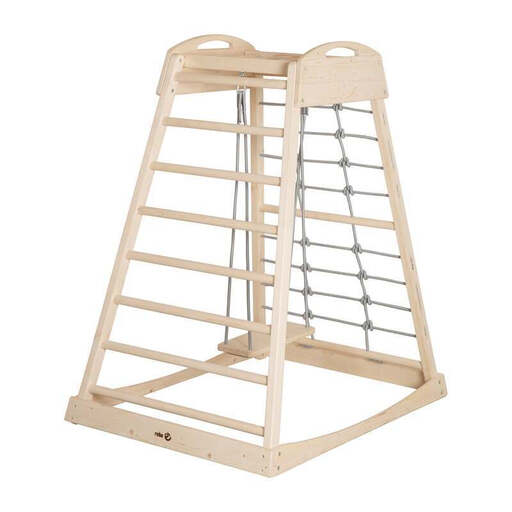
Why this product suits this profile: The natural wood construction is ideal for households looking for a permanent indoor movement unit with several climbing and swinging elements.
The dimensions of 127.5 × 83 × 110.5 cm make it easy to check the required floor space. The manufacturer states that it is suitable from 24 months, but also advises use under direct supervision and imposes a restriction for children under 36 months.
Climbing ropes, gymnastic rings and removable wooden swing; stated maximum load capacity of 70 kg.
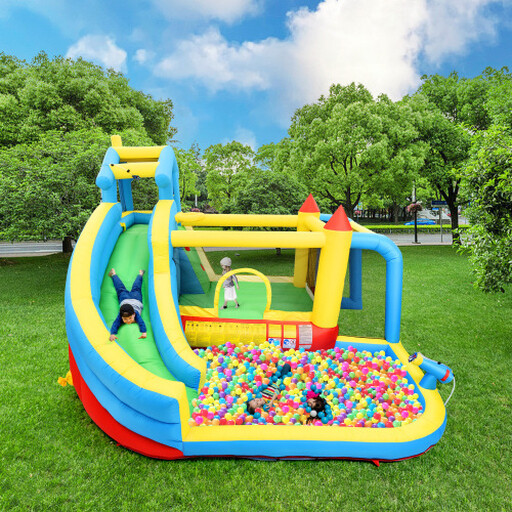
Why this product suits this profile: For gardens, birthdays or larger play areas, this bouncy castle offers several zones for children aged 3 to 10.
The assembled dimensions of 364 × 315 × 239 cm are clearly stated. The safety net, ground anchors, blower and limit of up to three children must all be taken into account when planning.
Combination of a bouncing area, slide, climbing area, water zone and football net; maximum total load of 135 kg according to the product information.
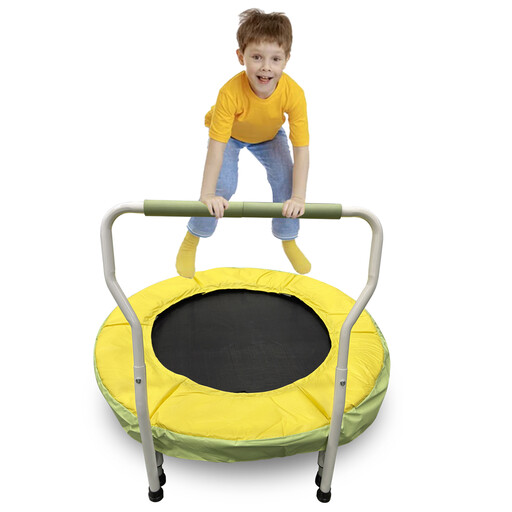
Why this product suits this profile: The compact 36-inch model with adjustable handle is suitable for households with limited space and supervised exercise sessions.
The maximum user weight of 25 kg and single-person use clearly limit how it can be used. The model has 24 springs and continuous protective padding.
Adjustable handle, steel frame and fully covered springs; check the frame, jumping mat and springs before every use.
We have put together a complete, regularly updated list of products that fully meet these strict selection criteria and the safety regulations applicable in the EU.
For settings such as nurseries or indoor play areas, you should also take account of internal supervision requirements, regular documentation and the manufacturer’s information.
This depends on the specific recommended age, height and use under supervision. Low foam elements may be suitable for younger children. With climbing towers, swings and trampolines, the manufacturer’s instructions should be followed particularly carefully, as some models include additional restrictions despite a general recommended age of 24 months.
For a single foam play set, the children’s bedroom will often provide enough space, provided there is sufficient room to move around it. A wooden climbing tower measuring 127.5 × 83 × 110.5 cm also requires clearance from walls, windows, radiators and furniture. The space needed therefore depends on more than just the external dimensions.
In addition to the purchase price, there are electricity costs for the blower, which must remain switched on during use. A water feature also involves water consumption and additional cleaning. After use, any remaining water should be removed and the bouncy castle dried completely before it is stored.