
Lieferung heute & morgen

Qualitätsgarantie

Willkommens-Angebote freischalten: KOSTENLOSE Lieferung | Bis zu 80 % RABATT | Kostenlose 30-Tage-JoyPlus-Testphase
App herunterladen
A children’s kitchen can encourage creative role play, shared play and sorting pretend food. However, when buying one, it is not just about how realistic the product image looks. The age recommendation, footprint, contents and whether light or sound functions are genuinely useful in everyday play are all important considerations.
A children’s kitchen with lights and sound may look appealing in product images. However, if there is no specific information about the battery type, volume, switches or replacement options, it is difficult to assess how practical it will be for everyday use. So check the following:
A play kitchen with fewer functions may be the better choice if it is clearly laid out and used regularly.
A long list of accessories does not automatically mean there are lots of ways to play. What matters is whether the pieces complement the kitchen and can be used in different play scenarios. With a children’s kitchen with accessories, parents should also pay attention to small parts. These can be lost or pose a risk to younger siblings.
A play kitchen needs more space than you might initially expect, as children need to stand in front of it, put accessories down and move around. Measure the intended area, including additional room for movement. The manufacturer’s age recommendation is equally important. A play kitchen for ages 3 and over is not automatically suitable for every three-year-old, particularly if it includes lots of small accessories.
Look for a clear age recommendation, warnings and information from the manufacturer. The CE marking is a mandatory conformity marking in the EU for many product groups; however, it does not replace parents’ own assessment. For toys, information about small parts, batteries and materials is also relevant.
In practical terms:
Compare the width, height and depth with the intended location. A kitchen that can be played with from both sides needs more room than a model designed for front-facing play only. Also check whether the product needs to be assembled and whether it requires a level surface.
It is worth looking closely at height information: product pages may give different measurements for the complete construction, the worktop or individual accessories. If the information is inconsistent, check the latest manufacturer or retailer description before buying.
Plastic is easy to clean in many play kitchens. However, the material is not the only important factor: also consider the edges, connections and care instructions. Pretend food should not be confused with real food. If you choose a miniature kitchen play set with very small parts, a compartmentalised storage box is recommended.
Anyone specifically looking for a toy kitchen for girls and boys can choose neutral accessory themes. Fruit, crockery, pans, shopping scenarios and cooking together are suitable for a range of role-play activities. Play does not need to be linked to a particular gender.
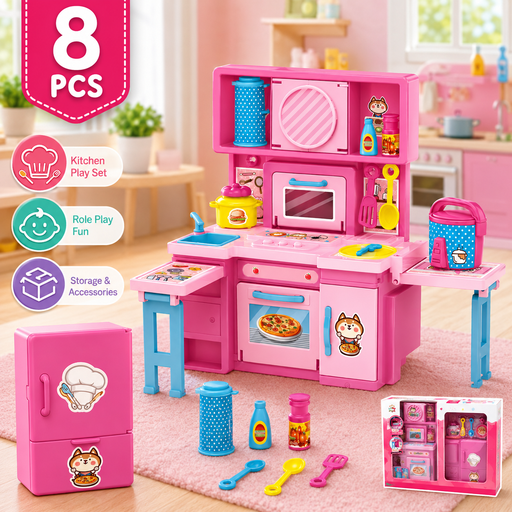
Why this product suits this profile: The 8-piece set offers an accessible introduction to kitchen role play and can be given as a birthday, Christmas or Halloween present.
The contents are clearly described as eight pieces. According to the product information, the colour or design may be selected at random, so this should be taken into account before buying.
8-piece kitchen play set, easy to incorporate into creative family activities and a compact range of accessories.
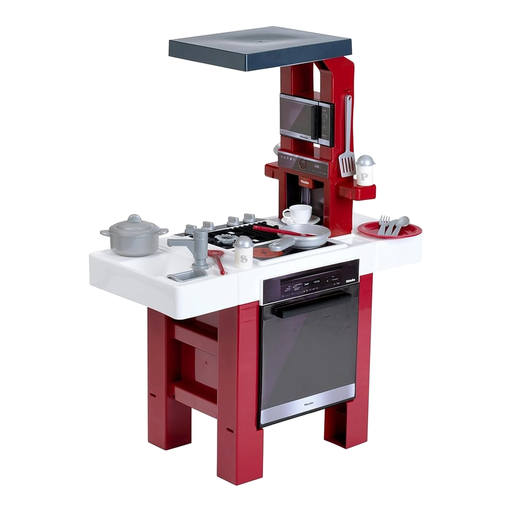
Why this product suits this profile: This model is designed for families who want to combine several play stations, such as an oven, microwave, gas hob and espresso machine, in one play kitchen.
The functions and accessories are listed in detail. However, the product information contains different age and battery recommendations, so these should be checked against one another before buying.
Sound and lighting effects, water-pump tap, play from both sides, plus accessories including pans, plates, cutlery and pretend food.
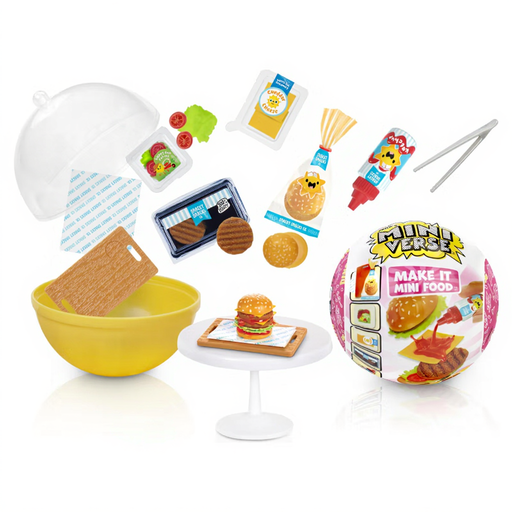
Why this product suits this profile: This set focuses on creating and displaying miniature food and is suitable for children who enjoy detailed crafting.
According to the product description, the ingredients are not edible. UV-activated resin, small parts and the blind-box format mean that the instructions must be followed and suitable supervision provided.
Recipe cards, mini table, packaging that doubles as a display stand and a selection from more than 100 listed ingredients and accessories.
We have put together a complete, regularly updated list of products that fully meet these strict selection criteria and the safety regulations applicable in the EU.
Before placing your order, it is worth running through this quick checklist:
For families who already own a kitchen, an additional pretend food set may be enough. Anyone wanting to recreate a range of everyday situations is more likely to benefit from a complete children’s role-play toy with several groups of accessories.
Many models are intended for children aged three and over. However, the specific manufacturer’s information, warnings and the child’s stage of development are the deciding factors. If a play kitchen for ages 3 and over contains small parts, it should only be used under supervision around younger siblings and all pieces should be put away afterwards.
How long it remains appealing depends on its size, accessories, build quality and the child’s interests. Models with an open-ended play concept can remain engaging for longer because they support shopping, cooking, serving and tidying up. Additional pretend food can also create new scenarios without replacing the entire kitchen.
Battery-operated functions may occasionally require replacement batteries. Before buying, check whether batteries are included, which type is needed and whether the effects can be switched off. With a model without electronic functions, this consideration does not apply; instead, the child’s freedom to shape their kitchen role play takes centre stage.