
Lieferung heute & morgen

Qualitätsgarantie

Willkommens-Angebote freischalten: KOSTENLOSE Lieferung | Bis zu 80 % RABATT | Kostenlose 30-Tage-JoyPlus-Testphase
App herunterladen
A children's play mat should cover the floor, be easy to clean and suit your child's age and how they use it. In practice, however, poor purchases are not caused solely by the material or design. Small surfaces are often advertised as spacious play areas, decorative designs are confused with practical features, or age recommendations are not given enough attention.
This buying guide helps parents, families and early-years education settings choose a baby play mat, crawling mat, EVA puzzle mat or children's play rug using clear, easy-to-understand criteria.
A mat with just a few puzzle pieces can look large in product images. What matters is the size once the pieces have been assembled. Six square pieces with sides measuring 12 inches result in an area of approximately 91.5 × 61 cm. That is enough for a small play corner, but offers considerably less space than a large crawling mat.
For several children, active games or a playroom, the surface area should be adapted at least to the space available. With interlocking mats, you should also check whether additional pieces using the same connection system are available.
Foam can make the floor more comfortable, but on its own it says nothing about grip on parquet, laminate or tiles. A non-slip play mat should be checked for stability after being laid out on the specific type of flooring. Raised edges, pulled-apart connections and creases increase the risk of tripping.
Before first use, check for damaged pieces. The mat should lie flat and must not be trapped under doors, furniture or radiators.
A play mat with a road design is not automatically suitable for babies. The manufacturer's information on minimum age, material and care is decisive. The Sombo model specifies a minimum age of 2 years; the product information also states that it is not suitable for children under 10 months. Use should always be supervised, particularly with babies and toddlers.
For a foam mat for children, EVA foam is a commonly used material. The product information should clearly state:
According to the product descriptions, several of the interlocking mats listed below are made from non-toxic EVA foam. This information comes from the respective manufacturer's details and does not replace your own check of the packaging and labelling information.
For textile mats such as the Sombo model, polyester is listed as the material. The washing or cleaning instructions and the mat's ability to retain its shape after being rolled up are particularly relevant here.
A compact set is suitable for a small corner in a nursery or children's room. A larger play mat for a playroom, on the other hand, should have as few interruptions as possible or be easy to extend securely.
Important comparison points include:
A foldable play mat can be stored away more quickly. An interlocking mat, meanwhile, can be adapted flexibly to the shape of the room. With both types, the floor should be clean, dry and level.
A wipe-clean surface is practical for food residue, dust and fingerprints. Nevertheless, you should follow the care instructions. Harsh cleaning products, high temperatures or standing water may damage the material and printed design.
If you also want to use a mat as a yoga and fitness mat or in a training area, check whether its size and thickness are sufficient for this purpose. A play mat is not automatically designed for heavy exercise equipment or sharp-edged objects.
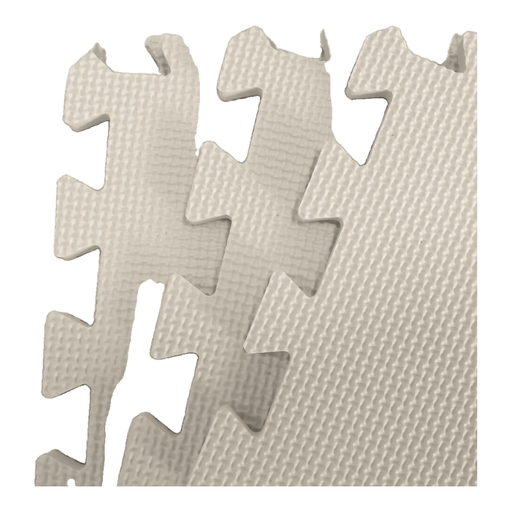
Why this product suits this profile: The compact set is ideal for a clearly defined play corner and can be assembled without tools.
The product details specify six square EVA pieces and ten edge pieces. This makes it easier to estimate the required floor area before buying.
Non-toxic EVA foam according to the product description; interlocking system and wipe-clean surface.

Why this product suits this profile: The large textile surface provides space for shared imaginative play and suits families looking for a clearly defined play concept.
At 100 × 190 cm, the play area is clearly specified. The minimum age of 2 years and the warning for children under 10 months should be taken into account before buying.
Reversible design with road and animal motifs; polyester surface and cleaning with a damp cloth according to the product description.
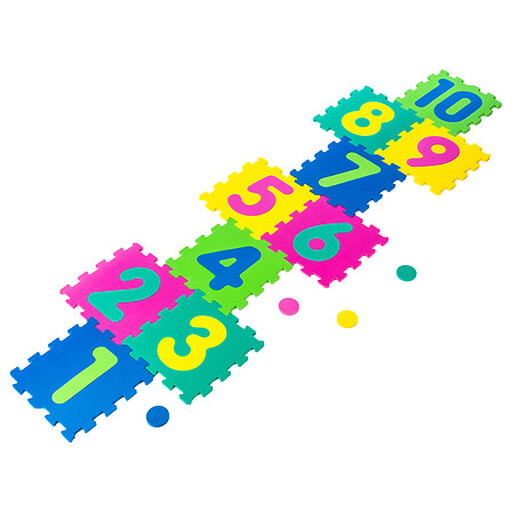
Why this product suits this profile: The combination of play area, hopscotch game and four foam pucks is designed for families, nurseries and pre-schools with changing activities.
The dimensions of the individual pieces and the overall size of approximately 58.1 × 198.7 × 1 cm are specified. This prevents a hopscotch mat from being judged solely by its design.
Ten EVA foam pieces, four pucks and suitability from 10 months according to the product information.
We have put together a complete, regularly updated list of products that fully meet these strict selection criteria and the safety regulations applicable in the EU.
Before setting up the mat, make sure the floor is free from grit, dust and moisture. Connect all interlocking elements fully; edge pieces can cover exposed edges. A new mat should be cleaned according to the care instructions and left to air thoroughly if it has a noticeable smell.
For everyday use, the following points are helpful:
Compact six-piece sets are sufficient for a single play corner. For crawling, building and active play, larger surfaces of around 100 × 190 cm or more are more practical. Before buying, measure the distance from furniture, doorways and the available storage space.
Its lifespan depends on use, cleaning, exposure to sunlight and storage. Frequent assembly and disassembly can put greater strain on the interlocking edges. Regularly checking for cracks, deformation and loose connections will show when individual pieces need replacing.
Most wipe-clean surfaces can be cleaned with a damp cloth and a mild, suitable cleaning product. The relevant manufacturer's instructions take priority. A textile mat should only be cleaned according to its stated care instructions and must be completely dry before being rolled up.