
Lieferung heute & morgen

Qualitätsgarantie

Willkommens-Angebote freischalten: KOSTENLOSE Lieferung | Bis zu 80 % RABATT | Kostenlose 30-Tage-JoyPlus-Testphase
App herunterladen
A children’s play mat needs to be soft, easy to clean and stable on the floor. In practice, though, it’s often only after you’ve bought one that you discover whether it really suits your family’s daily life. A small mat is fine for a baby during tummy-time training, whereas an active toddler needs more space and a robust surface. For nurseries, cleaning, modular expandability and a clear age recommendation are also important.
A non-slip play mat can behave differently on smooth tiles compared with laminate, carpet or PVC. What really matters are the details about the underside, the recommended use and the floor type. Even a mat with good grip can shift if dust, moisture or creases get underneath it.
A baby play mat isn’t automatically suitable for every age. Small accessories, electronic modules or detachable play figures may not be appropriate for younger children. So before you buy, you should always check the age recommendation on the product page and packaging against your child’s developmental stage.
Light effects, liquid movements and music can make play more varied. However, they also increase the need for cleaning and maintenance. With an interactive play mat, you should check the battery compartment, electronics, surface care and storage just as carefully as the design.
A puzzle mat made from EVA foam is lightweight, modular and easy to assemble. EVA tiles can be clicked together, taken apart and rearranged as needed. Look out for:
“Non-toxic” or “safe” shouldn’t be taken at face value as a marketing promise. Check whether the manufacturer provides specific material information, warnings and usage instructions.
Measure the available space before you buy. A crawling mat needs to be positioned so that your child isn’t playing right next to furniture edges, stairs or doors. For small flats, six square tiles or a roll-up mat are practical. For group rooms, modular sets with 18 pieces can be more adaptable.
A play rug measuring 100 × 190 cm offers a long play surface, but you’ll need enough storage space once it’s rolled up. A children’s bouncy mat, on the other hand, is narrower and designed for active games. So the shape should match the planned activity, not just the available pattern.
For an indoor play mat, the care instructions should be clearly understandable. Wipe-clean materials make daily cleaning easier. Washable textile surfaces are useful, but they need to be treated according to the manufacturer’s instructions.
Electronic products must not be submerged in water. With battery-operated models, you should remove the batteries if the mat won’t be used for a long time. Also check seams, edges, connectors and cable areas regularly for wear and tear.
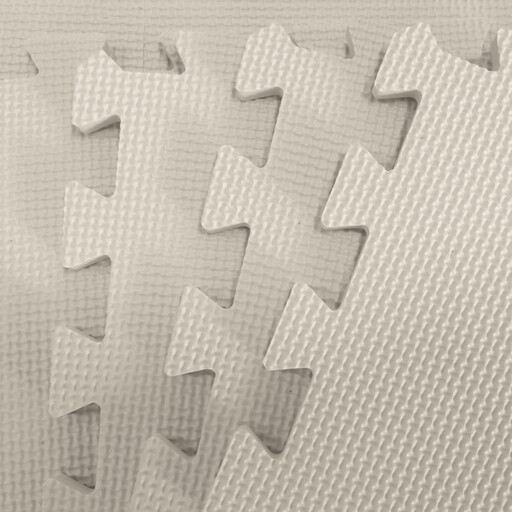
Why this product fits the profile: The set consists of six EVA foam tiles with a click-together system and ten edge pieces. It’s ideal for families looking for a compact, neutral mat for indoor use.
The modular design can be taken apart and cleaned separately when needed. Before use, check the connections and the chosen floor surface.
EVA foam, click-together connectors, six tiles and removable edge pieces.
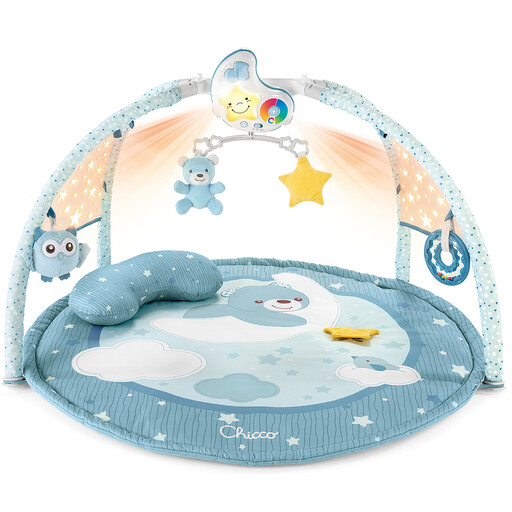
Why this product fits the profile: According to the product details, this 3-in-1 play gym is suitable from birth and combines a round play mat with an 83 cm diameter, cushions, a projector and detachable play elements.
The product description specifies concrete timer settings of 15 and 30 minutes, as well as washing instructions for the mat and cushion. Electronic parts must only be cleaned dry.
Washable mat and cushion, three play modes, detachable projector and several play elements.
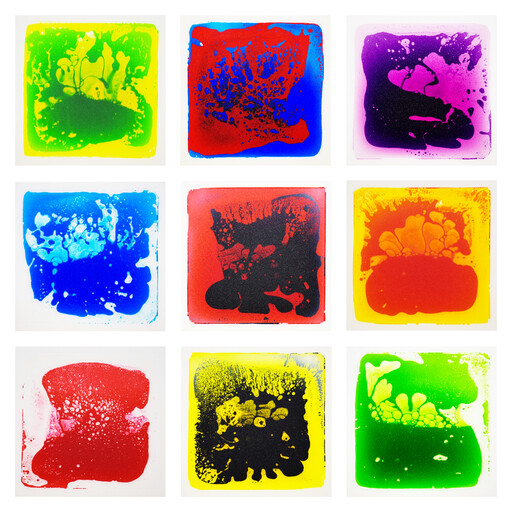
Why this product fits the profile: The nine liquid-filled tiles are designed for indoor use and, according to the product description, respond to steps, jumps and dance movements. This makes them interesting for playrooms, group rooms or sensory activities.
The reinforced PVC underside is specified as a non-slip base. Nevertheless, the surface should be dry, level and free of dust when in use.
Nine separate tiles, dynamic liquid movement and a non-slip PVC underside.
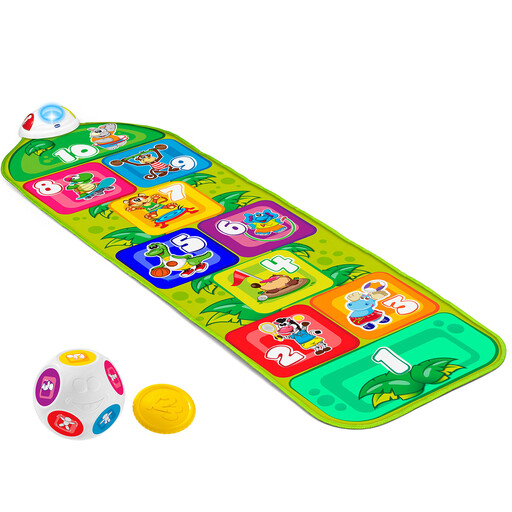
Why this product fits the profile: According to the product details, this 150 × 40 cm electronic bouncy mat for children is aimed at kids aged 24 months and over, and offers two play modes with lights, sounds and motion sensors.
The instructions specify a flat, dry floor and cleaning with a damp cloth. Small accessories require extra supervision.
Two play modes, ten illuminated zones, more than 30 sounds and melodies, and compact dimensions.
We’ve put together a full, regularly updated list of products that fully meet these strict selection criteria and the safety regulations in force in the EU.
For babies, a flat, sufficiently large surface, a clear age recommendation and easy-to-clean materials are crucial. A play gym with cushions and detachable elements can be suitable for early play. Small parts must be kept out of reach if, according to the warning label, they are not intended for babies.
EVA tiles and plastic surfaces can usually be wiped down with a slightly damp cloth and a mild cleaning agent. Textile mats should only be cleaned according to the care label. Electronic modules must not be held under water. The surface must be completely dry before the next play session.
The lifespan depends on the material, how much it’s used, how it’s stored and how it’s cared for. Click-together mats can be assembled and disassembled several times if handled carefully. Check edges, seams, connectors and electronic components regularly. If there are tears, loose material or damaged cables, the mat should no longer be used.