
Lieferung heute & morgen

Qualitätsgarantie

Willkommens-Angebote freischalten: KOSTENLOSE Lieferung | Bis zu 80 % RABATT | Kostenlose 30-Tage-JoyPlus-Testphase
App herunterladen
A children’s puzzle should suit the child’s age, experience and everyday routine. However, product descriptions do not always make it easy to choose the right one. Large picture designs, familiar characters or claims such as “educationally valuable” do not, on their own, indicate whether a puzzle is genuinely easy to handle.
Three common purchasing mistakes occur particularly often:
Your choice should therefore be based not only on the picture, but also on the recommended age, piece format, material, where it will be played and the desired level of difficulty.
The manufacturer’s age recommendation is an important starting point. It generally takes the number and size of the pieces into account, as well as the ability to match colours and shapes. However, it does not replace an assessment of the child’s individual experience.
As a practical guide:
A children’s educational puzzle can also introduce geographical, natural-history or astronomical topics. However, the educational value mainly comes from discussing the picture together; the puzzle itself should still be appropriate for the child’s age.
A frame puzzle gives beginners a clearly defined boundary. Printed outline markings can show where individual pieces belong. This reduces movement and makes it easier to find your way around the table.
For older children, loose puzzle pieces offer greater flexibility. Here, a clear picture layout, easily distinguishable colours and a suitable finished size are important. Measurements such as 27.5 × 19 cm or 33 × 21 cm help you assess whether there is enough room for playing and storing the puzzle.
Safety should also be considered when pieces are small: products containing pieces that could be swallowed are not suitable for children under three. The relevant age and safety information on the packaging should be read before purchase and before first use.
For frequent use, sturdy cardboard pieces with cleanly cut edges are practical. A matt or linen-textured surface can reduce reflections on the table. These features should be checked objectively in the product information and should not be treated as a general guarantee of quality.
Boxes, metal cases or compact travel games are ideal for families with limited storage space. A travel game for children should ideally hold all the pieces securely and require little preparation. With plastic games such as the SmartGames IQ Puzzle, it is also important that all the pieces can be stored back in the container after play.
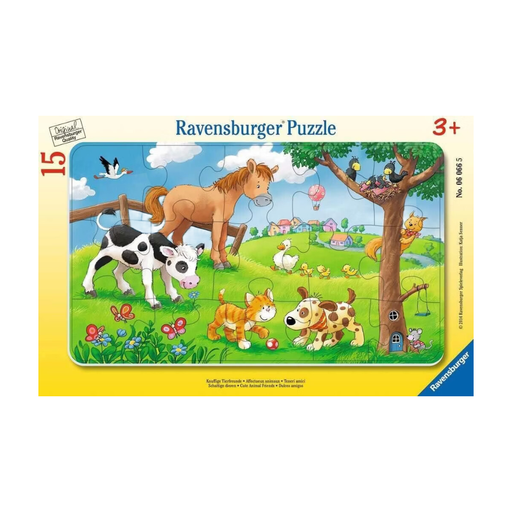
Why this product suits this profile: This frame puzzle is designed for children from age 3 and offers an accessible starting point with 15 pieces. The animal pictures are ideal for shorter play sessions.
The frame and outline markings make matching easier. This means getting started does not depend solely on the picture shown on the packaging.
15 sturdy pieces, an integrated base and an age recommendation from 3 years.
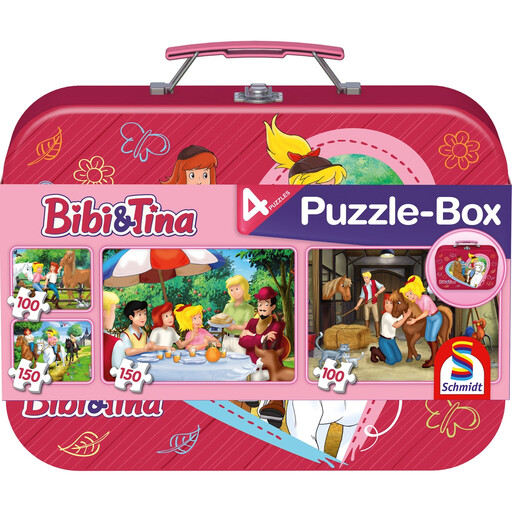
Why this product suits this profile: The box contains four pictures with 2 × 100 and 2 × 150 pieces and is designed for children from age 6. The metal case makes it easier to store the puzzles separately.
The number of pieces is clearly stated for each picture. Posters with cutting outlines provide extra guidance for children who are not yet used to larger puzzles.
Four pictures, 1.9 mm-thick cardboard, a matt linen-textured surface and a metal case.
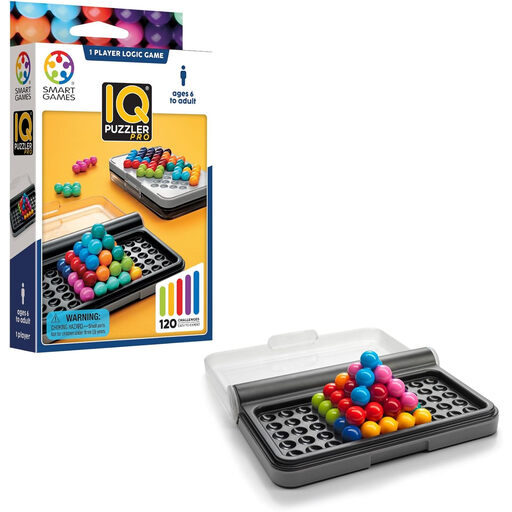
Why this product suits this profile: This compact logic game for children from age 6 is suitable for solo play and travel. It requires no batteries and can be used at home or while away.
This is not a traditional picture puzzle with loose cardboard pieces, but a compact placement and logic game with clearly described game modes.
120 challenges, 2D and 3D game modes, a compact format and a solo-play concept.
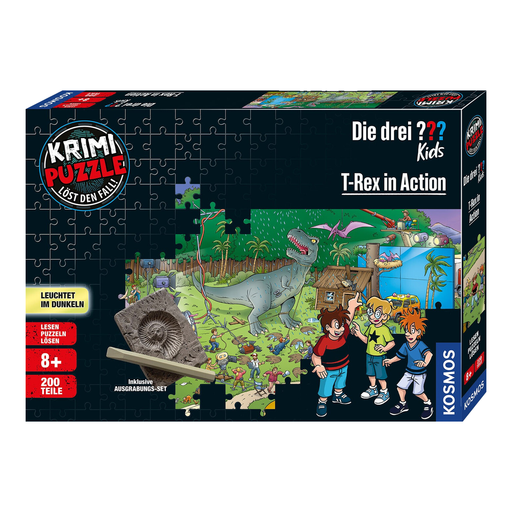
Why this product suits this profile: This 200-piece puzzle combines a dinosaur story, a glow-in-the-dark picture and a detective challenge. It is designed for children from age 8.
The product is clearly a multi-part experience: reading, puzzling and solving riddles all work together. This offers more than just a picture; it provides a specific play sequence.
200 pieces, an integrated story, an excavation kit with clue and a glow effect in the picture.
We have put together a complete, regularly updated list of products that fully meet these strict selection criteria and the safety regulations applicable in the EU.
The picture influences motivation, but it should match the level of difficulty. Animals and clear everyday scenes are often easy to structure. Dinosaurs, space and fairy tales appeal to children with a strong interest in these subjects; however, large areas of a single colour can make the puzzle more difficult to complete.
For use on the go, compact games such as a children’s travel game or a SmartGames IQ Puzzle are ideal. Puzzle boxes containing several pictures are practical for afternoons spent playing together. If you are looking for a gift, you should also check that the age recommendation, number of pieces and packaging are suitable for the intended child.
This depends on the child’s experience and the picture. 60 to 100 pieces are often a manageable range. 150 or 200 pieces are better suited to children who already puzzle regularly and are happy to play for longer periods.
Frame puzzles with a small number of sturdy pieces can be suitable for children from age 3 if this is stated in the manufacturer’s recommendation. The outlines on the base make it easier to find the right position. Because of the potential presence of small pieces, the safety information should be observed.
A cardboard puzzle should be stored in a dry place and handled carefully. A plastic logic game can be practical for frequent transport, but it also needs to be stored securely and with all parts together. Its lifespan therefore depends largely on the material, how it is used and how it is stored.