
Lieferung heute & morgen

Qualitätsgarantie

Willkommens-Angebote freischalten: KOSTENLOSE Lieferung | Bis zu 80 % RABATT | Kostenlose 30-Tage-JoyPlus-Testphase
App herunterladen
A children’s puzzle from age 3 should not overwhelm little hands while still providing enough encouragement to keep going. In practice, however, it is not just the picture and number of pieces that determine whether a puzzle will be used regularly. The piece format, surface, storage and specific age recommendation also play an important role.
Parents, grandparents, relatives and nurseries are faced with a huge choice: 24-piece children’s puzzles, children’s frame puzzles, educational children’s puzzles or sets featuring familiar characters. The following criteria will help you assess marketing claims and choose a children’s puzzle that matches the child’s stage of development.
“24 pieces” or “48 pieces” sounds clear at first. However, the actual difficulty also depends on the picture, the size of the pieces and the distribution of colours. A detailed image with lots of similar areas can be more challenging than a clearly structured picture with the same number of pieces.
As a rough guide:
These figures are not a substitute for an individual assessment. Some children enjoy starting with a more challenging puzzle, while others benefit from achieving success quickly.
A Disney Frozen puzzle, Paw Patrol puzzle, dinosaur puzzle or vehicles puzzle can attract a child’s attention. However, an appealing picture is of little help if the pieces are difficult to pick up or the completed image provides no clear points of reference. For beginners, clearly recognisable characters, animals and vehicles, along with high-contrast areas, are usually easier to identify and match.
Look for meaningful product details such as material, surface finish, piece format and fit. For children’s cardboard puzzles, a matt, low-glare surface and sturdy construction are practical features. They will not automatically prevent wear and tear, but they can make the puzzle easier to handle when used frequently.
The manufacturer’s age recommendation is an important starting point. A product marked “from age 3” is not automatically suitable for every younger child. Small puzzle pieces may be swallowed, so children should be supervised in an age-appropriate way while playing. The relevant warnings are particularly important for children under three.
With a puzzle from age 4, you can also check whether the number of pieces matches the child’s previous experience. A child who can already confidently assemble 24 pieces can gradually be introduced to a greater challenge with a 48-piece children’s puzzle.
A 24-piece children’s puzzle is often suitable for a child’s first independent attempts. Several individual pictures in one set provide variety without requiring the child to complete one very large image straight away. A 48-piece children’s puzzle is more suitable for children who already have experience sorting and matching pieces.
A children’s frame puzzle has a fixed border or base. This can make positioning easier because the picture is already spatially defined. With traditional puzzles, posters, templates or clearly separated picture areas can help children get started.
Practical features include:
Storage is particularly important for nurseries and educational settings. If a set contains several pictures, they should be easy to separate and store complete after play.
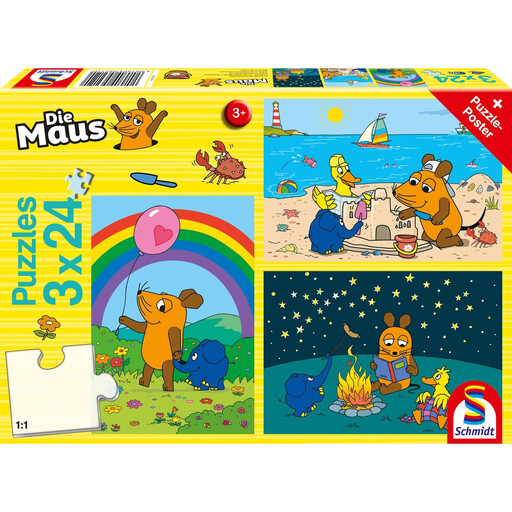
Why this product suits this profile: Three animal pictures with 24 pieces each offer a manageable introduction for children from age 3, while also providing variety for everyday play.
The number of pieces matches the commonly recommended starting point from age 3. Three separate pictures prevent repetitive play.
3 × 24 pieces, animal and friendship pictures, a matt linen texture and, according to the product details, precisely cut cardboard pieces.
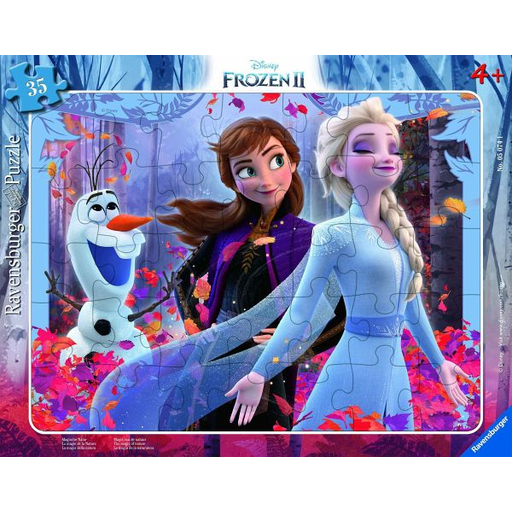
Why this product suits this profile: Featuring a Disney Frozen picture, this frame puzzle is designed for children from age 4 who benefit from visual guidance while completing a puzzle.
The base provides guidance and reduces the difficulty that can arise with a loose picture containing similar image areas.
35 pieces, frame with base, completed size 32,5 × 24,5 cm and an Anna and Elsa picture.
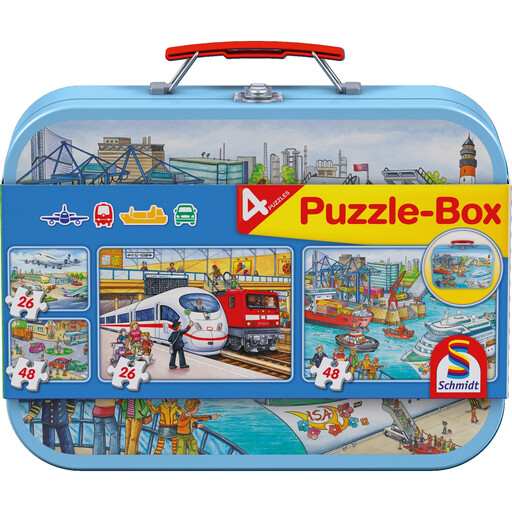
Why this product suits this profile: Four pictures featuring cars, trains and aeroplanes, together with a metal case, make this set suitable for children from age 4 and regular use.
The included puzzle posters mark the cutting lines, making it easier to match the pieces. The case supports organised storage.
4 puzzles with 2 × 26 and 2 × 48 pieces, a metal case, matt surface and posters with orientation lines.
We have put together a complete, regularly updated list of products that fully meet these strict selection criteria and the safety regulations applicable in the EU.
A children’s puzzle makes a suitable gift for children when the child’s age and interests are taken into account. Puzzles for girls and boys are available with neutral themes such as animals, everyday life, nature and vehicles, as well as characters from films and TV series. What matters is not assigning a theme to a particular gender, but whether the picture is familiar and interesting to the child.
A set with different pictures can be a sensible choice for several children. In a group setting, it is also advisable to check the pieces before putting them away and store each puzzle separately. With younger children, sorting the pieces together can make it easier to get started without taking away from the child’s opportunity to complete the puzzle independently.
A usual guideline is 12 to 24 pieces. A 24-piece children’s puzzle is often suitable for children who have already gained some initial experience. The age recommendation, piece size and picture should be considered together.
A frame puzzle can make it easier to find the right position, as it includes an outer boundary and, in some cases, a base. For children from age 3, it is important that the pieces are easy to grip and that the manufacturer’s safety information is followed.
Its lifespan depends on the thickness of the cardboard, cutting quality, frequency of use and storage. Dry storage, removing the pieces carefully and keeping them all in the original box can extend the useful life of a puzzle. Puzzle pieces should not be put in the mouth or stored in damp areas.