
Lieferung heute & morgen

Qualitätsgarantie

Willkommens-Angebote freischalten: KOSTENLOSE Lieferung | Bis zu 80 % RABATT | Kostenlose 30-Tage-JoyPlus-Testphase
App herunterladen
A children’s puzzle may be enjoyed for a long time or left untouched after just a few days. The deciding factors are not only the picture and brand name, but above all the age rating, piece size, material and level of difficulty. Parents, grandparents and other relatives should therefore check before buying whether the puzzle suits the child’s stage of development and intended use.
A high number of pieces often looks challenging and versatile on the packaging. For younger children, however, a puzzle with too many small pieces can quickly become confusing. A children’s puzzle for ages 3 and up with 12 or 15 pieces and a frame offers a different starting point from a children’s puzzle for ages 6 and up with 100 XXL pieces.
The age recommendation is therefore an important starting point, but it does not replace assessing the individual child. Experience with puzzles, attention span and interest in the picture also play a part.
The term ‘educationally valuable’ is not, on its own, a measurable quality criterion. Specific features are more meaningful: outlines in the frame, numbered pieces, a solution booklet, seek-and-find pictures or different difficulty levels. A learning puzzle should offer a clear play element that genuinely incorporates perception, matching or spatial thinking into the gameplay.
Small puzzle pieces can pose a choking hazard for children under 36 months. Even with older children, it is sensible to follow the information on the packaging and store all the pieces safely after playing. A 3D puzzle for children comes with additional requirements, such as more complex assembly, moving elements or small balls.
For beginners, frame puzzles with 12 to 15 pieces are often suitable. The outline helps with matching and gives the child a clear visual guide. For a children’s puzzle for ages 4 and up, 24 pieces or two separate 24-piece pictures can be a possible next step.
For children aged 6 and over, 100 XXL pieces may be appealing. From around the age of 7 or 8, more challenging logic games and 3D models may be suitable. It is important to consider whether the product involves free-form assembly, step-by-step instructions or a specific challenge.
Traditional puzzles are usually made from printed cardboard. Look for sturdy, sufficiently thick pieces, clearly recognisable pictures and a shape that is comfortable for small hands to hold. A frame, mat or poster can make storage and assembly easier.
For plastic or wooden products, check the manufacturer’s material information. For a mechanical model, power supply, cleaning and a stable playing surface are also relevant.
A puzzle intended for playing together can be somewhat more challenging than a product designed for one child to use alone. A logic game for children with individual challenges, for example, is suitable for quiet entertainment while travelling. A large-format picture, on the other hand, may be better suited to a table in the child’s bedroom.
Also check whether batteries are required, how many players the game is designed for and whether accessories such as a mat, poster or solution booklet are included.
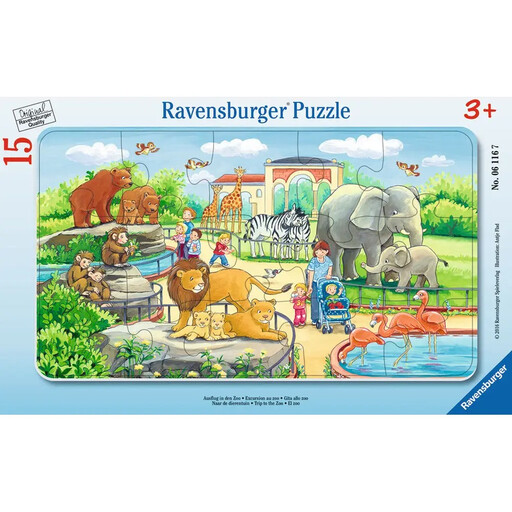
Why this product suits this profile: This frame puzzle is designed for children aged 3 and over and offers an accessible introduction with 15 pieces. The zoo picture can encourage conversations about animals and colours.
The outline markings on the mat give beginners clear guidance. This means the child does not have to match every piece solely through trial and error.
15 pieces, frame with outlines, cardboard construction and no batteries required.
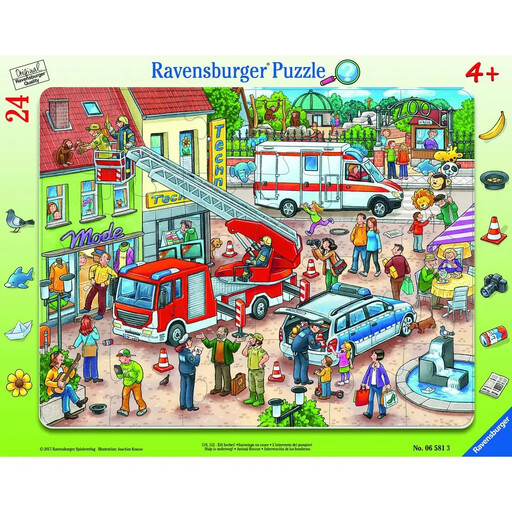
Why this product suits this profile: This set is designed for children aged 4 and over and combines a 24-piece frame puzzle with an additional matching game. The practical mat makes assembling the puzzle at home easier.
The number of pieces and age recommendation are clearly stated. The additional game provides a second way to play, rather than relying solely on an eye-catching picture.
24 pieces, frame and mat, additional matching game, cardboard construction and no batteries required.
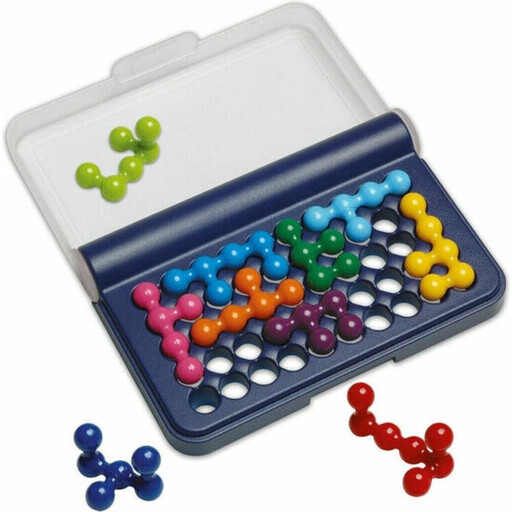
Why this product suits this profile: This compact solo game is designed for children aged 6 and over and is ideal for travel, waiting times or focused play sessions. The challenges are set up using the included booklet.
The product description clearly specifies solo play, the challenge booklet and the age recommendation. This makes its intended use clearer than that of a toy without a defined play structure.
Compact plastic case, solo play, age recommendation from 6 years and challenges with increasing difficulty.
For older children, teenagers and adults, a 3D puzzle for children aged 8 and over or more challenging models may also be suitable. The Ravensburger 3D Heart with 54 pieces is assembled without glue and can then be used as a small storage box. For technically minded users aged 14 and over, the Robotime ROKR Marble Spaceport offers a considerably more complex assembly with wooden pieces, a marble run and a USB-powered motor. The relevant age recommendation and warnings about small parts should always be followed.
We have put together a complete, regularly updated list of products that fully meet these strict selection criteria and the safety regulations applicable in the EU.
For beginners, frame puzzles with around 12 to 15 pieces can be a good choice. Check the age recommendation, piece size and manufacturer’s safety information before buying. An accompanying adult can help younger children sort and match the pieces.
That depends on the child’s age and experience. For beginners aged 3 and over, 12 to 15 pieces are often suitable. Children’s puzzles for ages 4 and over may contain 24 pieces or two separate pictures. From age 6, 100 XXL pieces may be suitable, while logic games with a challenge booklet work independently of a traditional piece count.
A puzzle makes a particularly good gift when the child’s age, preferred picture and ability level are known. For a safe choice, compare the number of pieces, material, dimensions and warnings with the intended place of use. For older children, 3D models or compact logic games can be an alternative to a traditional picture puzzle.