
Lieferung heute & morgen

Qualitätsgarantie

Willkommens-Angebote freischalten: KOSTENLOSE Lieferung | Bis zu 80 % RABATT | Kostenlose 30-Tage-JoyPlus-Testphase
App herunterladen
Children’s vehicles range from a simple children’s tricycle to a motorised off-road model. For parents and grandparents, the design is only part of the picture. Age, height, speed, load capacity, terrain and supervision determine whether a vehicle fits everyday life. A low price can prove impractical if spare parts are unavailable, the seating position isn’t right, or the vehicle only works on smooth, flat ground.
“From 3 years” is a rough guide. Children develop differently, and the right seat height or handlebar position is often more telling. For a children’s vehicle for ages 3+, you should also check:
An oversized electric motorbike for children can make control harder. A vehicle that’s too small will quickly become uncomfortable and shorten its useful life.
High speed isn’t automatically an advantage. For beginners, multiple speed modes, a controlled pull-away and an easy-to-reach brake matter more. A children’s electric vehicle should only be used on suitable, private premises. Public roads and cycle paths are not intended for many motorised toy vehicles.
Battery life and range depend on weight, incline, surface, temperature and speed mode, among other factors. With an electric kids’ car or an off-road motorbike for children, don’t look at watt-hours alone. Also check charging time, battery swap options, the charger and how to store the battery correctly.
The manufacturer’s age guidance is a starting point, but it doesn’t replace checking measurements. With motorised vehicles, low speed modes and parental limits are helpful. For a kids’ scooter, adjustable handlebar height, a non-slip deck and a working rear brake are key. Safety warnings like “not suitable for children under 3 years” must be observed; small parts can pose a choking hazard.
For asphalt, concrete and wooden surfaces, different tyres can suffice than for mud, grass or gravel. A kids’ quad or an off-road motorbike for children needs adequate ground clearance and tyres with a suitable tread. Hydraulic disc brakes, suspension and an emergency cut-off switch are technical features that should be checked individually on more powerful models.
Also pay attention to product information on the electrical ingress protection rating. Designations such as IP54, IP65 or IP67 refer to defined protection conditions and are not a free pass for riding through water. After any outdoor use, check the vehicle, battery connections and charger.

Why this product suits the profile: The pedal drive needs no battery and is suitable for children aged 3 to 8 on appropriate, flat surfaces.
The two-stage seat adjustment reduces the risk of the vehicle becoming unusable early because of a poor seating position.
Metal frame, forward and reverse gears, 30 kg load capacity and 20° steering angle limiter according to the product details.
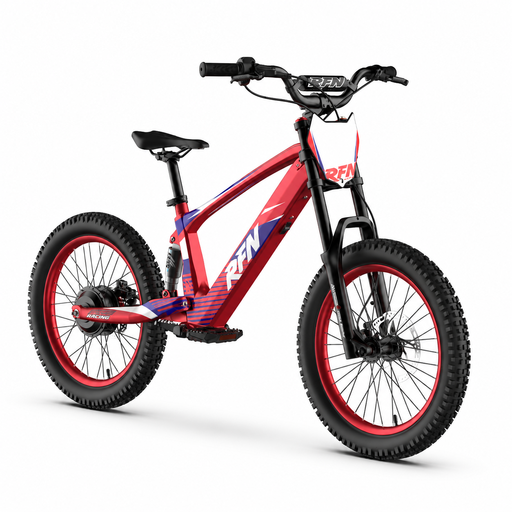
Why this product suits the profile: This model is aimed at taller, more experienced users seeking a more powerful off-road motorbike for children on private outdoor spaces.
Three speed modes at 15, 25 and 35 km/h allow gradual adjustment rather than only a high top speed.
36 V, 750 W rated output, 20-inch tyres, hydraulic brakes, 75 kg maximum load and IP66 stated for the electrical system, according to the spec sheet.
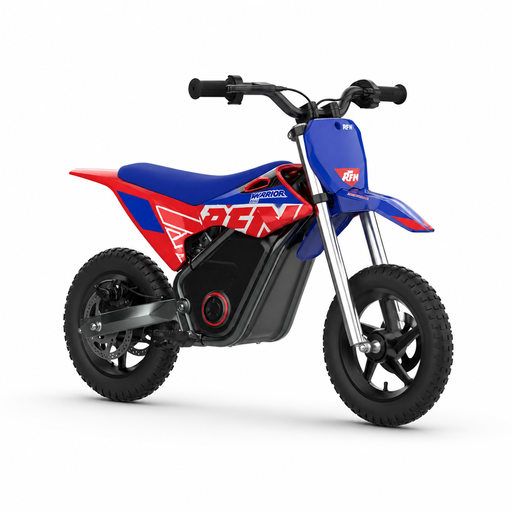
Why this product suits the profile: The three speed modes and off-road tyres appeal to families planning supervised rides on private paths and natural terrain.
The listing gives concrete speed modes, a seat height of 490 mm and a possible speed limit. That makes it easier to check the fit before buying.
14-inch off-road tyres, front and rear suspension, 36 V battery, disc brakes and a stated range of 18 km.
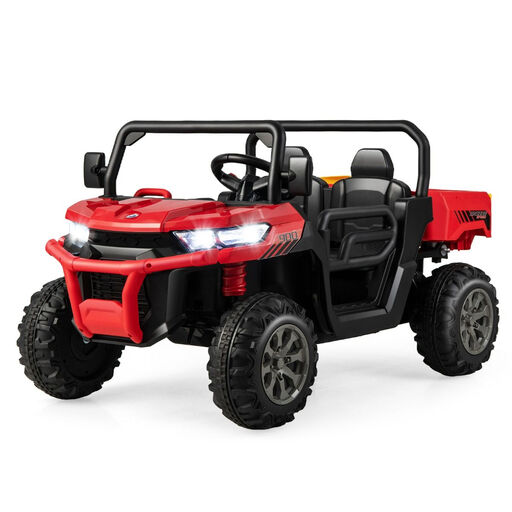
Why this product suits the profile: Two seats and a remote control are ideal for shared rides by children aged 3 to 8 with supervision.
The stated top speed of 3 to 8 km/h and the soft-start function limit the dynamics compared with more powerful vehicles.
Two seats, 50 kg load capacity, 12 V battery, suspension, safety belt and 2.4 GHz remote control, according to the product description.
We’ve compiled a complete, continuously updated list of products that fully meet these strict selection criteria and the safety regulations applicable in the EU.
That depends on height, motor skills and where it will be used. A tricycle, a simple scooter or a pedal go-kart are often easier to control than a powerful electric motorbike. Key factors are the manufacturer’s guidance, seat or handlebar height, and direct supervision.
Runtime varies with the battery, weight, surface and speed mode. A 12 V vehicle at low speed is designed for short, supervised rides. Before buying, check charging time, spare battery options and storage. A range figure from the spec sheet is a guide, not a guarantee for every situation.
Electricity costs per charge are usually modest. Families should also factor in potential battery replacement, batteries for remote controls, tyre wear and spare parts. With a scooter or pedal vehicle there are no charging or battery costs, whereas off-road models can involve more maintenance and the cost of protective gear.