
Lieferung heute & morgen

Qualitätsgarantie

Willkommens-Angebote freischalten: KOSTENLOSE Lieferung | Bis zu 80 % RABATT | Kostenlose 30-Tage-JoyPlus-Testphase
App herunterladen
A children's ride-on vehicle can combine exercise, imaginative play and quality time outdoors. The range extends from electric children's ride-on vehicles and children's electric cars to classic pedal go-karts. However, eye-catching designs and numerous extra features do not automatically make a vehicle the right choice.
Before ordering, parents, grandparents and other family members should therefore check whether the vehicle is suitable for the child's age, weight, the surfaces it will be used on and their everyday routine. Our selection highlights the technical details that matter and the common buying mistakes you can avoid.
‘Suitable from 3 years’ is not enough to make an informed choice. You should also consider load capacity, seat size, controls and the child's height. A vehicle with a maximum load of 30 kg may be unsuitable for an older, heavier child, even if the age recommendation still appears to fit.
With an electric children's vehicle, parents should also establish whether the child will drive independently or whether an adult will initially take control using a remote. A children's ride-on vehicle with remote control provides an additional steering option, but it does not replace supervision.
With electric models, battery capacity, charging time and the riding environment are crucial. A vehicle with a 12-volt battery may run for different lengths of time depending on the surface, load and riding style. Figures such as ‘up to 15–20 kilometres’ should be understood as the manufacturer's stated range, not a guaranteed distance for every situation.
The charging requirements are also important. Some ride-on vehicles have a stated charging time of around 8 to 12 hours. If the vehicle is to be used the following day, the battery should therefore be charged in good time.
Music, lights, a USB port or an MP3 player can enhance play value, but they reveal little about the vehicle's practical suitability. The priorities should be a safety belt, a stable seating position, controllable speed, braking capability and a stable construction.
A safety belt on a children's ride-on vehicle should fit correctly and be suitable for the child's height. For younger children, a low centre of gravity or anti-tip protection may also be relevant. Parents should check the information in the instruction manual before the first ride.
The age recommendation is only useful when considered together with the maximum load. For example, models with a load capacity of 30 kg may be suitable for a child aged 3 to 8. A two-seater children's ride-on vehicle with a maximum load of 50 kg is generally suitable for two smaller children, provided that the seat width, safety belts and actual weight distribution are appropriate.
The external dimensions are important too. A vehicle measuring 151 × 68 × 70 cm needs enough space for storage, doors and turning manoeuvres. Before buying, measure whether it will fit in your cellar, garage or storage room.
With electric children's ride-on vehicles, a moderate speed is often easier for younger children to control. The 12-volt model mentioned above travels at 3 to 8 km/h according to the product information. The Rictor C8 offers three speed settings of 5, 10 and 15 km/h; the limit can be set using a parental app.
A 2.4 GHz remote control allows adults to operate several electric ride-on vehicles. Check whether it includes an emergency stop function, several speed settings or only basic directional controls.
PP wheels may be designed for grass, asphalt or sand. Even so, the surface should be as level as possible, free from obstacles and suitable for the particular model. A children's buggy or electric children's tractor with larger wheels may be more practical outdoors than a small vehicle designed for smooth indoor surfaces.
With a pedal-powered children's go-kart, there is no battery, charger or electric control system to worry about. However, the child must have enough strength and coordination to operate the pedals and handlebars. A metal frame, hard-wearing wheels and an adjustable seat are objectively verifiable features that may be relevant to the vehicle's lifespan.

Why this product suits this profile: This pedal-powered vehicle needs no battery and is suitable for children aged 3 to 8. The two-position adjustable seat can make it easier to use the go-kart through several stages of growth.
There are no hidden charging times or battery specifications to consider. With a 30 kg load capacity and mechanical pedal operation, its intended use is clear.
Adjustable seat, metal frame, forward and reverse gears, plus hard-wearing wheels.
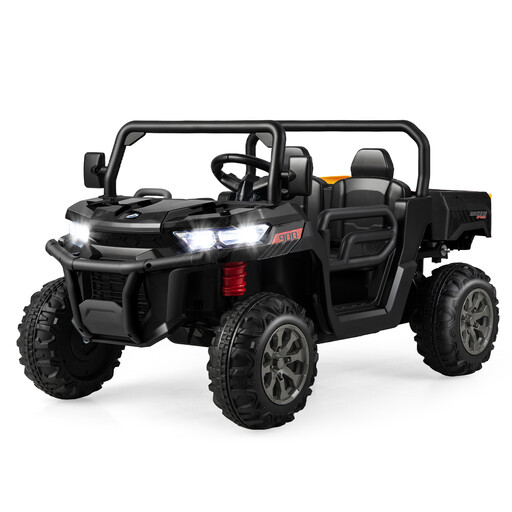
Why this product suits this profile: This model is designed for families who want two children to ride together and value remote control, a safety belt and a clearly limited speed range.
The specifications state two seats, a 50 kg load capacity and a speed of 3–8 km/h. This makes it easier to assess the space required and how the vehicle will be used before buying.
Two seats, 2.4 GHz remote control, safety belt, soft-start function, suspension and two drive motors.

Why this product suits this profile: According to the product information, this vehicle is intended for children aged 5 to 12. The folding design, app control and three speed settings are useful for families with limited storage space.
The app allows the speed to be limited. The five-wheel design, low centre of gravity and puncture-proof solid rubber tyres are clearly stated construction features.
120 W motor, 24 V battery with a stated range of 15–20 km, folding design and three selectable speeds.
We have put together a complete, regularly updated list of products that fully meet these strict selection criteria and the safety regulations applicable in the EU.
This depends on the child's height, weight and motor skills. A children's ride-on vehicle suitable from age 3 should offer an appropriate seating position, controls that are easy to reach and a manageable speed. A pedal go-kart is a battery-free option, while an electric model with remote control gives adults additional control.
The running time depends on the battery, motor, weight, surface and riding style. Manufacturer specifications should therefore be treated as guidelines. Charging time and battery capacity should be considered together. If the vehicle is stored for a longer period, follow the manufacturer's charging and storage instructions.
No. A children's ride-on vehicle with music and lights mainly refers to additional play features. When making your decision, first check the age suitability, load capacity, seating, speed, controls and safety equipment. A remote-controlled toy car may offer a different experience for younger children than an electric children's tractor or a ride-on vehicle.