
Lieferung heute & morgen

Qualitätsgarantie

Willkommens-Angebote freischalten: KOSTENLOSE Lieferung | Bis zu 80 % RABATT | Kostenlose 30-Tage-JoyPlus-Testphase
App herunterladen
A children's vehicle should be enjoyable, safe to use and suited to your family's everyday life. With children's vehicles and toy cars, it is therefore not enough to focus only on eye-catching colours, lights or high motor power. Age, height, where it will be used, how it is operated and the maintenance involved are all crucial.
Whether you are looking for an electric vehicle for children, a remote-controlled car for children, a classic toy car or a tricycle with a push handle, some important buying criteria can easily be overlooked in product descriptions.
The label ‘from 3 years’ is only a starting point. With a children's ride-on vehicle, you also need to consider seat height, legroom, handlebar position and the permitted body weight. A vehicle may be labelled as suitable for a particular age, yet still be unsuitable for an especially small or tall child.
When choosing a children's vehicle from 3 years, parents should therefore compare the dimensions with their child's height. For younger children, a tricycle with a push handle may be more suitable, as an adult can initially help control the direction and speed.
A toy car with lights and music looks attractive in a shop or in product photos. For everyday practicality, however, sturdy wheels, easy-to-reach controls and robust materials are more important. With a toy tipper truck, for example, you should check whether the tipping function operates smoothly and whether any small parts could come loose.
The product description should also be read carefully for battery-powered models: Are the battery and charger included? Is a remote control supplied? How long does charging take? These details have a greater impact on practical use than additional sound effects.
A children's electric motorbike or an off-road toy vehicle with several speed settings requires sufficient space and a suitable environment. The requirements for a garden, courtyard or enclosed area differ from those for a living room. A high maximum speed can limit where the vehicle can be used and calls for particular attention to protective clothing, brakes and supervision.
Look for rounded edges, a stable seat, secure connections and clear instructions for use. For electrically powered models, features worth checking include a suitable charging port, an easily accessible on/off switch and, where applicable, a safety belt.
The CE mark and manufacturer's information are useful points of reference, but they do not replace checking the specific model. Age warnings must be observed for toys containing small parts. A toy tipper truck with a moving tipping bed should be checked regularly for cracks, loose axles and damaged hinges.
Before buying, consider door width, storage space and how the vehicle will be transported. A large electric vehicle will not necessarily fit in the boot of your car or a narrow garden shed. Grippy wheels and an easy-to-clean surface are practical for sandpits and gardens. For indoor use, compact, lighter models with softer wheels are more suitable.
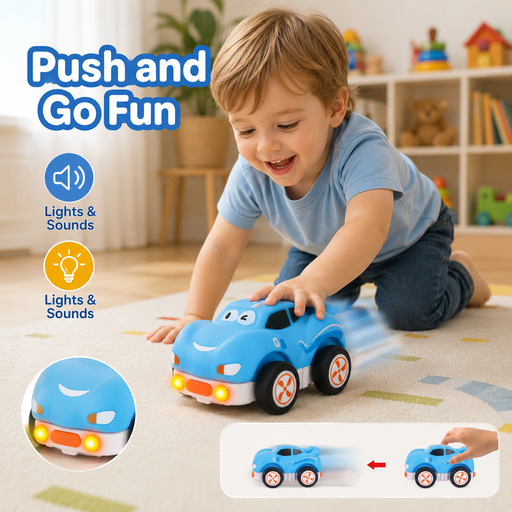
Why this product suits this profile: This push-and-go toy moves when pushed and, according to the product description, does not require complex electronic controls. It is suitable for creative play and as a gift for boys and girls.
There is no need to check battery life or a charger, as the toy moves when pushed. Before buying, note that the colour or design is selected at random.
Push-and-go operation, plus light and sound functions according to the supplier's information.
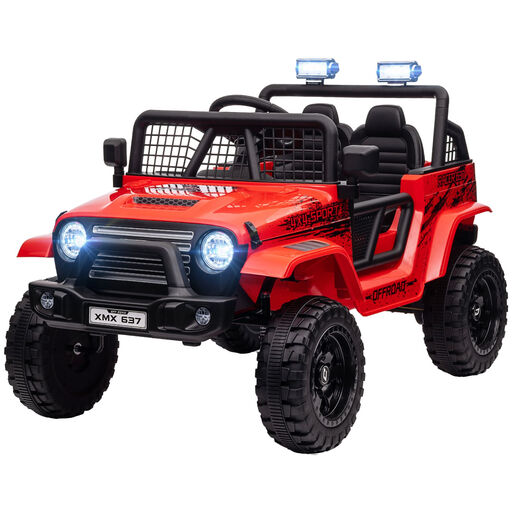
Why this product suits this profile: According to the product name, this 12-volt Jeep combines dual drive with remote control, lights, music and a safety belt. It could appeal to families planning shared driving play outdoors.
The stated remote control allows for supervised use. Before ordering, check the age, child's height, riding surface and precise operating specifications against the product page.
12-volt system, dual drive, remote control and safety belt according to the product name.
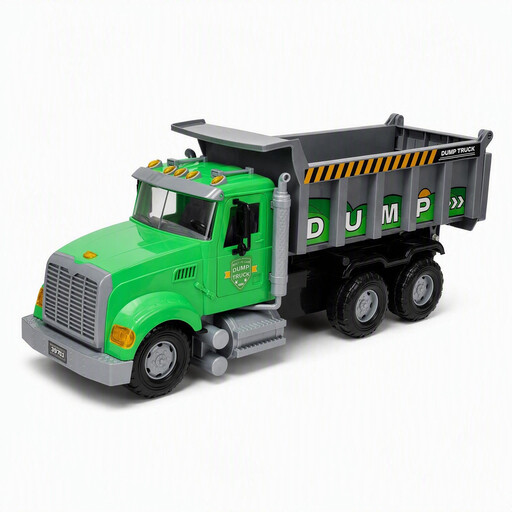
Why this product suits this profile: According to the supplier, this toy tipper truck is suitable for children aged 3 and over, as well as for indoor use, sandpits and role play. The large tipping bed supports play ideas involving sand, building blocks or small objects.
According to the description, the vehicle does not require batteries. The guidance also recommends regularly checking the hinges, screws and tipping mechanism.
Thick-walled ABS plastic, friction drive and manually liftable tipping bed according to the product description.
An electric jeep for children should only be used on suitable, level surfaces or areas specifically intended for this purpose. Adults should supervise the first ride, check the battery charge and store the vehicle somewhere dry after use. A children's electric motorbike also requires suitable protective clothing, sturdy footwear and sufficient distance from roads, stairs and obstacles.
With an RC pickup truck or another remote-controlled car for children, a clear area away from traffic is recommended. Batteries and rechargeable batteries should be charged and stored according to the manufacturer's instructions. If the toy will not be used for an extended period, the batteries should be removed where appropriate to prevent damage caused by leakage.
We have put together a complete, regularly updated list of products that fully meet these strict selection criteria and the safety regulations applicable in the EU.
That depends on the type of vehicle and the manufacturer's information. A simple toy car may be suitable for younger children, provided it has no small parts that could be swallowed. A ride-on vehicle or children's electric motorbike, on the other hand, requires an appropriate height, safe operation and close supervision. Age guidance should always be considered alongside weight, seat height and the product dimensions.
There is no standard running time. It depends on factors including the battery, load, surface, temperature and how the vehicle is driven. Before buying, check the battery capacity, charging time and the running time stated by the supplier. During longer breaks, storing the vehicle somewhere dry and not too hot is advisable.
A compact RC car requires less space and is usually easier to transport. A ride-on vehicle needs sufficient room to move and should not be used near stairs, glass surfaces or delicate furniture. For smaller rooms, manual toy cars or a lightweight remote-controlled car for children are often more practical.