
Lieferung heute & morgen

Qualitätsgarantie

Willkommens-Angebote freischalten: KOSTENLOSE Lieferung | Bis zu 80 % RABATT | Kostenlose 30-Tage-JoyPlus-Testphase
App herunterladen
A children's ride-on vehicle should suit the child's age, height and intended use. In practice, however, three common purchasing decisions in particular often lead to unnecessary expense:
Children aged around 2 to 8 can choose from a range of vehicle types. The manufacturer's age recommendation is a useful guide, but it does not replace checking the dimensions and weight capacity.
With a slow-moving vehicle, the child's feet should ideally reach the ground securely. On a go-kart, the pedals should be within easy reach without the knees being sharply bent or fully extended. You should also check:
For example, the pedal go-kart in our selection is listed as having two seating positions, a load capacity of up to 30 kg and dimensions of 84 × 57 × 55 cm. These figures make it possible to assess objectively whether the model is suitable for the child and the intended storage space.
On a children's balance bike or tricycle, the wheelbase, track width and centre of gravity affect stability. A four-wheel model can provide a different balance when riding slowly compared with a two-wheel balance bike. On a go-kart, a metal frame and wear-resistant wheels are relevant details, but the construction of the pedals, axles and steering joints should also be clearly explained in the product description.
You should also check whether there could be sharp edges, exposed pinch points or loose small parts. For every children's vehicle, following the manufacturer's instructions and ensuring that the guidance is easy to understand are essential for safe use.
For an electric children's motorbike, a high top speed is not a sign of quality. More important features include several selectable riding modes, reliable brakes, an easily accessible emergency cut-off switch and a seat height suitable for the child's size.
The electric motorbike described in the product data as a 12-inch model has three speed settings of 8, 12 and 25 km/h, a 36-V battery, a 250-W motor, a rear disc brake and a stated range of 18 km. The larger 14-inch model also lists three settings of 15, 22 and 30 km/h, a seat height of 490 mm, front and rear brakes and an emergency cut-off switch. These figures should always be considered alongside the child's age and height, the riding surface and the level of supervision available.
CE marking may be required for many products, but it does not provide a blanket statement that a product is suitable for every child. Check the specific instructions, age recommendation, warnings and, where applicable, information on EN standards. For electric models, a helmet, closed-toe shoes and a clearly visible, cordoned-off area are basic safety precautions. Depending on the type of vehicle and local regulations, these products are not intended for use on public roads or pavements.
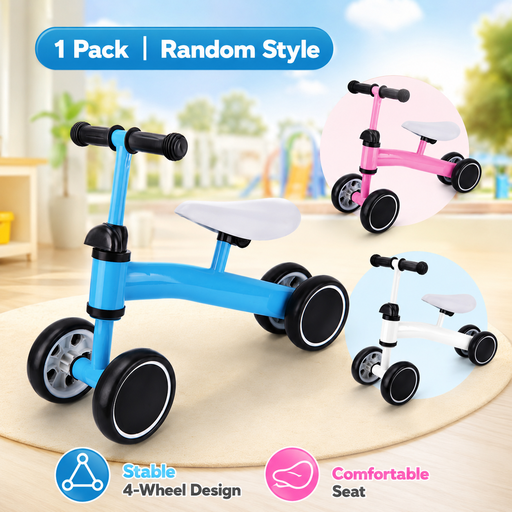
Why this product suits the profile: The four-wheel balance bike offers younger children an easy start and needs neither a battery nor a charger.
The four wheels reduce the balance skills required at the start. Even so, seat height and the child's height should be checked before purchase.
Stable four-wheel design, comfortable seat and simple handling without electrical components.

Why this product suits the profile: For families looking for a non-motorised vehicle for a yard, courtyard or suitable paths, this model offers adjustable seating and forward and reverse gears.
The stated 30 kg load capacity, two seating positions and 20° steering lock provide concrete points to check rather than vague marketing claims.
Metal frame, four wheels, adjustable seat and pedal drive for independent riding.
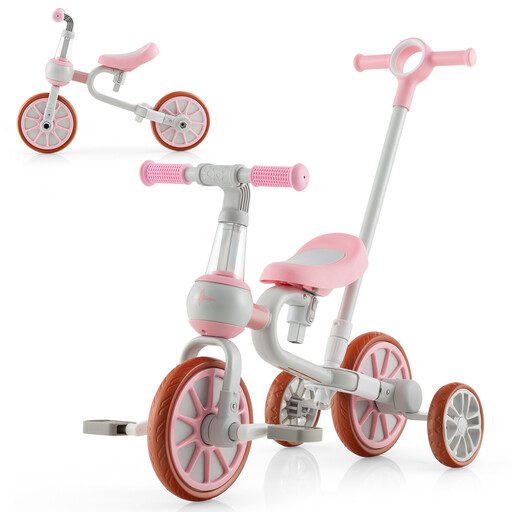
Why this product suits the profile: According to the product name, this model is intended for children aged 2 to 4 and features an adjustable push bar for accompanied outings.
The push bar can support the transition from accompanied to more independent riding. Its operation and safety features should be checked before every ride.
4-in-1 design and adjustable parent push bar, as stated in the product name.
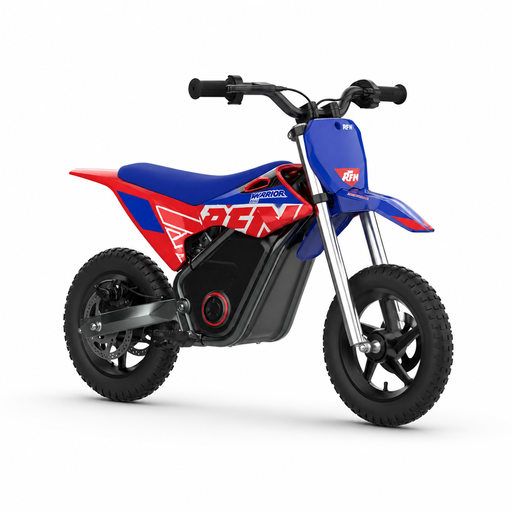
Why this product suits the profile: For supervised rides on suitable private land, this model lists three riding modes, suspension, disc brakes and an emergency cut-off switch.
The three speed settings allow a choice suited to the rider's experience. The stated top speed requires particular care and protective equipment.
36-V 5-Ah lithium battery, 350-W motor, front and rear brakes, plus front and rear suspension, according to the product data.
We have put together a complete, regularly updated list of products that fully meet these strict selection criteria and the safety regulations applicable in the EU.
With a traditional balance bike, tricycle or go-kart, the main costs after purchase are for wear-and-tear parts. Tyres, pedals, chains and steering joints should be checked regularly and maintained according to the manufacturer's instructions. Dry storage protects metal parts and electrical components from unnecessary strain.
An electric children's vehicle also involves electricity costs, charging times and possible battery replacement. Check whether the charger and battery are included, how long charging takes and whether the battery is available separately. The vehicle should not be charged unattended and should only be operated with the supplied charger.
That depends on the child's height, coordination and where the vehicle will be used. A children's go-kart with an adjustable seat may be suitable for independent pedalling, while a children's vehicle with a push bar allows for closer supervision. Dimensions and the maximum load are more important than the age recommendation alone.
Their service life depends on the materials, load, storage conditions and maintenance. An adjustable seat can extend the period of use as the child grows. With electric vehicles, battery care and the possibility of replacing the battery later are also key considerations.
In addition to the purchase price, the main costs are electricity and potential spending on wear-and-tear parts or a replacement battery. The actual cost depends on battery capacity, charging frequency, riding time and the model. Before buying, compare the range, charging time and availability of replacement parts.