
Lieferung heute & morgen

Qualitätsgarantie

Willkommens-Angebote freischalten: KOSTENLOSE Lieferung | Bis zu 80 % RABATT | Kostenlose 30-Tage-JoyPlus-Testphase
App herunterladen
A well-organised children's room creates a calm and stimulating environment for play and creativity. But the sheer volume of books and toys presents a challenge for many parents. The right children's room bookshelf is more than just a piece of furniture—it's a key element that promotes tidiness and helps children develop independence.
However, the selection is vast, and not every shelf that looks appealing is also practical and safe. Before you make a decision, you should be aware of three common pitfalls that often only become apparent after the purchase.
To avoid these problems, you should focus on a few core features. These objective criteria will help you identify a functional and safe storage shelf for the children's room.
Stability is the most important criterion. Ensure the shelf includes an anti-tip kit to securely anchor it to the wall. This is a fundamental safety measure that is essential for furniture in a child's room. Equally important are rounded corners and edges to prevent injuries during play. A good toddler shelf is designed to have no pinching hazards or sharp parts.
The choice of material affects both the safety and the lifespan of the shelf. E1 grade MDF (Medium-Density Fibreboard) is a common standard as it is dimensionally stable and robust. A white wooden children's shelf is a popular choice because it blends neutrally into many interior design styles. The surface finish is crucial: it should be scratch-resistant, easy to clean, and free of harmful substances. A water-based paint finish is often a good indicator here.
A shelf is only useful if your child can use it independently. A low overall height allows toddlers to reach their favourite books and toys and put them away on their own. Models that combine a classic bookshelf with a toy shelf offer the greatest flexibility. A children's shelf with boxes is ideal for storing smaller toys like building blocks or doll accessories in an organised and dust-free way.
Instead of presenting a confusing list, we have matched some products to specific use cases.
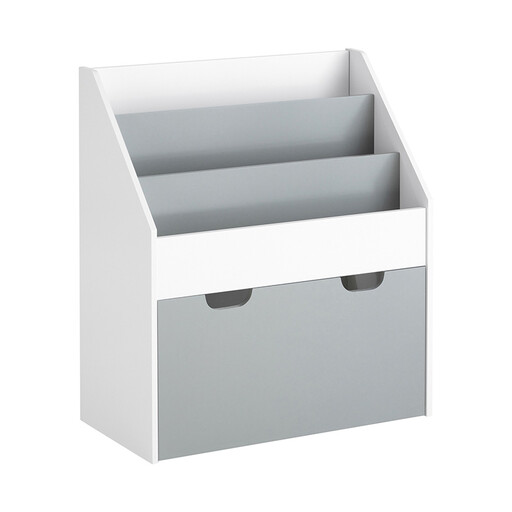
Why it's a good fit: Ideal for smaller children's rooms that need a single solution for both books and toys. The combination of open compartments and a large, removable toy box on wheels efficiently meets both needs.
The child-friendly height of 70 cm and the softened corners and edges address the pitfalls of impractical design and injury risk. According to the manufacturer, an anti-tip kit for wall mounting is included.
The large toy box on wheels is easy to pull out and put back, making it easier for children to tidy up.
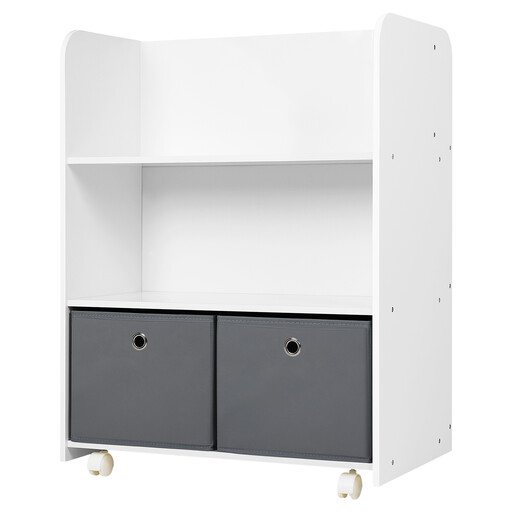
Why it's a good fit: Perfect for families looking for a flexible storage solution. Thanks to its wheels, the shelf can be moved effortlessly between play and sleep areas. The double-sided design makes it ideal for the middle of a room or for siblings to share.
This shelf solves the problem of impractical design with its mobility and double-sided usability. It combines open compartments, fabric boxes, and book ledges, allowing for highly versatile organisation.
The double-sided construction, with one side for books and the other for toys, maximises storage space on a small footprint.
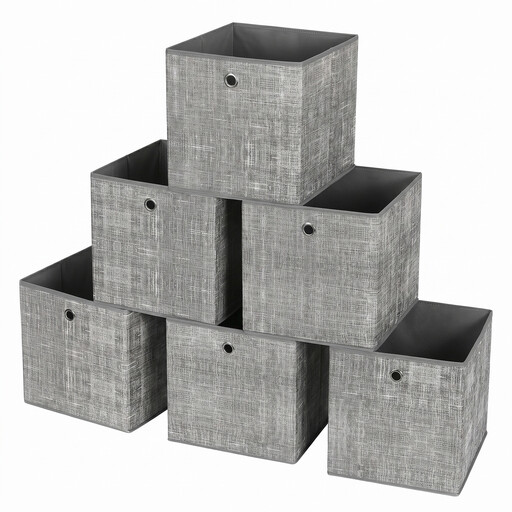
Why it's a good fit: For parents who already own a shelf (like a cube storage unit) and are looking for a flexible solution to sort small items. These boxes create structure and turn any open shelf into an organised storage powerhouse.
These boxes solve the pitfall of impractical design by giving open shelves a clear structure. Instead of messy piles, they allow for sorting toys by category, which simplifies tidying up for children.
The standard dimension of 30 x 30 x 30 cm fits most common cube storage units. When not in use, the boxes are foldable and can be stored to save space.
We have compiled a complete, up-to-date list of products that meet these strict selection criteria and relevant safety requirements.
Most shelves designed for children come with an anti-tip kit. This usually consists of a bracket or a strap that is screwed to the shelf and the wall. For wall mounting, use wall plugs and screws that are appropriate for your wall type (e.g., drywall, concrete, brick). Installation should always be carried out according to the included instructions to ensure maximum stability.
For toddlers and preschoolers (approx. 2-6 years old), an overall height of 70 cm to 120 cm is ideal. It's important that the lower shelves are easily accessible to the child to encourage independence. Higher shelves can be used for items that should only be accessible under supervision.
Robust and low-maintenance materials are crucial. E1 grade MDF or solid wood are good options. Look for a high-quality, non-toxic surface finish, such as a water-based paint. The surface should be smooth, with no sharp edges, and easy to clean with a damp cloth.