
Lieferung heute & morgen

Qualitätsgarantie

Willkommens-Angebote freischalten: KOSTENLOSE Lieferung | Bis zu 80 % RABATT | Kostenlose 30-Tage-JoyPlus-Testphase
App herunterladen
A children’s rug can make a child’s bedroom feel more inviting, add visual structure to the floor and create a comfortable textile surface in the play area. However, colour and design are not the only factors to consider. The material, workmanship, care instructions and suitable size all determine whether a rug remains practical for everyday use.
A colourful children’s rug featuring a tractor, animal or rainbow can become the centrepiece of a room. However, the design says little about whether it is suitable for daily use. Important factors include the pile height, edge finishing and the care instructions provided by the manufacturer.
A hand-woven children’s rug and a hand-tufted rug are made using different processes. Hand-tufted models are typically created by inserting yarn into a backing material. With hand-woven rugs, the yarn is worked on a loom. Both options can be decorative, but they should be compared using specific product data.
For example, a 100 x 60 cm children’s rug can fit in front of a shelving unit, beside a bed or in a small play corner. However, this size may be too small for a larger play area. Before buying, mark out the available space with masking tape. This will help you check that doors, drawers and walkways remain clear.
A cotton children’s rug is often an option for bedrooms and children’s rooms, particularly if you want a comparatively lightweight material with a textile surface. The specific care requirements vary from product to product. Several cotton models in this selection recommend professional cleaning, while others can, according to the product information, be spot-cleaned with a damp cloth and vacuumed.
A wool rug for children can feel different from a cotton rug because of its material structure and greater weight. According to the product data, the wool models listed here weigh between 3.6 and 4.4 kg. Wool requires care in line with the manufacturer’s instructions; the products mentioned recommend spot cleaning and regular vacuuming.
Jute is another natural fibre. A jute rug may have a textured surface, but it is not automatically suitable for every play corner. For toddlers, the surface, edges and slip resistance should be checked particularly carefully.
Look out for the following information:
The products’ warnings should be observed. For example, the rainbow model with tassels specifically recommends a non-slip surface to reduce the risk of slipping and tripping.
A rug for a child’s bedroom should be positioned so that no door catches on it. Larger formats such as 150 x 90 cm are more suitable for a play corner if several children or toy boxes need to fit on it. Smaller shapes, such as a 100 x 60 cm cloud rug, are better suited as a decorative feature beside the bed, in front of a chest of drawers or in a limited corner.
Colour is also practically relevant: marks and dirt can become visible more quickly on white or very light surfaces. Colourful designs and multi-coloured patterns can disguise minor signs of use to some extent, but they are no substitute for regular care.
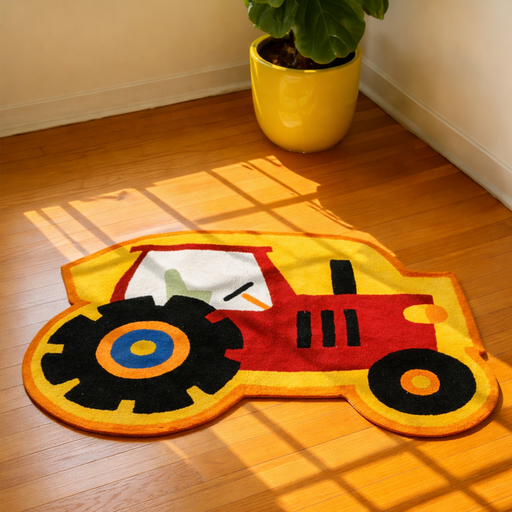
Why this product suits the profile: Measuring 100 x 70 cm, this cotton model features a clearly recognisable tractor design and is suitable for smaller children’s bedrooms or defined play areas.
The product data specifies the material, manufacturing method, dimensions and a clear care recommendation instead of focusing solely on the design.
100% cotton according to the product information, hand-tufted construction and a surface area of 100 x 70 cm.
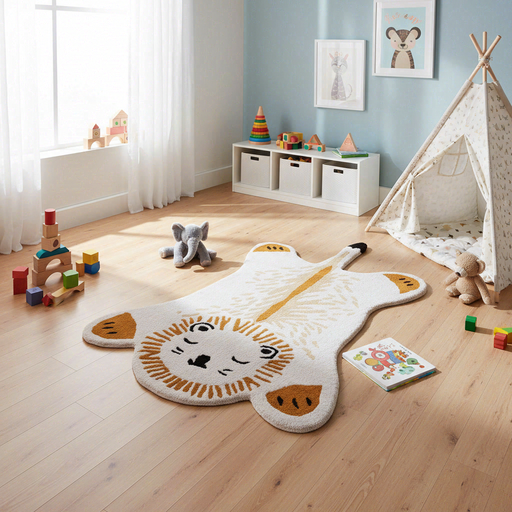
Why this product suits the profile: The larger format covers more floor space, while the combination of 100% wool and hand-woven construction is well suited to a thoughtfully chosen interior.
The choice is based not only on the lion design, but also takes into account the material, dimensions, 4.4 kg weight and stated care requirements.
100% wool according to the product information, 150 x 90 cm and hand-woven construction with additional hand-tufted workmanship according to the description.
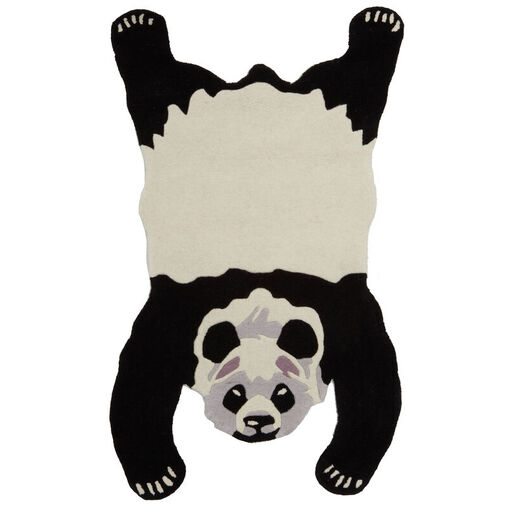
Why this product suits the profile: The generous surface area is suitable for a more heavily used play area, provided the floor is level and a suitable non-slip underlay is used.
The monochrome design is less dependent on a particular room colour. At the same time, the care instructions, including spot cleaning and vacuuming, are clearly stated.
100% wool, 150 x 90 cm, 1 cm height, plus hand-woven and hand-tufted construction according to the product description.
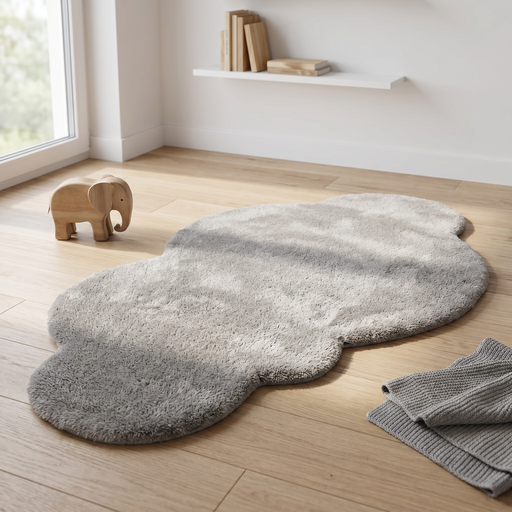
Why this product suits the profile: The compact format works well as a children’s bedroom rug beside the bed or in front of a piece of furniture. The grey cloud shape pairs well with a wide range of colours.
The specific dimensions help prevent poor planning in small rooms. The care information recommends spot cleaning and vacuuming.
100% cotton, 100 x 60 cm, 1 cm height and hand-woven construction according to the product data.
We have put together a complete, regularly updated list of products that fully meet these strict selection criteria and the safety regulations applicable in the EU.
Before use, the children’s rug should be fully unrolled and checked for uneven areas. A suitable non-slip underlay is recommended on smooth floors. Avoid creating trip hazards near doors or furniture.
For cleaning:
A rug should not be used as a load-bearing base, mattress substitute or fall protection. With babies and toddlers, loose tassels, raised edges and slipping undersides should also be checked particularly carefully.
For limited areas, compact dimensions such as 100 x 60 cm or 90 x 80 cm may be suitable. They keep walkways clear while still adding a decorative accent. Before buying, simulate the area on the floor using masking tape.
That depends on where it will be used and the type of care you prefer. Cotton is often used for lighter, decorative models. Wool can offer a different feel and greater weight, but it also requires cleaning appropriate to the material. The specific product description is the deciding factor.
It is not possible to give a reliable, standard lifespan. This depends on use, the underlying floor, care, the load placed on it by furniture and the construction. Information about the material, height, weight, manufacturing method and care instructions is more meaningful than general advertising claims.