
Lieferung heute & morgen

Qualitätsgarantie

Willkommens-Angebote freischalten: KOSTENLOSE Lieferung | Bis zu 80 % RABATT | Kostenlose 30-Tage-JoyPlus-Testphase
App herunterladen
A children’s scooter must suit the child’s age, body weight and intended use. However, product images and marketing claims often lead to unsuitable purchases: one model may look sturdy but be too heavy for a younger child. Another may have light-up wheels but lack a suitable handlebar height or sufficient load capacity.
As a Joybuy Product Recommendation Officer, I filter the most important details according to transparent criteria. This makes it easier to assess whether a kick scooter for children, a children’s stunt scooter, a balancing scooter or an electric ride-on toy is suitable for the user in question.
The recommendation “from 3 years” is no substitute for checking the child’s height. What matters is whether the child can stand safely on the deck and reach the handlebars with their arms slightly bent. For a scooter for children aged 3 and over, three wheels, a wide deck and a simple foot brake are often more suitable than a two-wheeled sports model.
The requirements change for older children and teenagers. A scooter for children aged 6 and over or a scooter for children aged 8 and over may be smaller, more responsive and designed for tricks. However, the manufacturer’s recommendation should always be checked against the child’s weight, height and riding ability.
Children’s scooters with light-up wheels can make riders more visible and are attractive to many children. However, the lighting does not replace a helmet or a suitable environment. On some wheels, the lights only come on once a certain speed has been reached. They may remain unlit when stationary or moving slowly.
A folding children’s scooter is not automatically more practical for everyday use either. Check whether the folding mechanism is protected against accidental folding and whether the scooter actually fits into the intended storage space when folded.
A children’s trick scooter is designed to withstand different stresses from a leisure scooter. Fixed handlebars, a rigid fork and a non-folding frame support controlled movements. These features may be less comfortable for the school run, while they can be advantageous in a skatepark.
Terms such as freestyle scooter, BMX scooter and skatepark scooter describe the intended use, but on their own they say nothing about fit. Check the technical specifications rather than relying solely on graphics and terms such as “Pro”.
Pay attention to three details:
For example, the VOKUL S2 Pro is listed as weighing 3.6 kg and having a maximum load capacity of 100 kg. This does not mean that the model is suitable for every child in this age group. The handlebar height of approximately 30.3 inches and the fixed construction must match the child’s height.
Solid polyurethane wheels are common on many stunt and leisure models. They are less prone to punctures than pneumatic tyres, but transfer more vibration on uneven tarmac. Small wheels accelerate responsively and are suitable for tricks; larger wheels roll more easily over longer distances.
The bearing specification, such as ABEC-9, describes a technical classification of manufacturing tolerances. It is not, on its own, evidence of greater everyday safety. More important factors include a correctly fitted front wheel, screw connections without play, and a working rear or foot brake.
The stunt scooters featured here use materials including aluminium, steel, polyurethane and rubber. A non-slip deck and grippy TPR or TPE handles can help with control. Parents or guardians should check the screws, handlebars, wheels and brake before every ride.
For tricks and riding in a skatepark, a helmet, knee and elbow pads, and wrist guards are essential equipment. Children under twelve should be supervised while riding. Roads, stairs, steep descents, and wet or uneven surfaces are not suitable for the models described.
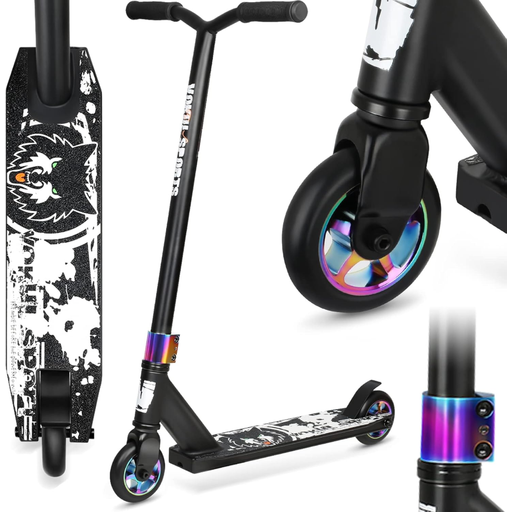
Why this product suits the profile: According to the product information, this model is intended for children aged 6 and over and designed for learning their first tricks. The steel and aluminium frame weighs 7 lb, while the maximum load capacity is listed as 220 lb.
The fixed handlebar construction and rigid suspension are clearly described. This helps buyers understand that it is not a comfort-focused folding scooter.
Sturdy polyurethane wheels with metal cores, fixed handlebar and rear brake; suitable for smooth, dry surfaces and practising first stunts.

Why this product suits the profile: This model uses a T-6061 aluminium deck, a one-piece T4T6 fork, 110-mm wheels and ABEC-9 bearings. These specifications are aimed at children aged 8 and over and teenagers interested in freestyle riding.
The product data specifies the material, wheel size, bearings and load capacity. This makes it easier to compare the equipment objectively with the planned use in a skatepark.
Aluminium deck, one-piece fork, non-slip deck and soft 145-mm handles; the model is supplied largely pre-assembled.

Why this product suits the profile: According to the product information, this three-wheeled balancing scooter is designed for children aged 3 and over. The extra-wide deck and 30 kg load limit make it suitable for getting started through play.
The three wheels and wide deck clearly indicate that it is intended as a balancing scooter. The 30 kg specification prevents its load capacity from being confused with that of a model for older children.
Three-wheel platform, foot brake, extra-wide deck and light-up wheels; suitable for controlled riding on flat, dry surfaces.
We have put together a complete, regularly updated list of products that fully meet these strict selection criteria and the safety regulations applicable in the EU.
An electric children’s scooter or an electric Wiggle Car is not the same as a traditional kick scooter. The Neuleb Electric Wiggle Car is listed with a 12-volt battery, a top speed of 3.2 mph and suitability for children aged 3 and over. Before use, the charger, connectors and on/off switch must be checked. The charger should be removed before switching the toy on, and the manufacturer’s instructions on storage and regular battery charging must be followed.
Different legal requirements apply to public paths depending on the type of vehicle and its equipment. An electric ride-on toy should therefore only be used in the intended environment and in accordance with the manufacturer’s instructions.
Check the following before every ride:
Dirt can usually be removed with a damp cloth. Pressure washers can damage bearings and connections. Worn wheels, loose screws or damaged brakes are reasons to stop using the scooter until it has been repaired.
For many beginners, three-wheeled balancing scooters with a wide deck and foot brake are a good choice. Also check the child’s height, the load limit and the specific manufacturer’s recommendation. A two-wheeled stunt scooter is generally not the intended starting point for this age group.
The service life depends on the materials, usage, weight, surface and maintenance. A scooter used every day on rough tarmac will wear differently from a model used occasionally. Regularly checking the wheels, bearings, screws and brake helps identify wear at an early stage.
With a traditional kick scooter, the main costs are replacement wheels, bearings or grips. An electric model also requires electricity and, in the event of wear, possibly a battery or charger. Before buying, check the availability of spare parts, warranty terms and maintenance instructions.