
Lieferung heute & morgen

Qualitätsgarantie

Willkommens-Angebote freischalten: KOSTENLOSE Lieferung | Bis zu 80 % RABATT | Kostenlose 30-Tage-JoyPlus-Testphase
App herunterladen
A children’s scooter should be easy to ride, stable enough for everyday use and suitable for as long as possible. In practice, however, illuminated wheels or eye-catching colours alone do not guarantee a good purchasing decision. The key factors are an age-appropriate design, a suitable handlebar height, a non-slip deck and a brake that is easy to reach and reliable.
When choosing a children’s scooter from age 3, three common purchasing pitfalls often arise:
A height-adjustable scooter can grow with your child over several years. The handlebar should be set so that the child stands upright with their arms slightly bent. Handles that are too low can encourage an uncomfortable posture, while handles that are too high make the scooter harder to control.
Look out for:
The Beleev V2-Pure model is listed with three handlebar heights between 24.0 and 32.1 inches. This corresponds to approximately 61 to 81.5 cm. According to the product description, it is intended for children aged 3 to 12 who are under 62 inches tall. At the same time, the warnings mention small parts and state that it is not suitable for children under 3. Parents should therefore assess age, height and motor skills together.
A wide, low-to-the-ground deck makes mounting easier and can give beginners more space to stand. A non-slip surface is important, providing sufficient grip even with normal levels of dirt. The steering should suit the child’s stage of development.
Many scooters change direction using a lean-to-steer system. The child shifts their body weight instead of turning the handlebar sharply. This design may feel more intuitive for younger children, but it does require a short period of familiarisation.
A rear brake is usually operated with the foot. Check whether it is easy to reach and whether the child can initially practise braking in a flat, traffic-free area. A brake does not automatically shorten every stopping distance: speed, surface and reaction time remain crucial.
A lightweight scooter for girls and boys is easier to carry to the playground, into the cellar or in the boot of the car. However, weight should always be considered together with stability and load capacity.
LED wheels often light up as they move without batteries. An illuminated deck, on the other hand, may require batteries. The Beleev model’s deck lighting is specified as requiring two AA batteries, which are not included. Before buying, check whether the battery compartment, on/off switch and folding mechanism are practical for the intended everyday use.

Why this product suits this profile: This model combines an adjustable steering column, folding function and LED wheels with a wide deck. It is therefore suitable for families looking for a children’s scooter for leisure and short journeys, while also valuing easy transport.
The product description specifies three handlebar heights, a weight of 6.1 lb and a rear brake. This makes it easier to check the size, portability and braking features before buying.
Battery-free LED wheels, eight modes for the battery-powered deck lighting and a stated load limit of 110 lb.
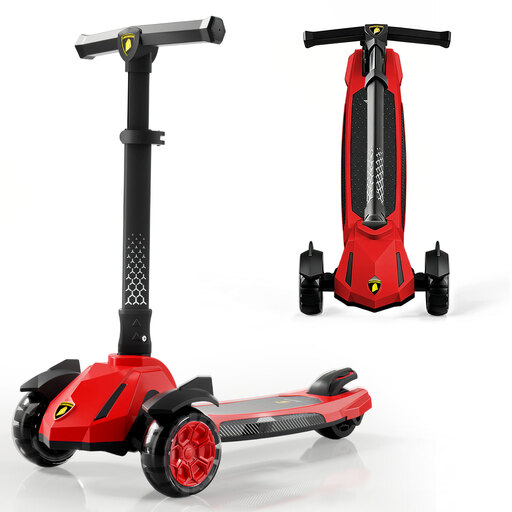
Why this product suits this profile: According to its product name, this scooter is intended for children aged 3 to 10 and combines an adjustable, foldable handlebar with three illuminated wheels. It is a good fit for parents who prioritise functionality and adjustability over additional features.
The stated features make it easier to assess handlebar adjustment, portability and braking equipment before placing an order. The actual deck width should also be checked in the detailed specifications.
Adjustable and foldable handlebar, three illuminated wheels, extra-wide deck and brake according to the product name.
Why this product suits this profile: For families that regularly move the scooter between home, the car and the playground, the stated weight of 6.1 lb and the folding function are important. The adjustable steering column supports use by children at different stages of development.
The combination of a low deck, non-slip surface and rear brake addresses typical everyday requirements. The brake, wheels and locking mechanism must be checked before every ride.
Compact storage, low net weight, adjustable handlebar height and an integrated stainless-steel component on the rear brake, according to the product description.
We have put together a complete, regularly updated list of products that fully meet these strict selection criteria and the safety regulations applicable in the EU.
Before buying a scooter for children, compare these points in particular:
A children’s scooter for ages 3 to 12 is not automatically suitable for every child in this age range. Growth, coordination and riding environment vary. For the first rides, a flat, traffic-free area with a helmet and age-appropriate protective clothing is recommended.
Many models are listed as children’s scooters from age 3. Height, weight, balance and the ability to operate the brake are also crucial. The manufacturer’s warnings must be observed before use. Children under three should not use a scooter unless it has the appropriate age approval.
Its service life depends on the load, surface, storage and care. A height-adjustable scooter may remain suitable for longer if the handlebar height and load limit provide sufficient room for growth. Regularly checking the wheels, screws, folding mechanism, deck and brake helps identify wear at an early stage.
LED wheels are often powered by movement and therefore do not require batteries. Additional LED lighting in the deck, however, may use batteries. The Beleev V2-Pure is specified as requiring two AA batteries, which are not included. Check the product details before planning to buy accessories or replacement batteries.